


Why Modi must turn down Trump’s offer to join ‘Board of Peace’ for Gaza
After Donald Trump ‘withdrawing’ the invitation to Canada’s prime minister Mark Carney and Pakistan accepting a place on the ‘Board of Peace’ for Gaza, the world is now watching the Indian PM
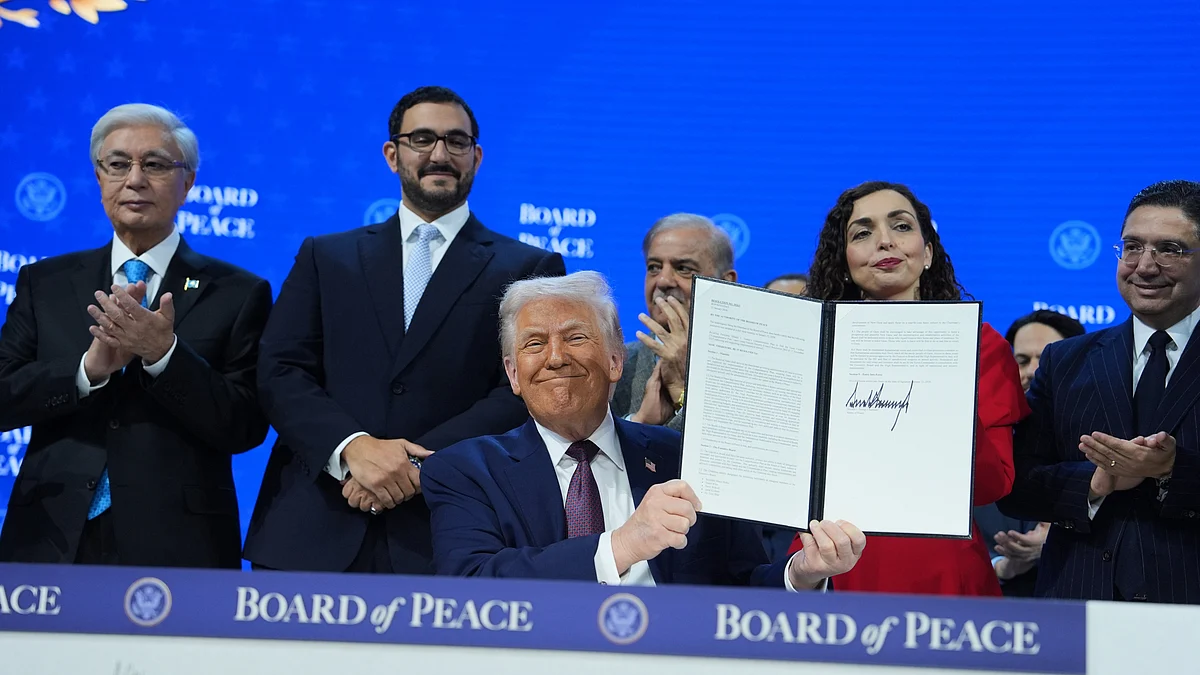


Large sections of Indians are interpreting US President Donald Trump’s invitation to Narendra Modi to be a non-executive member of the so-called ‘Board of Peace’ for Gaza as a poisoned chalice.
Even as New Delhi maintains a studied silence, President Trump has already unveiled the Board at Davos despite most of his European allies, UK and France among them, indicating their reluctance to join. Trump has now withdrawn the invitation to Canadian PM Mark Carney. Pakistan is on board. The choice before Modi is getting clearer.
India has been invited to be a non-executive member alongside 60 other heads of government or senior ministers. It is of course still unclear if the non-executive members will have any voting rights or authority to veto, or be just ceremonial or ornamental additions to satisfy Trump’s vanity.
Trump is the self-appointed chairman of the ‘executive board’ which includes former British prime minister Sir Tony Blair, the US secretary of state Marco Rubio, president of the World Bank Ajay Banga, buddy businessmen Steve Witkoff and Marc Rowan, a US national security adviser Robert Gabriel and Trump’s ubiquitous son-in-law Jared Kushner. Nickolay Mladenov, a Bulgarian politician and an erstwhile United Nations Middle East envoy, will represent the board on the ground in Gaza.
Observers have been quick to point out that the Indian PM has been extended a role wherein he will sit beneath not just a long retired prime minister and a foreign minister, but also Banga, an overseas citizen of India, and some sundry individuals. It is a complete violation of protocol, they have added. The general sentiment is that no self-respecting head of government should pander to such a casual and cavalier invitation.
Norway has declined to be on the Board while Britain and Ukraine have expressed concerns about the invitation to Russia, which too has expressed reservations on the functioning of the board, which by all accounts looks like a real estate project rather than a peace plan. Indeed, European cooperation, considering Trump’s aggressive design in Greenland, could well not be forthcoming. Benjamin Netanyahu, the Israeli prime minister, accused of war crimes in Gaza, is also on the board. While Modi is known to share a warm relationship with Netanyahu, sharing a blatantly anti-Palestinian platform with him, may well be an embarrassment.
Then there is the small matter of contributing $1 billion to enjoy a permanent seat on the board. The Canadian PM, even before the invitation to him was withdrawn, refused to pay.
All the above factors notwithstanding, the corporate-style takeover of Gaza with a board of executives administering it disregards the internationally accepted and recognised process of restoring peace and normalisation in a conflict zone. Sidestepping the United Nations is again a move which will have far-reaching consequences.
Not surprisingly, therefore, Modi is caught between a rock and a hard place. A rejection would likely infuriate Trump and make him more hostile towards India. An acceptance would be humiliating, politically inadvisable, diplomatically problematic and unacceptable to Indian public opinion. India has consistently refuted Trump’s repeated claim that he had brokered peace between India and Pakistan after Operation Sindoor. By all accounts, India has also resisted US pressure to accept its unreasonable demands on the Indo-US trade deal.
On the other hand, India has humoured Trump by reducing oil imports from Russia and withdrawing from the Chabahar port project in Iran, which India constructed and which was conceived as a parallel to the Chinese-built Gwadar port in Pakistan. Notwithstanding such timidity, Trump is yet to accede to a trade agreement with India, continuing to insist on unreasonable access of US agricultural products to the Indian market.
From a strategic standpoint, Trump has warmed to Pakistan, which was in Washington’s doghouse ever since double-crossing America's war against terror in Afghanistan. Unlike his predecessors, Trump sees China more as an economic and technological rival than a security threat. This is extremely worrying for India, since it retreats from the QUAD vision of creating a bulwark against Chinese expansionism.
According to a former Indian diplomat, who also happens to be a former foreign secretary, a shrewd move would be for India to seek more details and thereby delay accepting the invitation. In due course, a response may not be necessary, given the uncertain prospects of the board, its unwieldy size and debatable vision.
The plan to rebuild and energise the economy of Gaza by domain experts does not answer the question who will pay for it and why? What is the return for investors? There is no sanction yet for the US government to open its purse strings either. While some oil-rich Arab states can be persuaded to cough up, such reconstruction without the consent of Palestinians would be nothing but an imperial project.
Amusingly, the plan says, ‘Israel will not occupy or annex Gaza’. Funny, because Israel is already in occupation of Gaza in utter disregard of the 1947 UN General Assembly’s two-state award. It has also significantly encroached into the West Bank, which is Palestinian territory. What is also amusing is that 11 of the 25 countries invited to be on Trump's Board of Peace are currently banned from immigrant visas to the United States.
President Trump may see Gaza as a riviera on the eastern Mediterranean, but without a referendum to determine whether Gazans want this or not, the Board of Peace could transpire to be a non-starter. One wishes the plan well for the sake of peace and the economic well-being of Gazans. There’s a danger, though, that such a business-driven, naïve, simplistic and superficial formula for a complex political and territorial problem could come a cropper. Therefore, it might be wise for India to steer clear of a possible minefield.
Join our official telegram channel (@nationalherald) and stay updated with the latest headlines