


Covering up history: Why the NCERT ‘Dancing Girl’ controversy matters
The recent controversy over the historic figurine matters because it highlights a critical debate over how history and ancient art should be presented in textbooks
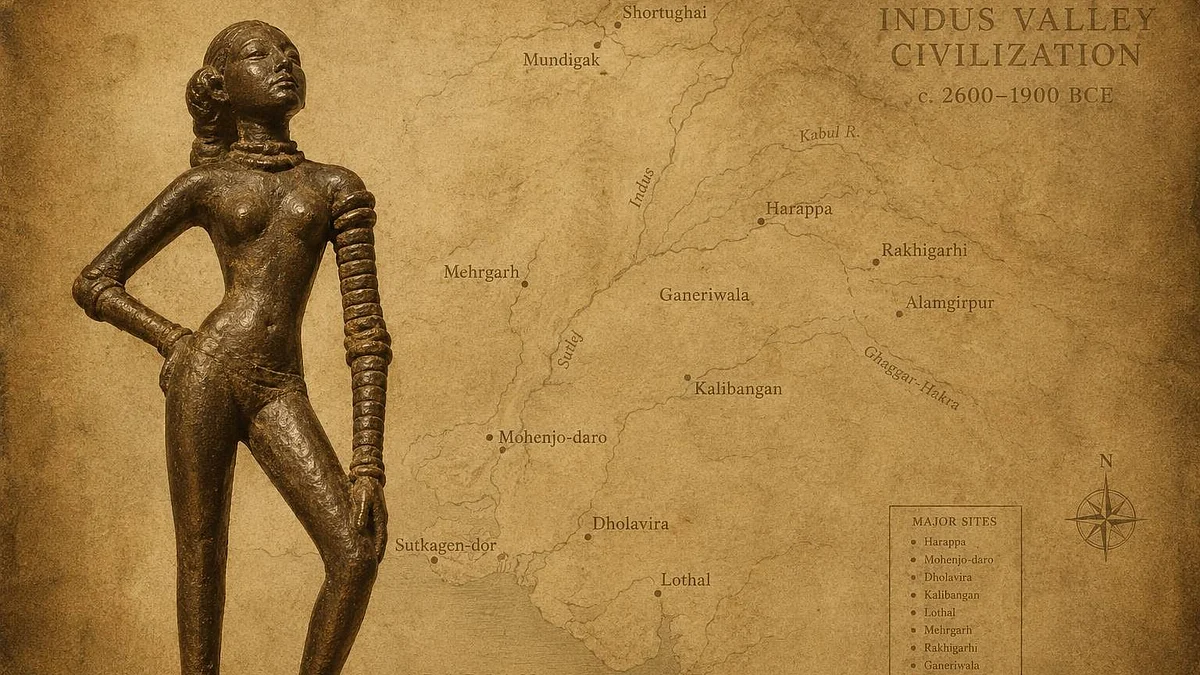


When a 4,500-year-old bronze figurine becomes the target of contemporary moral anxiety, the real casualty is not art—it is historical honesty.
The recent controversy surrounding the alteration of the iconic Harappan ‘Dancing Girl’ in a Class 9 NCERT art history textbook has sparked a debate that extends far beyond a single image. At stake is a fundamental question: Should history and art be presented to students as they are, or should they be modified to conform to contemporary notions of propriety?
The National Council of Educational Research and Training (NCERT) initially chose to digitally shade over the bare torso of the celebrated bronze figurine in its newly introduced Class 9 arts textbook Madhurima.
Following a wave of criticism from archaeologists, historians, artists, educators and cultural commentators, it reversed its decision and announced that the original image will be restored in the digital edition and in all future printings.
The correction is welcome. Yet the episode leaves behind troubling questions about the growing impulse to sanitise history and repackage the past through the lens of present-day moral sensitivities.
The Dancing Girl is no ordinary artefact. Created around 2500 BCE during the mature phase of the Indus Valley Civilisation, it is among the most recognisable symbols of South Asia’s ancient cultural heritage.
Discovered in 1926 by archaeologist Ernest Mackay at Mohenjo-daro, the tiny bronze figurine stands just over ten centimetres tall. Yet its artistic significance is immeasurable. Cast using the sophisticated lost-wax technique, it demonstrates a remarkable mastery of metallurgy that flourished in the subcontinent more than four millennia ago.
What has fascinated generations of scholars is not merely the technical skill behind the sculpture but its extraordinary personality. The young figure stands with one hand on her hip, her head tilted slightly back, projecting confidence, ease and individuality. Her body language is strikingly modern. The numerous bangles adorning her arms and the necklace around her neck provide valuable clues about adornment, aesthetics and social life in the Indus Valley.
The figurine’s power lies precisely in its authenticity. It is an archaeological document as much as it is a work of art.
To alter such an object is not merely to modify an image. It is to interfere with evidence.
The Problem with Moral Retouching
The argument advanced in defence of the alteration was that younger students might be uncomfortable viewing nudity. This reasoning is difficult to sustain.
The Dancing Girl is neither erotic nor provocative. It is a historical artefact reproduced in a textbook for educational purposes. Students encounter diagrams of the human body in biology textbooks, sculptures from ancient civilisations in world history courses and classical artworks in museums across the globe. The educational context matters.
Indeed, generations of Indian students have seen the original image in textbooks for decades without controversy.
The figurine appeared in NCERT publications for at least a quarter century without anyone suggesting that its authenticity required modification.
The hypocrisy of the decision is further highlighted by a glaring institutional contradiction: while the Class 9 textbook subjected the figurine to moral policing, the very same artefact appeared completely unedited and in its original form within the newly released Class 6 Social Science textbook.
This incident is part of an unsettling trend. The persistent drive to retroactively enforce modern puritanical standards onto an ancient culture is not merely absurd; it is a dangerous rewriting of history.
What has changed is not the sculpture but the climate surrounding it.
The impulse to conceal parts of a historical artefact reflect an anxiety that says more about contemporary society than about the civilisation that produced the object.
What is sanitised heritage?
The larger concern is the precedent such actions create.
If a Bronze Age sculpture can be digitally clothed because its natural form is considered inappropriate, where does the logic end?
Would the magnificent temple sculptures of Khajuraho be deemed unsuitable for educational study? Would the intricate carvings of Konark’s Sun Temple require visual editing before being shown to students? Would the countless depictions of the human form found across Buddhist, Jain, and Hindu artistic traditions need to be selectively hidden?
Indian civilisation possesses one of the richest artistic traditions in the world precisely because it never viewed the human body through a singular moral lens. Ancient Indian art celebrated beauty, fertility, spirituality, sensuality, devotion, and humanity in all their complexity.
The sculptures of Khajuraho and Konark are not embarrassing relics to be concealed; they are UNESCO-recognised masterpieces that attract scholars and visitors from across the world. Their significance lies in what they reveal about historical societies, artistic imagination and philosophical attitudes towards life.
The same principle applies to classical literature. If historical works are to be judged by contemporary discomfort, then texts such as Vatsyayana’s Kamasutra could easily become future targets for selective editing or contextual dilution. Such an approach would impoverish rather than enrich education.
Civilisations are understood through evidence, not through censorship.
This latest episode is not an isolated incident.
In 2023, when a life-sized replica of the Dancing Girl was unveiled as the mascot of the International Museum Expo, observers noted that the figure had effectively been clothed. That decision too generated criticism from historians and cultural commentators who argued that modifying an ancient artefact undermined its historical integrity.
The repetition of such interventions suggests a broader discomfort with presenting the past on its own terms.
Yet museums, archives and educational institutions have a different responsibility. Their role is not to make history conform to present-day tastes but to help society understand history in its original context.
The distinction is crucial. Historical education is not an exercise in moral approval. It is an exercise in understanding.
Those defending the alteration often invoke children as the reason for caution. But education does not become stronger by withholding information or altering evidence.
Students deserve context, not censorship.
A properly written caption explaining the significance of the figurine, the artistic techniques involved, and the cultural world from which it emerged would serve a far greater educational purpose than digitally modifying the object itself.
The assumption that students must be shielded from an ancient bronze sculpture underestimates both their intelligence and their capacity for learning.
The task of education is not to protect students from history. It is to equip them to understand it.
The NCERT’s decision to restore the original image deserves recognition. It demonstrates that public criticism, scholarly intervention and informed debate can still influence institutional decisions.
Yet the controversy should not be dismissed as a minor editorial error. It reveals a deeper tension between historical scholarship and cultural gatekeeping.
The Dancing Girl has survived for 4,500 years. She has outlived empires, kingdoms, invasions, colonialism, and partition. Through it all, she has stood exactly as the artisan who cast her intended her to stand—unapologetic, self-assured, and free.
The attempt to cover her up lasted only briefly. But it serves as a reminder that the preservation of heritage requires constant vigilance.
History cannot be taught honestly if it is first edited to suit contemporary anxieties. Archaeological artefacts are not canvases for moral correction. They are witnesses from another age.
Their value lies not in how well they conform to present sensibilities, but in how truthfully they illuminate the worlds from which they came.
The restoration of the original image is therefore more than a technical correction. It is a reaffirmation of a principle that should guide all educational institutions: the past must be studied as it was, not as some would prefer it to have been.
~Hasnain Naqvi is a former member of the history faculty at St. Xavier’s College, Mumbai
Join our official telegram channel (@nationalherald) and stay updated with the latest headlines