


If the cow is sacred, should the law say so?
Muslim leaders’ demand for a national policy forces a fresh reckoning with India’s constitutional ambiguities.
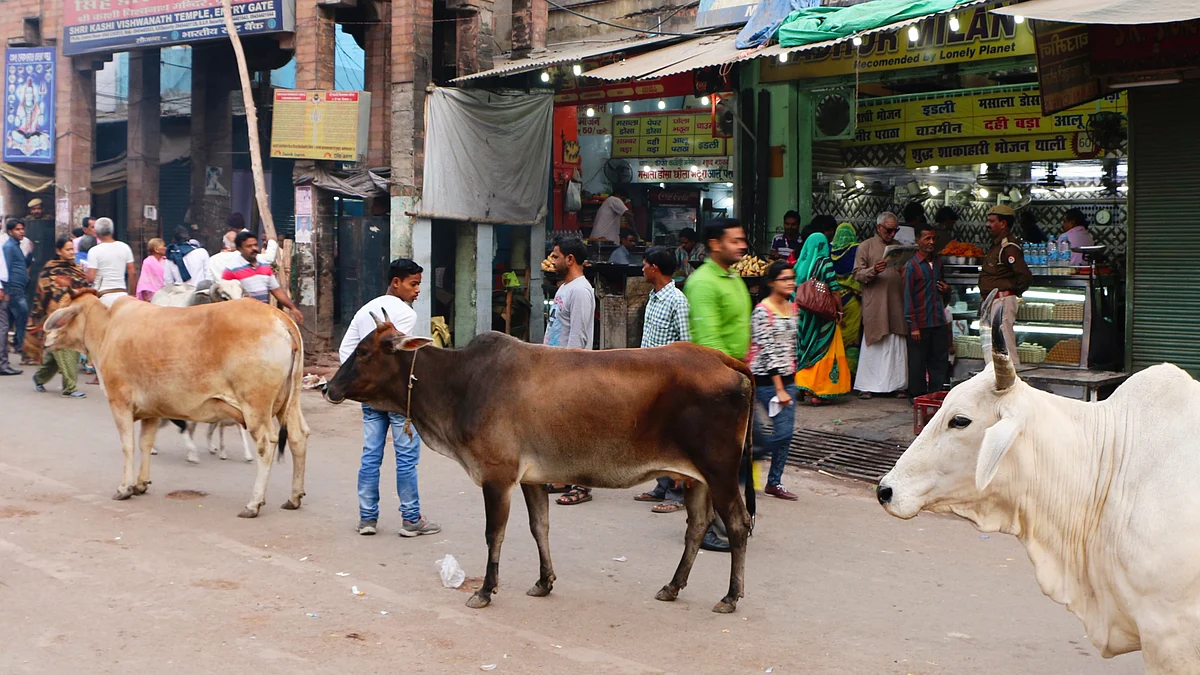


Prominent Muslim voices have asked the prime minister to declare the cow a national animal and therefore ban its slaughter across India. The head of the largest body of clerics, Jamiat Ulma-e-Hind president Maulana Arshad Madani, said Muslims would have no objection to this, since it would stop mob lynchings.
Madani said when the majority of the country's population considers the cow sacred and gives it the status of 'mother', there should be no political compulsion for the government to avoid declaring the cow as the national animal. Former vice-president Hamid Ansari also weighed in on this and repeated what Madani was asking for.
Laws criminalising the possession of beef were first legislated in 2015, in Maharashtra, then Haryana, which began a spate of violence we call ‘beef lynchings’. Other BJP states followed and the lynchings continue.
Those who support a nationwide ban on cow slaughter say it is a constitutional requirement. So why has it not been implemented? Let us examine the matter.
Article 48 of India’s Constitution is a directive principle, meaning that it is guidance and not law. It reads: ‘The State shall endeavour to organise agriculture and animal husbandry on modern and scientific lines and shall, in particular, take steps for preserving and improving the breeds, and prohibiting the slaughter, of cows and calves and other milch and draught cattle.’
There is something unusual here. The reasoning is not religious but framed as an economic and scientific argument. Those pressing for a ban kept bringing up religious sentiment but also said they did not want to impose a cow slaughter ban on unwilling minorities.
Two members, Seth Govind Das and Pandit Thakur Das Bhargava, both of the Congress, even wanted to introduce a ban on cow slaughter as a fundamental right of the cow. Others wanted buffaloes, bulls and other cattle of all ages to be included in the ban.
Also Read: The extortion rackets of cow vigilantes
However, to retain the appearance that India’s Constitution was secular, the legislators wanted a non-religious reason for the ban. Cows were needed to nourish children with milk and slaughter was wrong since there was no such thing as unproductive cattle (because a cow and a bullock were a ‘moving manure factory’).
In a letter written on 7 August 1947, just a week before Independence, the soon-to-be president Rajendra Prasad wrote to Jawaharlal Nehru. It read: ‘There are two points which I had for consideration at our meeting yesterday. I mentioned the agitation which is spreading with tremendous speed about the stopping of cow slaughter, but as everybody was in a hurry to go, the matter was not considered. I have been flooded with postcards, letters, packets and telegrams making a demand that cow slaughter should be stopped by legislation … The Hindu sentiment in favour of cow protection is old, widespread and deep-seated and it has taken no time to rouse at this moment to a pitch when it is difficult, if not impossible, to ignore it. I think that the matter does require consideration and we must take a decision, whatever it is, after due consideration.'
In the Constituent Assembly, the Muslims requested the Hindus to proceed with the ban but to lay out their religious reasons unequivocally. Zahir-ul-Hasan Lari from UP said, 'if the House is of the opinion that slaughter of cows should be prohibited, let it be prohibited in clear, definite and unambiguous words.’
It was in the interest of goodwill and cordial relations between Hindus and Muslims that, if Hindus wanted a ban on cow slaughter for religious reasons, ‘this is the proper occasion when the majority should express itself clearly and definitely’. He said Muslims were aware that their faith did not necessarily require them to sacrifice the cow; it permitted it.
The question was whether, given the strong religious sentiments expressed by members of the Assembly, they would continue to extend to the Muslims the permission and privilege they had at present. It was not so much interference with religion, Lari said, as with liberty.
He said he did not want to get in the way of the Hindus protecting the cow but the economic argument was weak. Modern and scientific development of agriculture necessarily meant mechanisation and not the continued use of draught animals. His plea was not heard and the amendment was adopted.
This state of affairs has continued. Maulana Madani has pointed out another problem: 'In favour of the Uniform Civil Code, it is argued that when the country is one, the law should also be one, but the laws related to animal slaughter in the country are not equally applicable in all states.'
Author Rasheed Kidwai wrote on the issue that the 'Muslim clergy’s demand for a nationwide position should therefore be read not as submission, but as a challenge. It asks the state to stop dithering. It asks the political class to stop profiting from confusion. It asks the country to decide whether the cow is a matter of governance or merely an unfair instrument of polarisation.’
We must also ask the government to tell us whether the Indian state is founded on secularism or religion. The prime minister, who has been vocal on the matter with his harangue against the ‘pink revolution’, can address the issue and resolve it by passing an honest law. It may or may not bring an end to the beef lynchings but it will certainly end the hypocrisy.
Views are personal. More of Aakar Patel’s writing here
Join our official telegram channel (@nationalherald) and stay updated with the latest headlines