


Words fail to describe the desecration
Never before has Kolkata, a city that takes pride in its love of books, witnessed such an assault


“Boitake noshto koro na, bhai (don’t destroy the book, brother)”.
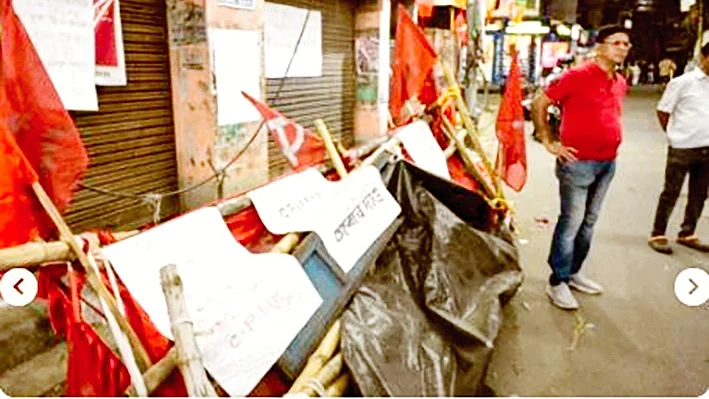
You may have seen a video reel from West Bengal’s Barasat during this Durga Puja, in which an elderly man is pleading with a younger fellow to show some respect for the books he is flinging to the ground. It’s enduring literature (‘chirayata sahitya’), the older man says, but his plea falls on deaf ears. All the goon and his gang see is that it is a Left bookstall — enough to see red — and their instructions are clear.
In another incident at Nagerbazar, right-wing hoodlums allegedly linked to the BJP tore pages from books at a CPI(M) stall and threw them onto the road. The pattern was hard to miss, as underlined by organisations like the Association for Protection of Democratic Rights, which reported similar incidents in Jadavpur, Jorabagan, Entally, Kasba and Haridevpur. Unsurprisingly, the BJP–RSS have sought to distance themselves from the incidents.
Chief minister Suvendu Adhikari reportedly urged Durga Puja committees to not allot stalls to Left organisations that refer to the festival as ‘Sharodotsav’ (autumn festival) instead of ‘Durga Puja’. Soon after, CPI(M) supporters and Jadavpur University students formed a human chain at the nearby 8B bus stand to stop a municipal bulldozer from removing a stall. Garbage trucks were commandeered to carry away books!
On 15 October, the dispute reached the Calcutta High Court. Justice Saugata Bhattacharyya allowed a CPI(M) stall near the party’s Bongaon office, but a division bench stayed the order the next day on an appeal by the state government.
The BJP, meanwhile, announced plans for about 5,000 bookstalls near Puja pandals that would sell literature on Prime Minister Narendra Modi, Sangh ideologue Syama Prasad Mookerjee and the party’s own promotional literature.
A political party has every right to distribute its literature, but that right must apply equally. Or it would, if ours was still a functional democracy and an invocation of citizen rights did not seem a quaint anachronism. What we saw on the streets of Kolkata and elsewhere in the state was not the kind of violation that leaves any room for doubt that this was political vendetta.
Even after Left bookstalls were targeted in this utterly lawless fashion, state BJP president Samik Bhattacharya still maintained that ‘real party workers’ would never throw books onto the road, adding that he had spoken to the chief minister to take action against the perpetrators.
Bhattacharya proceeded to recount his experience of political violence under CPI(M) rule, saying he still carries marks from bomb splinters. Was he perhaps making the case that his stories, even if true, constituted grounds for the vandalism or that the State should therefore wink at it?
State finance minister Swapan Dasgupta feigned outrage: “I don’t know who they are. But I must ask, how dare they?” The Sangh also made a show of defending everyone’s right to distribute literature, ‘provided the stalls did not illegally encroach on public space’.
In Amta, BJP legislator Amit Samanta was filmed leafing through books at a CPI(M) stall while party workers and volunteers sat around, avoiding eye contact.
Even as Samanta staged this little ‘damage control’ charade for the camera, we had more news from Barasat. A copy of Hanuman Chalisa had taken the place of the offending Left literature flung onto the road. And in the words of visibly irate BJP legislator Purnima Chakraborty, this was “a response to the Left’s use of ‘Hanuman’ while raging that BJP supporters had been ‘monkeying around’ the area.”
****
Boipara on College Street, easily one of India’s best-known book markets, is a good showcase of Kolkata’s love affair with books. Publishers, second-hand book-sellers and pavement hawkers have catered to generations of students and readers.
Days after the new BJP government assumed office in May this year, municipal affairs and urban development minister Agnimitra Paul floated a plan to redevelop College Street on the lines of London’s Oxford Street. Pavement ‘encroachments’ and stalls were removed or placed under surveillance, but one pressing question was left unanswered: how can public infrastructure improve if the people who sustain the market are displaced?
Puja bookstalls have long carried the culture of reading, browsing beyond College Street’s boipara. The Left book stalls typically focus on labour history, political theory and party literature alongside other books that might interest readers regardless of their politics. These makeshift stalls, a simple bamboo framework wrapped in red cloth, are points of contact between common folk and ideas they might not otherwise encounter.
The BJP is tapping into this very tradition to display its own literature. Which would have been fine, if displaying their range did not entail vandalising other material. The same extreme intolerance has been on display ever since the BJP came to power in the state.
On 1 September, saffron-clad demonstrators of the BJP’s youth wing Bharatiya Janata Yuva Morcha (BJYM) gathered outside the office of Anandabazar Patrika to protest the Bengali daily’s use of the phrase ‘gerua gundami (saffron hooliganism)' in its report on 21 August on the campus violence the previous day at Jadavpur University. The mob defaced the building and smeared its white pillars with saffron paint.
The landmark Academy of Fine Arts in central Kolkata was targeted as well. In July, the ticket room of the Academy received a daub of saffron paint, to mark political territory as it were. It drew condemnation from prominent theatre artists and Left-leaning activists, who gathered on 11 August to paint over the saffron walls with a fresh coat of white paint. Barely 24 hours later, a group of about 50 BJP activists, led by actor Rudranil Ghosh, came by again, to re-do the saffron.
The CPI(M)’s 34-year tenure in power is certainly not above criticism, but never before has this state and its storied capital city, which prides itself on its love of books, of the world of ideas and its cultural mores witnessed this kind of assault on its way of life.
Join our official telegram channel (@nationalherald) and stay updated with the latest headlines