


The crumbling edifice of higher education
The Satya Niketan building collapse is just one symptom of a large systemic failure
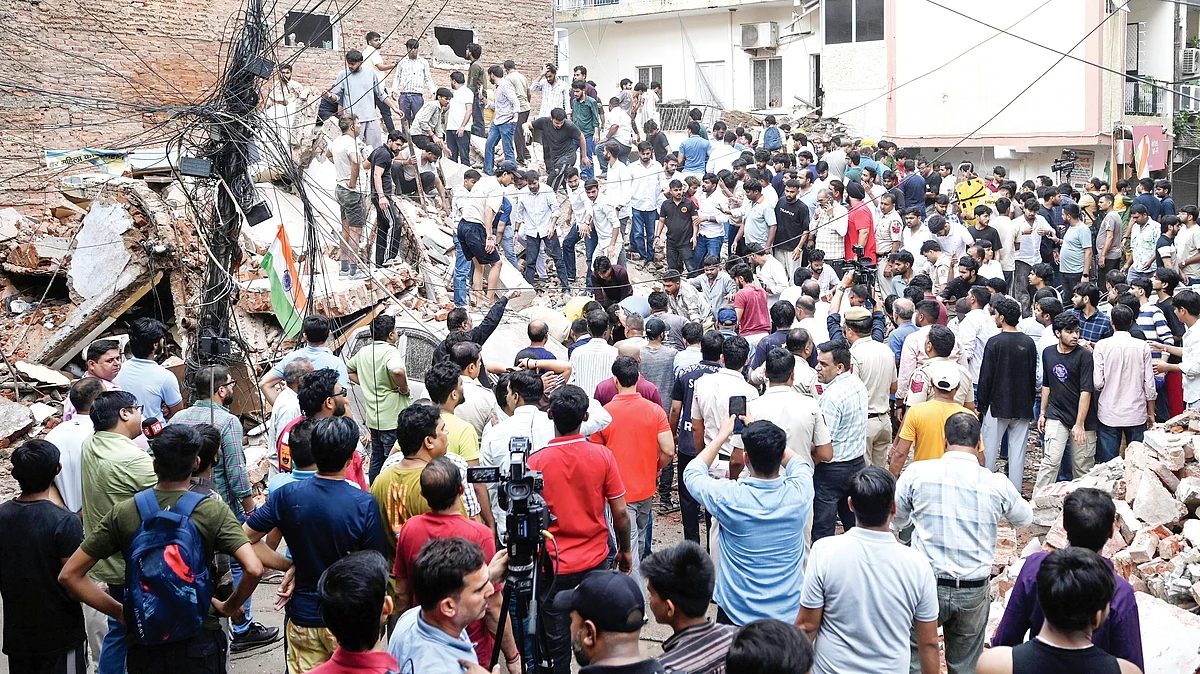


The Satya Niketan incident raises uncomfortable questions for those in power (should they choose to face them). The collapse of the five-storey building on 6 September refocused attention on the old debate over the shoddy quality of building materials, unauthorised construction and lack of adequate hostel facilities for students of Delhi University. It was a Sunday, which increased the risk for those who had shelled out significant amounts of money for paying guest accommodation close to South Campus. At least seven died, and several were critically injured.
The media and their expert panelists, ranging from astrologers to architects, shouted themselves hoarse, but we know that once the dust settles, things will return to ‘normal’ (read: apathetic and indifferent).
Almost three decades ago, a DTC bus carrying schoolchildren fell into the Yamuna river: 30 students died. Similar debates took place then, too. One panelist even observed that had the bus fallen in April-May instead of November there wouldn’t have been so many casualties as the water level in the Yamuna would have been lower!
These so-called debates have pointedly avoided some fundamental questions. Why must students travel hundreds of kilometres to metropolitan centres to access ‘excellence’ in higher education? Whatever happened to the idea of community colleges?
The Kothari Commission’s most revolutionary recommendation — the common school system, whereby children in any given neighbourhood were to attend the same school — was trashed long ago. We are still waiting for an equivalent vision of decentralised, accessible and publicly supported higher education.
The question of ‘funding’ higher education in the country has also been scrupulously ignored. Declining public allocation to education has material consequences for classrooms, hostels, laboratories, libraries and other basic infrastructure.
The Union Budget 2024–25 presents a telling example. The allocation for the University Grants Commission was reduced from Rs 6,409 crore in the 2023–24 revised estimate to Rs 2,500 crore in 2024–25, a reduction of approximately 61%. The overall allocation for higher education was also reduced by more than Rs 9,600 crore compared to the previous year’s revised estimate.
Every reduction of public investment in higher education has a physical consequence. It means fewer new hostels being built, poorer maintenance of existing buildings, and shrinking capacity to accommodate growing numbers of students.
When universities do not provide hostels, students move into PGs, rented rooms or improvised accommodation. The responsibility of housing students is thus transferred to a private market that often prioritises profit over safety. The demand for cheap accommodation is created by the education system itself, but its cost is pushed onto landlords and, ultimately, students. Additional floors are added and safety regulations compromised. The question is therefore not merely why a building collapsed, but what kind of funding priorities made such a collapse possible.
Delhi, the national capital, has over five lakh higher education students, with nearly two-thirds coming from outside the city. Only 20 of Delhi University’s 91 colleges provide hostel facilities, with barely 7,000 hostel seats for 2.45-plus lakh regular students. Of its 5,375 students, Miranda House can barely accommodate 370 in hostel; Sri Venkateswara College has only 150 hostel seats for nearly 4,600 students. Colleges such as Ram Lal Anand and Satyawati do not have hostels at all.
With the university unable to accommodate all its students, paying guest accommodations, private hostels or rented rooms become the default for outstation students. This is more than an inconvenience — it is an additional economic burden imposed upon those pursuing higher education. The cost of ‘quality’ education increasingly includes the cost of finding a place to live near the institution that provides it.
The victims of the Satya Niketan building collapse are therefore not merely victims of the unchecked, haphazard and corrupt nexus between building owners and municipal corporations. They are also victims of the unequal and unbalanced growth of higher education in India. Those who can pay gain access to premier institutions and better facilities; those who cannot pay, and come from places like Dewas or Auraiya in overlooked and under-developed India, are accommodated in chicken-coops.
The advantages of economic and cultural capital are often mistaken for merit. The student who arrives with the language, confidence, cultural familiarity, social networks and forms of knowledge valued by elite institutions is more readily recognised as ‘meritorious’.
The student who arrives without these forms of cultural capital is judged less capable, less polished or less deserving, even when the difference lies not in ability but in the unequal conditions under which that ability has been cultivated. What is presented as merit is therefore often the accumulated advantage of privilege, retrospectively made to look like individual achievement.
Through these unequal distributions of economic and cultural capital, a varna-like hierarchy is produced within higher education. IITs, IIMs and Central universities constitute the creamy layer while state universities and colleges are left to deal with what remains.
Why is the government creating what is increasingly a parallel system of quality education? Why is it neglecting its own higher education institutions, ostensibly to help privatise or facilitate foreign universities to set up local campuses that will attract the ‘right kind of clientele’?
It bears repeating that the problem is not simply that one building was constructed illegally or that one municipal authority failed to act. Those responsible must of course be held accountable, but stopping there individualises what is fundamentally a structural problem. The question isn’t just: why did the building fall? It’s also: why did the students have to live there in the first place?
Why have state universities been allowed to deteriorate to the point where leaving one’s home town or state appears to be the only route to better education? A system that forces students to migrate, pay exorbitant rents and settle for unsafe accommodation makes access to education itself unequal.
Satya Niketan is symptomatic of the collapse of the dreams that people across Bharat carry when they aspire to be part of India’s higher education system. It is the collapse of a promise: that talent, aspiration and hard work should open the doors to learning irrespective of where one comes from.
Navneet Sharma teaches at the Central University of Himachal Pradesh, Dharamshala. Anamica is a PhD scholar at IIT Bombay-Monash University