


India needs a Zohran Mamdani
The New York mayor embodies the much-needed counter-current to the kind of autocratic majoritarian State that democratic India has morphed into
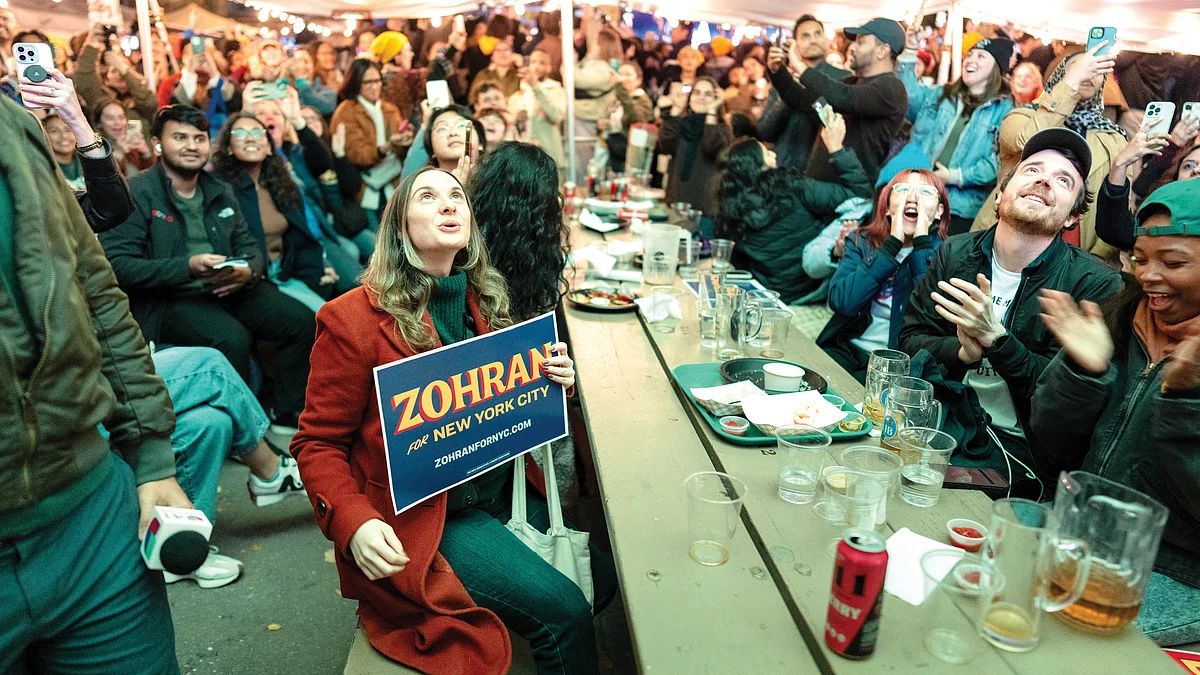


Wearing his democratic socialist heart on his sleeve, Zohran Mamdani took the oath of office as the mayor of New York in a decommissioned subway station in Manhattan to symbolise his affinity with the city’s workers and the marginalised people whose cause he said he would serve. The 34-year-old was administered the oath by veteran Democratic senator Bernie Sanders, a torchbearer of democratic socialism in America, with Congresswoman Alexandria Ocasio-Cortez by his side.
There was hardly any coverage in the Indian media of this historic moment, and the seminal impact of Mamdani’s election on American politics. The man who broke several taboos in taking charge of the Big Apple remains taboo in India. Through its media handlers, the government made it a point to invisibilise Mamdani despite his stupendous victory, ousting his nearest rival, two-time Democrat governor Andrew Cuomo, by polling more than 50 per cent of the vote.
Over 1 million New Yorkers, cutting across race, religion, ethnicity and economic background, with many immigrants among them, voted for him in a groundbreaking election that created waves across the world. His home country India was the only one that did not salute Mamdani’s unprecedented win, rising from an Assemblyman to head America’s richest city.
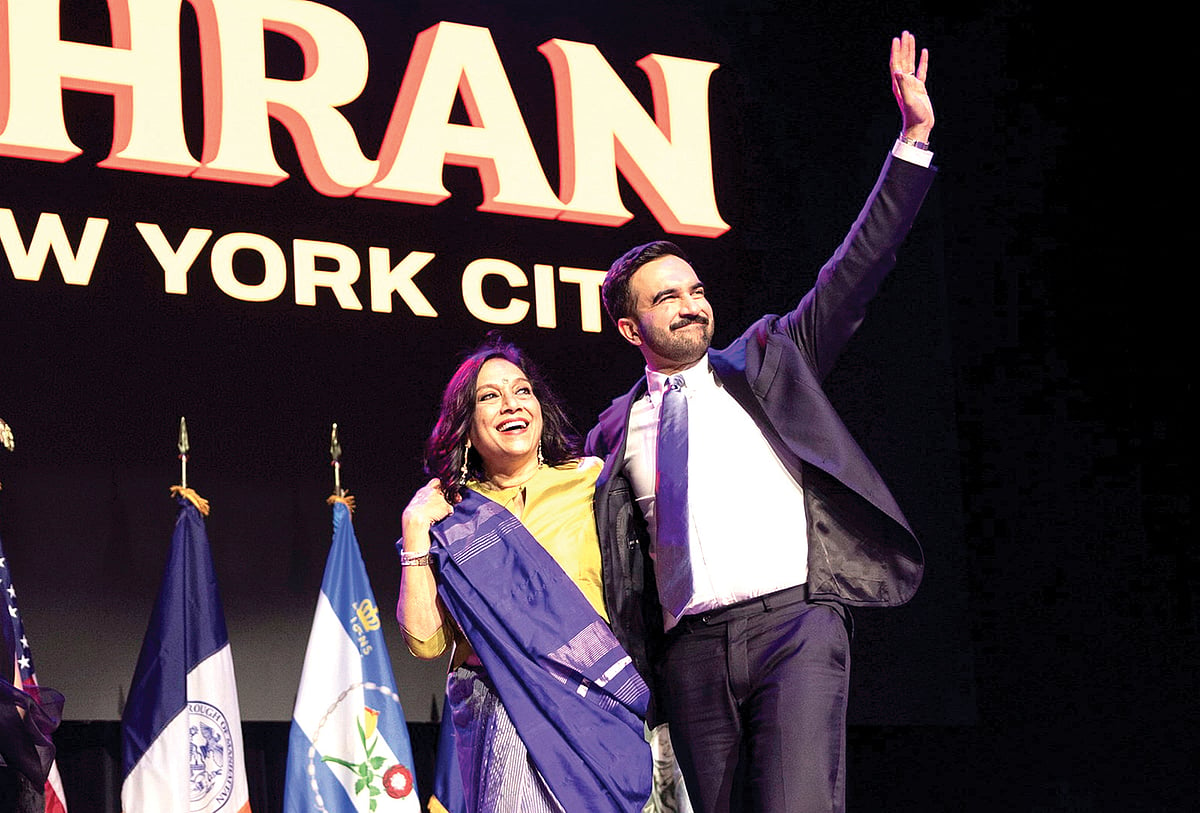
Mamdani has several firsts to his name: the first American of Asian descent and African origin, the first Muslim and the youngest to be elected mayor of New York. His parents are a celebrated power couple: Mira Nair, the globally acclaimed filmmaker with films like Salaam Bombay, Monsoon Wedding and Namesake to her credit, and Mahmood Mamdani, professor emeritus at Columbia University and post-colonial theorist whose celebrated work Good Muslim Bad Muslim, published soon after 9/11, stayed on the New York Times bestseller list for weeks.
Also Read: More vignettes of ‘Viksit Bharat’
But Mamdani never chose to remain cocooned within the elite legacy he was born into. On the contrary, he took up the cause of the immigrants — New York hosts more than 150 nationalities.
Secular and liberal in orientation, Mamdani has proven that he cares for the plight of every New Yorker. Outspoken about Netanyahu’s role in the genocidal killings of Palestinians, he distanced himself from allegations of antisemitism. (The American Israel Public Affairs Committee, America’s largest pro-Israel lobbying group, and the New York Jewish Foundation had played an active role in canvassing support for Cuomo.)
The results saw an even split of the Jewish vote: the younger generation rooted for Mamdani while the older, wealthier and Hasidic Jews voted en masse for Cuomo.
President Trump’s fulminations and public denunciations of Mamdani, his threats to cut off federal funds and his open support for his Democrat rival Cuomo, hardly dented Mamdani’s surging popularity. Calling Mamdani a Marxist and anti-national, Trump sought to nix Mamdani’s political career even before it had begun.
Mamdani, mayor of New York, turned the tables on Trump by appearing at the White House for a courtesy meeting, stressing his primary objective of affordability for all New Yorkers through free transport, childcare, housing and government-run grocery stores as he had promised in his election campaign.
Surprisingly, perhaps gauging the public mood, Trump turned turtle and assured Mamdani of his full support. Two ideologically contrarian politicians of the right and left in the same frame — one, mean-minded, vindictive, unpredictable; the other, defiant, committed and fearless.
With Trump defying all international norms and capturing the elected president and first lady of Venezuela, a sovereign country, the American system literally collapsed. The media stayed largely and perniciously silent; both Congress and the Supreme Court were voiceless against this flagrant abuse of power. Mamdani stood up to condemn the brazen act of aggression as a “declaration of war”.
Known for his outspoken views (he had called Narendra Modi a fascist) Mamdani has positioned himself securely on the side of the people. While calling for the Palestinians’ right to a peaceful homeland on their own soil, he cautioned the Israeli prime minister not to ever land in New York. If he did, he would have him arrested for committing “crimes against humanity” by massacring thousands of helpless Palestinians — women and children, the old and the sick.
With a Muslim Kutchi-Gujarati father, a Hindu Punjabi mother and a Syrian Muslim wife, Mamdani radiates the kind of cosmopolitanism that is as unequivocally liberal as it is comfortable with taking his oath on a historic old Quran to reaffirm his Muslim ancestry. (The five boroughs of New York have a sizeable Muslim population — Mamdani won their near unanimous vote.)
Mamdani embodies the much-needed counter-current to the kind of autocratic majoritarian State that democratic India has morphed into over the last decade or so. With India’s secular and democratic credentials founded on a nonviolent freedom struggle, it is no wonder that Mamdani chose to quote from Nehru’s iconic ‘Tryst with destiny’ speech when he vanquished all his opponents to emerge as the youngest leader of a new generation of Americans, without relying on any corporate or political backing, simply the people’s support.
In his seminal work The Idea of India, eminent political scientist Sunil Khilnani writes: ‘Modern Indian politics continues to plunder the nationalist pantheon for its iconography while, at the same time, in its practical struggles, it moves further and further away from the nationalist world and its distinctive temperament. The old arguments and battles are replayed today with the current generation’s new meanings and desires: Ambedkar is once again ranged against Gandhi, Patel is brought into battle against Nehru.
'Even as they divide, these struggles themselves testify to the presence of a common history, a shared Indian past… These struggles constitute the identity of India’s history since 1947. And, in its ability constantly to encompass diverse ideas of what India is, this history is itself expressive of the Indian idea’.
India’s strength lies in its civilisational diversity; no attempts to paint with a monochromatic brush can bring the real Indian canvas to life. In its hour of reckoning in a world tossed between powerful and opposing ideological blocs, India needs a Zohran Mamdani.
Malay Mishra is a retired diplomat and policy analyst
Article courtesy: The Billion Press
Join our official telegram channel (@nationalherald) and stay updated with the latest headlines