


Is Netanyahu exporting Gaza’s crisis to the Horn of Africa?
Israel’s recognition of Somaliland is not an isolated foreign policy gesture, it is a political toxin, writes Ashok Swain
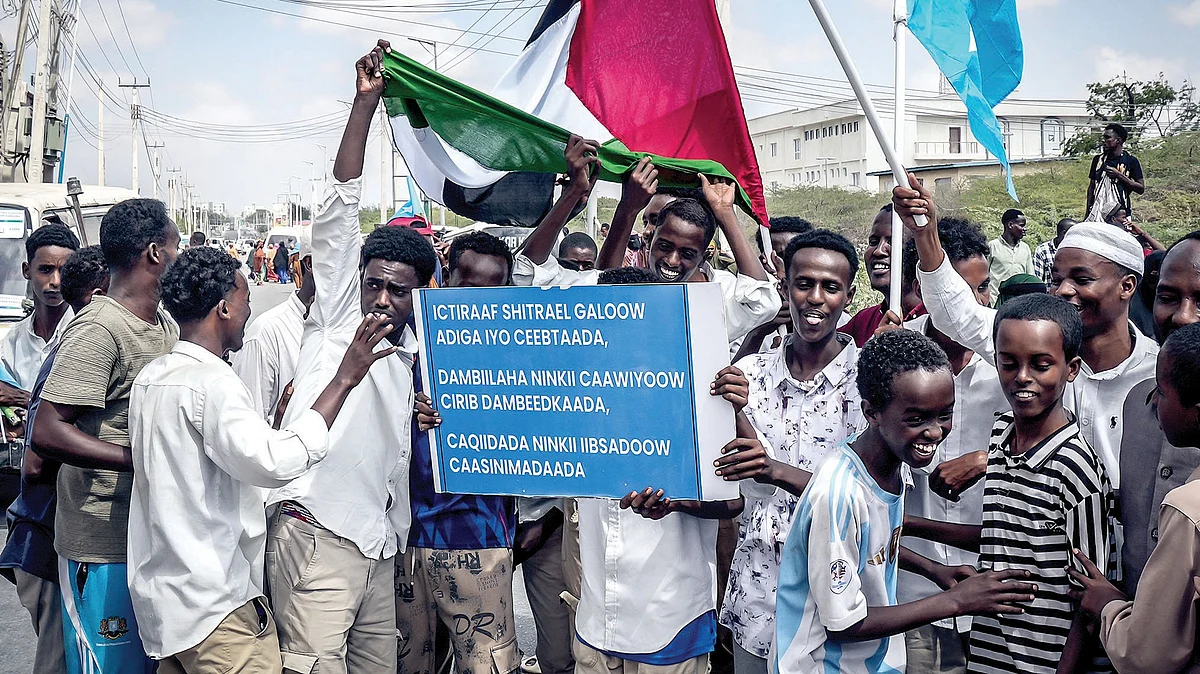


On 26 December 2025, Israel became the first country to formally recognise Somaliland. Prime Minister Benjamin Netanyahu is presenting the decision as a diplomatic breakthrough, an extension of the Abraham Accords logic into the Horn of Africa.
It is also being marketed as a strategic move, a foothold near Yemen, a vantage point over the Bab el-Mandeb, and a way to demonstrate that the pro-Palestinian camp is too fragmented to impose real costs on Israel. At the same time, the move has revived the most toxic speculation of all: that Somaliland might be pressured to accept Palestinians forcibly displaced from Gaza. Even if that scenario never materialises, the association alone is cause for serious trepidation.
Somaliland was a British protectorate that briefly gained independence in 1960 before voluntarily uniting with Italian administered Somalia to form the Somali Republic. After the collapse of the Somali state and the brutal repression carried out by the Siad Barre regime, Somaliland declared independence in 1991. Since then, it has functioned as a de facto state with its own government, currency and security forces.
Somalia, by contrast, has remained internationally recognised as a single sovereign state. No country had formally recognised Somaliland until Netanyahu’s move, and under international law and African Union norms, it is still considered an integral part of Somalia’s territory. This recognition is a familiar Netanyahu manoeuvre.
Create a headline, declare momentum, provoke outrage, and then present backlash as proof of resolve. Yet recognition of Somaliland is not an isolated foreign policy gesture. It is a statement about borders, sovereignty and what Israel believes it can get away with even as the war in Gaza continues to corrode international norms.
That is precisely why the strategy is likely to backfire. Not because Somaliland lacks a case for recognition—it has built functioning institutions and pursued international legitimacy for decades—but because Israel’s motives will be interpreted through the prism of Gaza, displacement and expansion. In that context, the symbolism is explosive and the security logic deeply flawed.
For years, Israel has lobbied for a strict doctrine of recognition. Do not reward unilateral secession. Do not legitimise breakaway entities. Do not bypass negotiated settlements.
This posture lies at the core of Israel’s argument against recognising Palestinian statehood without its consent. By recognising Somaliland unilaterally, Israel punctures its own narrative. It hands opponents an easy and powerful line: Israel supports self determination when it serves Israeli strategy and rejects it when it empowers Palestinians.
Israel may believe it has exposed hypocrisy among states that support Palestinian. In reality, it has highlighted the hypocrisy of its own legal and diplomatic posture. The backlash has not been confined to Somalia, which understandably views recognition as an assault on its territorial integrity. Condemnation has quickly coalesced into a broader front involving Egypt, Turkey, Djibouti, the African Union, the Arab League and the Gulf Cooperation Council.
The Arab League has requested the UN Security Council to take a firm stance against Israel’s ‘illegal’ recognition of Somaliland. This matters because Israel is already struggling to maintain and expand its diplomatic presence in Africa, including its contested standing within continental institutions.
Any marginal gain from being the first mover on Somaliland risks becoming a lasting liability in the arenas where African and Arab world governments coordinate positions, enforce norms, and punish actions seen as setting dangerous precedents. Although the backlash was predictable, it is not easily manageable.
In the Horn of Africa, diplomacy is not theatre. It is an integral part of the security architecture. Egypt and Turkey are not merely issuing statements. They have concrete stakes in Red Sea security, Somali state survival, energy routes and regional influence.
Somalia itself will use every available forum to deter other states from following Israel’s lead. The more Israel frames recognition as a triumph, the more it incentivises rivals to treat it as a precedent that must be confronted rather than tolerated.
The security rationale behind the move is even shakier. Yes, Somaliland sits across from Yemen, close enough to support surveillance and logistics. But a forward base is not automatically a forward advantage. In volatile environments, new foreign footprints create new targets.
Israel has already learned that striking the Houthis does not eliminate the threat. More often, it entrenches cycles of retaliation. If Israel is perceived as building an operating platform on Somali territory, it will not only inflame Yemen’s war theatre, it will internationalise it further. That is how a maritime chokepoint becomes a magnet for proxy attacks, sabotage and asymmetric escalation.
The Horn of Africa is already saturated with militarised competition. Djibouti hosts multiple foreign militaries. The United Arab Emirates operates facilities and ports across the region. Ethiopia has pursued controversial arrangements to secure access to the sea. Adding an Israeli security presence to this mix does not stabilise the Red Sea corridor. It invites counter alignment.
Actors that want to hurt Israel, or punish its partners, will find ample soft points: ports, shipping lanes, critical infrastructure and political fault lines within and around Somaliland. In such an environment, each additional security actor raises the risk of miscalculation and widens the battlefield.
The most immediate backfire risk comes from violent non-state actors. Al Shabab has already framed the recognition as foreign intrusion and pledged to resist any Israeli use of Somaliland.
The narrative writes itself: a Zionist project on Somali soil, a betrayal of Muslim solidarity, and a new frontier for jihad. Israel may dismiss such rhetoric as inevitable, but in security terms it is deeply consequential.
Extremist movements thrive on symbols that fuse local grievances with global narratives. Israel has delivered precisely such a symbol at a moment when anger over Gaza is widespread, visceral and easily mobilised. Even within Somaliland, Israel’s move risks becoming a political toxin.
Somaliland’s leadership seeks recognition and investment, but it governs a society where sympathy for Palestinians runs deep. If the relationship is perceived as trading diplomatic recognition for complicity in Gaza’s dispossession, public legitimacy will erode. This is not a theoretical concern. Somaliland faces internal disputes, contested territories, and recent episodes of violence that have already strained confidence in governance.
A partnership with Israel, cast as militarised and morally tainted, can inflame domestic opposition and deepen internal fractures. This brings us to the darkest cloud hanging over the recognition: forced relocation. Israel has repeatedly flirted with schemes to move Palestinians out of Gaza and rebrand them as humanitarian resettlement. The international backlash has been overwhelming because the logic is clear. Population transfer is not peace, it is erasure.
In this climate, any hint that Somaliland could become a destination for displaced Gazans turns Israel’s recognition into evidence for the prosecution. Even if Somaliland rejects such plans, and even if Washington distances itself, suspicion will persist because Israel has made displacement a recurring theme rather than a firmly rejected aberration. If Israel’s objective is to demonstrate that Palestinian solidarity is hollow, it may achieve the opposite.
The Somaliland move has already pushed disparate actors to coordinate around a simple principle: borders cannot be redrawn through opportunistic recognition, and Palestinians cannot be expelled to solve Israel’s political problem. That stance cuts across rivalries and regional divisions. It allows states that disagree on almost everything else to stand together around a shared red line.
Netanyahu’s government has, unintentionally, created a new diplomatic focal point for its opponents at a moment when many were struggling to align. Recognition of Somaliland will not make Gaza disappear. It will make Israel’s problem larger, and it will bring that problem uncomfortably closer to home in the Red Sea.
ASHOK SWAIN is a professor of peace and conflict research at Uppsala University, Sweden
Join our official telegram channel (@nationalherald) and stay updated with the latest headlines