


It was both a protest and a carnival
Jaideep Hardikar on how India discovered a new gharana of defiance and learnt a lesson in slaying government arrogance with a smile
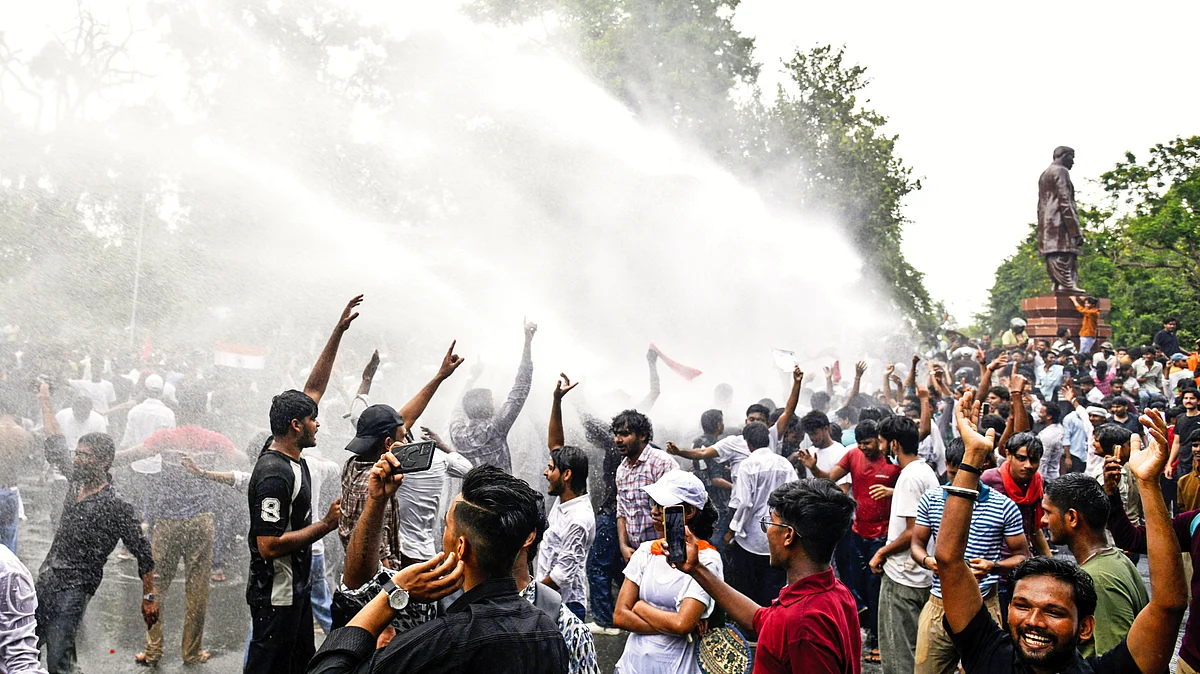


This went viral on Instagram. Shot on mobile cameras, here’s how the scene unfolds: a column of policemen advances, shields raised, lathis in hand. A crowd of students faces them on a chaotic Patna street. A confrontation appears inevitable. Then, from somewhere in the crowd, a familiar tune rises: ‘Jana Gana Mana...’
Others join in. The crowd begins to sing the national anthem. The policemen must halt their surge, stand erect and recite the anthem. For those few seconds, nobody really knows what comes next. Or what this moment is. Theatre? Satire? Civil disobedience? Guerrilla tactic? Perhaps everything all at once.
It was hard to resist a laugh. Unless you were an andhbhakt. In the same protest, a boy is seen asking the bewildered policemen in that special Bihari lilt: “Koi tear gas ka intejaam nahi kiye? Water cannon hee chala dijiye.”
For days, Patna and several other cities across India turned into Jantar Mantar. Reels were emerging from every protest site, and you couldn’t help marvelling at the creativity, the style and swagger, the idiom, the humour, the good cheer, the irreverence, the many registers of their protest. Their rebellion had become a festival. The youth were angry and they were leaving nobody in any doubt. But they were somehow managing to scream with a smile. It was a protest and a carnival.
‘You f***ed with the wrong gen,’ read one placard, held by a young girl. It may well be a message for audiences beyond governments. They had no fear in taking on the strongmen they defied, no shame in hurling cuss words at them.
One father, interviewed by someone for his Instagram feed, said he had come to the site from Kolkata to represent his son, who was stuck in London. He told his father to go to Jantar Mantar — and take a police beating, if he could, on his behalf! Because he couldn’t. And the father came, was all smiles, and asked the Instagram reporter where and how. It was ridiculous and the old man knew it. But he was doing it for his son and his protesting peers.
‘My Hinge (it’s a dating app, ICYDK) matches reply faster than the government,’ one placard read. Another poked fun at the government’s initial refusal to come to a conversation: ‘Even my ex didn’t ghost me this badly!’
Someone came dressed as Batman. A hop, skip and jump away, Spiderman was posing for photographs. Dora the Explorer became Dora the Protester. There was even a low-budget Pokémon wandering through the crowd. Protesters rewrote Bollywood lyrics into political satire. Others recreated Subway Surfers-style reels, complete with the game’s soundtrack, while running from the police. Someone even proudly uploaded a Strava screenshot, recording not a Sunday morning run but the kilometres clocked during the protest.
There’s another notable shift. Earlier protest movements rode on attendance, this one on shareability. The placard was not just for the policeman standing ten feet away, it was aimed at someone scrolling through Instagram far away. The slogan became a screenshot. The speech became a reel. The march acquired GPS coordinates. Every witty sign had been designed to outlive the afternoon and survive inside the algorithm.
While the immediate trigger may have been repeated examination paper leaks, what lies beneath the surface of their anger is accumulated disgust and disappointment with shrinking opportunities, expensive education and uncertain employment, the rampant bigotry and whataboutery, the breakdown of common decency, the knowledge that even institutions meant to guarantee fairness are no longer trustworthy.
When previous generations protested, you saw moral outrage; this generation chose irony. Of course it knows the power of the internet but perhaps it also intuitively understands that humour travels farther than outrage, that irony may survive censorship, that a joke will be passed around with greater enthusiasm and relish than a political pamphlet. A meme might slip through where ideology is shown the door. Political theorists have known this for long.
Also Read: The clamour for change echoes far and wide
The Russian philosopher Mikhail Bakhtin argued that hierarchy temporarily collapses during carnivals. Kings become ordinary men. Sacred authority becomes ridiculous. Laughter entertains; it rearranges relationships between the rulers and the ruled.
James C. Scott, writing in Domination and the Arts of Resistance, described jokes, rumours and satire as the ‘hidden transcripts’ of ordinary people. Before citizens openly challenge power, they often laugh at it. Ridicule quietly rehearses rebellion. History is full of such rehearsals.
In Communist Poland during the 1980s, the Orange Alternative underground movement organised protests where students dressed as dwarfs. Police, determined to crush dissent, ended up arresting people dressed as fairytale characters. The government kept order but lost dignity.
In the famous Otpor student movement of Serbia in the late 1990s, student activists opposing Slobodan Milošević rolled a barrel painted with the strongman’s face into a public square, inviting passers-by to hit it with a stick after dropping a coin into a box. The police arrived eventually to ‘arrest’ the barrel, and the satirical fundraising stunt made authority look ridiculous, with newspapers around the world splashing photographs of police officers carrying away a painted drum. That one absurd image punctured years of manufactured authority.
Authoritarian power, whatever its ideology, constructs a fake majesty that humour punctures with ease. Indian folklore celebrates Birbal and Tenali Raman not because they defeated kings with swords but because they crushed arrogance with wit. During the Emergency, Abu Abraham’s cartoons often said what editorials could not. Habib Tanvir’s theatre mocked power without always naming it. Sharad Joshi’s opus Ek Tha Gadha Urf Aladaad Khan, Cho Ramaswamy’s Tughlak mocked authority with the same tools.
But India’s Gen Z did something different. They democratised satire and they gave it wings. It wasn’t a handful of cartoonists, playwrights or columnists channelling the angst of a generation. If one wrote a placard, another filmed it, a third edited the reel, a fourth added trending audio, a fifth turned it into a meme before dinner. By nightfall, a joke born on the pavement outside Parliament had travelled farther than any prime-time TV debate.
For over a decade, Narendra Modi’s politics has been built around projection — choreographed events and spectacle creating the image of a larger-than-life leader. The Instagram generation is taking it down by poking fun at it through reels, memes and punchlines.
Humour, of course, cannot replace organisation. No government has ever fallen because of a clever placard. Memes are not manifestos. Reels cannot substitute movements. Eventually every protest must answer difficult questions about leadership, strategy and political direction.
But perhaps its biggest achievement is how this movement buoyed itself with laughter and dissolved fear, how it gave courage to the cowering, how it made change look possible.
We watched with astonishment how these young protesters faced the brutality of the Delhi Police. We saw how support soared in the days following the police action. It was magical to see that the police batons couldn’t kill their brio or their sense of humour. Many of those returning to Jantar Mantar had watched videos of students being dragged away, seen their bleeding, bandaged heads and broken legs. They knew the risks. Yet they returned.
It’s hard to tell where they go from here, but their act of defiance has already punctured the great bully’s aura of invincibility.
Jaideep Hardikar is a senior Nagpur-based journalist and author of Ramrao: The Story of India’s Farm Crisis. More by him here
Join our official telegram channel (@nationalherald) and stay updated with the latest headlines