


The clamour for change echoes far and wide
The large footprint of this protest is a sign that the movement no longer requires a nerve centre. Delhi did not export this protest
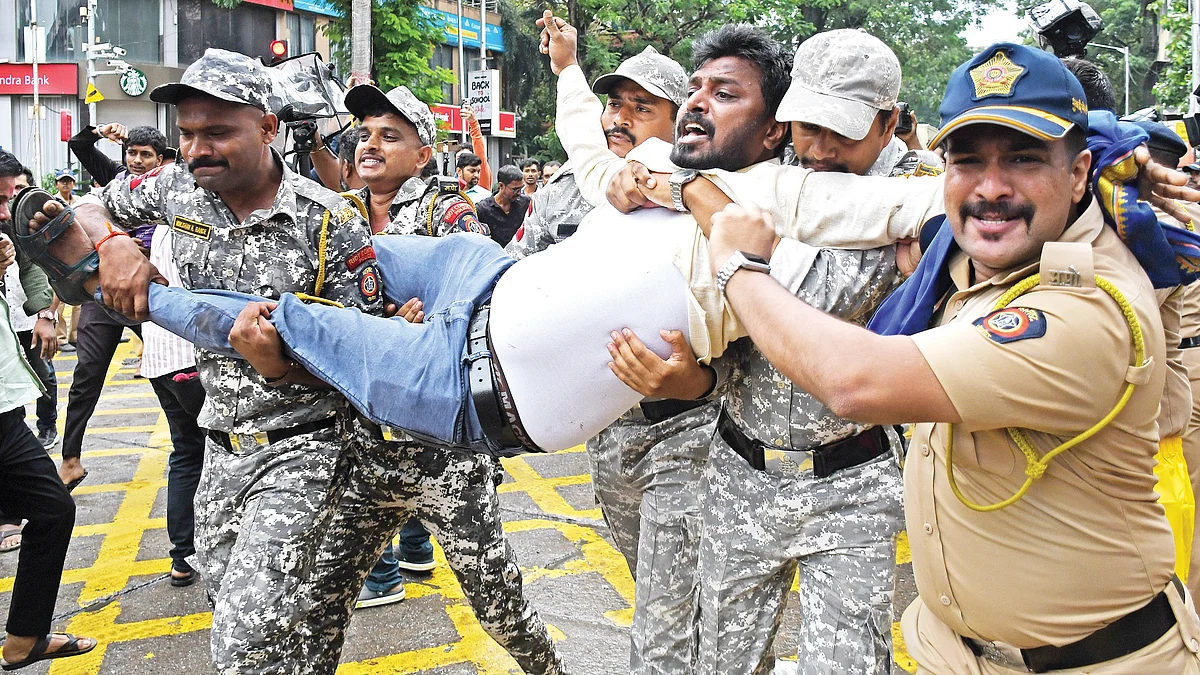


On Monday, 20 July, the national capital became the epicentre of a student uprising that rang out across the country and even abroad in cities like NYC, San Jose and London, where the Indian diaspora has a sizeable presence.
The police deployment in Delhi was heavy on the day. Several arterial roads leading in and out of central Delhi were barricaded and closed to traffic. Around 4.00 pm, as the heaving crowds of peaceful protestors finally breached police defences at Jantar Mantar and began their march towards Parliament Street, defying barricades and prohibitory orders, the police went on a rampage — with batons, water cannons, tear gas, pellet guns et al.
Delhi’s fortissimo note may have drowned out the chorus of protests in the country, but they had begun even before things came to a head in Delhi on Monday.
On Sunday, 19 July, the morning after Sonam Wangchuk was forcibly whisked away from Jantar Mantar, there was a protest at Mumbai’s Shivaji Park where hundreds gathered in solidarity with the agitation. Former Maharashtra chief minister Uddhav Thackeray joined the demonstrators and called for a larger agitation against the Union government.
In Bengaluru, Freedom Park overflowed with students and young professionals. Their message went beyond a single examination (NEET) and a solitary minister (Dharmendra Pradhan). As postgraduate student Apoorva R. put it: “It’s not about one person or one exam. If students remain silent today, tomorrow every institution will lose credibility.”
Jadavpur University in Kolkata organised its first big march since the change of government in West Bengal. Students, teachers and research scholars marched together, condemning what they described as police brutality against peaceful protesters.
Presidency University students joined the chorus in Delhi for Pradhan’s resignation, while nearly fifty students at Medical College Kolkata observed a twelve-hour hunger strike in solidarity with Wangchuk, then on the twenty-first day of his fast.
Beyond these metros, the same simmering resentment was palpable in the NSUI (National Students’ Union of India) gherao outside the education minister’s residence in Bhubaneswar, in prayer meetings in Leh and Kargil, torch marches in Purnea, Sikar, Jaipur and Ranchi, demonstrations in Lucknow, Chandigarh, Indore, Sirsa, Jaunpur, Aligarh, Bhiwani and Yamunanagar. Even in Manipur, already dealing with a hellish ethnic conflict, students and citizens made common cause with the protestors in Delhi.
Perhaps the most revealing geography was Himachal Pradesh. In Shimla, students marched several miles in pouring rain. Simultaneous protests surfaced in Hamirpur, Nadaun and Barsar — places that rarely occupy national headlines.
The movement had travelled far beyond the national capital and state capitals into smaller towns and districts, where competitive examinations have become the only gateway to social mobility.
Two cities deserve special attention: Kota and Dehradun.
Kota, India’s coaching capital, hosted Rahul Gandhi’s ‘Chhatron Ki Goonj’ programme, which drew an unexpectedly large audience. Students returned to the streets in significant numbers after the Delhi crackdown. In Dehradun too, student organisations demanded accountability for the repeated paper leaks that have wrecked confidence in the country’s education system.
Beyond the scale or spread of this protest, what makes it truly remarkable is its social texture. This was never a protest confined to one student organisation or one political party’s calendar. Across the country, students stood alongside teachers, parents, retired government employees, farmer unions, labour organisations and women’s groups.
In Indore, freedom fighter and former parliamentarian Pandit Ramkrishna Sharma, who is now 101, walked to a protest site to express solidarity with students demanding educational reforms. Posters displayed the names of students who had died by suicide after repeated paper leaks or other exam failures. Here, the candle- light vigils and silent marches gave the impression that grief had perhaps overwhelmed rage. This was communal mourning; what had brought them together was shared grief.
The large footprint of this protest suggests that these movements no longer require a headquarters. Delhi did not export this protest. No doubt social media was both carrier and catalyst, but technology alone cannot manufacture outrage. Digital platforms may spread information faster than wildfire, but it was shared experience, shared pain that made it possible for people living so far from each other to make common cause.
That the confrontation between the police and the protesters in Delhi made the headlines is not surprising but this quiet convergence of aspirations and anxieties is also telling us something. India’s youth is lashing out against a system that has failed them. Even merit is not a passport to opportunity and the discovery of merit has itself become a lottery. Years of disciplined preparation can be rendered meaningless by systemic failures.
History reminds us that student uprisings are early warning systems for democracies. Long before economic statistics or electoral verdicts reveal public dissatisfaction, campuses begin to register shifts in the national mood.
The message of 20 July is devastatingly simple: India’s youth is serving this government notice. They have waited too long to be heard — and can wait no longer for change.
Join our official telegram channel (@nationalherald) and stay updated with the latest headlines