


Crude lies and accounting sleights of hand
Gurdeep Sappal on the reality of the Modi government's fuel prices policy, as exposed by its own figures
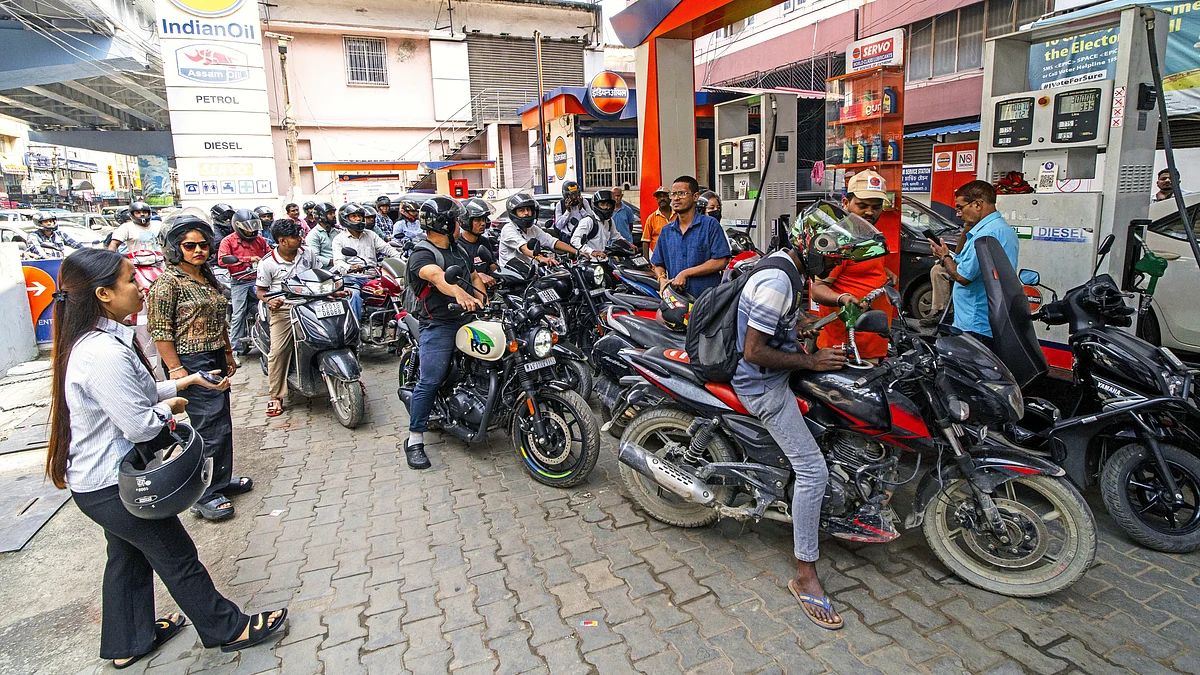


Even as the war in West Asia sends fuel prices into a dizzying upward spiral, at fuel stations in India, prices have counter-intuitively held steady. The Modi government has made much of its ‘people-centric’ interventions to shield citizens, but these interventions are nothing more than a ‘commercial break’ in a decade-long pattern of relentless extraction and profiteering.
Prime Minister Narendra Modi’s decade in power has been, in large part, a windfall for the government exchequer. Global crude oil prices have crashed repeatedly during his tenure, at one point touching $30 a barrel. Each time crude prices fell, Indian consumers waited for retail petrol and diesel prices to follow suit. But they never did. The government quietly pocketed the difference, rarely even bothering to explain why the benefits had not been passed on.
When it deigned to explain, it trotted out the same three arguments: it was either the oil bonds issued by the Congress-led UPA government or roads built with petroleum revenues or cash transfers to the poor. The reality is vastly different though, and exposed by the government’s own figures.
Claim #1: ‘We were repaying UPA-era oil bonds’
The Manmohan Singh government left behind Rs 1.6 lakh crore in oil bonds, instruments issued to oil marketing companies to compensate them for selling subsidised fuel. The BJP has repeated this ad nauseum, citing the oil bonds as both grievance and absolution.
Also Read: The meaning of energy sovereignty
The detail it conveniently skips is that over the past decade, the Modi government has collected more than Rs 44 lakh crore in petroleum taxes. Whereas the oil bond repayments, principal plus interest, amount to approximately Rs 3.3 lakh crore. That is roughly seven per cent of the taxes collected.
In other words, for every rupee that went towards repaying oil bonds, the Modi government pocketed thirteen.
Claim #2: ‘The money was used to build roads’
It cannot be denied that India has added highway kilometres during the Modi years. The government cites this as evidence that petroleum revenues were invested productively. On the face of it, this argument sounds more tenable, but it conceals an accounting sleight of hand.
As of March 2024, the National Highways Authority of India (NHAI) carried an outstanding debt of Rs 3.35 lakh crore. That figure is more than twice the value of the oil bonds liability the BJP loves to lament. If, as the BJP argues, deferred debt is such an unconscionable burden on future generations, shouldn’t the NHAI’s balance sheet also demand the same outrage?
There is more. The highways built with borrowed money are now being sold back, in effect, to private investors and sovereign wealth funds through the InvIT (Infrastructure Investment Trust) mechanism. Future toll revenues are pledged to service debt in addition to generating returns for private players.
Union road minister Nitin Gadkari has publicly stated that the NHAI’s annual toll income is expected to rise from Rs 50,000 crore to Rs 1.45 lakh crore. In the financial year 2025-26, toll collections have already reached Rs 73,000 crore.
So, roads are built on borrowed money, future tolls are pledged to repay loans and to reward investors, and the citizen-consumer is asked to believe that the high taxes on fuel financed the road project. It’s the same consumer that also pays the toll that supposedly repays the debt and rewards the private investor.
Claim #3 ‘The money went to the poor’
The third argument is the most sophisticated — and the most dishonest. The BJP cites Direct Benefit Transfers of over Rs 50 lakh crore during the Modi years as evidence that petroleum revenues were recycled to the poor. The number is striking until one disaggregates it.
India’s total subsidy bill, measured as a share of the Union Budget, has actually fallen from 16.3 per cent in 2013-14 to 13.06 per cent in 2025-26. Nearly 91 per cent of current subsidies cover food grain distribution, fertilisers, housing under the PM Awas Yojana and LPG, all of which existed in the UPA years as well — at substantially higher levels. So, this government has not expanded welfare; it has simply rebranded it.
The most telling figure is the collapse in petroleum subsidies — down from 5.1 per cent of the Union Budget under the UPA to a meagre 0.24 per cent today. Food and fertiliser subsidies together accounted for 9.6 per cent of the budget in 2013-14; they are now at 7.33 per cent. Nor has there been a compensating substantial increase in housing allocations over the UPA years.
It’s worth noting that the ‘efficiency gains’ cited in DBT claims are government-reported figures, not independently audited by the Comptroller and Auditor General of India. The government changed the pipeline, reduced the volume flowing through it, and then presented the change as welfare.
Debt that’s hard to hide
When Narendra Modi took office in May 2014, India’s total national debt accumulated over 67 years, under all prime ministers Jawaharlal Nehru onwards, stood at approximately Rs 55 lakh crore. By March 2026, that figure had risen to Rs 197 lakh crore! The Union Budget for 2026-27 projects it will reach Rs 218.63 lakh crore by March 2027.
In a single decade, the Modi government has added nearly Rs 150 lakh crore to India’s national debt, more than 2.5 times the debt all previous governments accumulated over nearly seven decades. India now pays approximately Rs 11 lakh crore a year in interest. Every Indian citizen now carries an average debt burden exceeding Rs 1.5 lakh.
This does not include the off-budget liabilities of the NHAI, Indian Railway Finance Corporation, Power Finance Corporation and the Food Corporation of India, estimated at Rs 20–25 lakh crore, which do not appear in official FRBM (fiscal responsibility and budget management) statements.
If Rs 1.6 lakh crore in deferred subsidies was, as the BJP argues, an unconscionable burden on India’s future, what do we call this Rs 150 lakh crore in new debt, accumulated not to subsidise the poor but to finance a governance model that extracts from citizen-consumers, mortgages public assets and calls it development?
Gurdeep Singh Sappal is a Permanent Invitee to the Congress Working Committee. More by the author here
Join our official telegram channel (@nationalherald) and stay updated with the latest headlines