


No 'dalali' please, we are Indians
Aakar Patel on how we’d rather bury our head in the sand than broker resolution of a dispute


I am not sure why but the Indian state finds the idea of international mediation distasteful. The distaste extends to both the mediator and the parties who need mediation. We know this because of our insistence — under all Indian governments, I should add — that outstanding issues between two nations must be resolved bilaterally.
This stance has particular reference to one neighbour. And our contempt for that neighbour, currently mediating between the US and Iran, was recently expressed by our external affairs minister, who used the pejorative ‘dalaal’ to describe them. So, we won’t brook dalali, but what we will do, to solve a problem that involves us and affects us, is not clear at the moment.
We are involved because we are suffering as the rest of the world is, in terms of both prices and shortages, but we are content to be onlookers and hoping that the crisis will resolve itself, or someone else will resolve it, so that things go back to normal for us.
That is the way India has decided to approach the ongoing war and we can agree or disagree whether India could have or should have done more or something different.
I wanted to write about the other approach, the one that is not being deployed. We don’t need to speculate about what that might be because the previous government left us a document that informs us what it should be.
On 4 November 2013, then Prime Minister Manmohan Singh spoke to over 120 heads of Indian missions and outlined the five principles that defined his foreign policy.
These were: First, recognition that India’s relations with the world — the major powers and Asian neighbours — were shaped by its developmental priorities. Singh said ‘the single most important objective of Indian foreign policy has to be to create a global environment conducive to the well-being of our great country’.
Also Read: The Iran war is real. India’s response isn’t
Second, that greater integration with the world economy would benefit India and enable Indians to realise their creative potential.
Third, to seek stable, long term and mutually beneficial relations with all major powers. And to work with the international community to create a global economic and security environment beneficial to all nations.
Fourth, to recognise that the Indian subcontinent’s shared destiny required greater regional cooperation and connectivity.
Fifth, a foreign policy defined not merely by interests, but also by the values dear to Indians: ‘India’s experiment of pursuing economic development within the framework of a plural, secular and liberal democracy has inspired people around the world and should continue to do so.’
In short: India would use foreign policy to advance its economic development; it would be friendly with global great powers and its neighbours; and it would be helped in doing this by continuing to be a pluralist and secular democracy.
Because this was a clear exposition of what was sought to be achieved, we can apply it today to see what we would do differently. Let us take them each in turn.
If we are to agree that ‘the single most important objective of Indian foreign policy has to be to create a global environment conducive to India’s well-being’, then it is obvious that we should have ensured that the environment is not vitiated. That means engaging with those who have the agency to harm our growth.
India is one of the few nations, and perhaps the only nation, that has good relations with America, Israel and Iran. Pakistan is friendly with two of them. Knowing that a war in the Gulf would damage our economy, hurt supply of fertilisers and fuel, and cause general chaos, we should have tried to ensure this war did not begin. We chose not to do that.
Also Read: Modi’s Iran policy is ‘strategic surrender’
The second point on integration is one that we have become cautious if not wary about over the last decade. We chose not to enter the Regional Comprehensive Economic Partnership that included about 15 Asia Pacific nations and the view of economists, including those who adore the prime minister, is that India has become unnecessarily protectionist.
The third point on seeking long term mutually beneficial relations with “all powers” has its meaning with relation to China. How much agency we have exercised on this since 2020 and where things stand are clear and that need not detain us here.
The fourth and fifth points Singh raised are to my mind the ones where there has been maximum departure since 2014. Borders in South Asia remain either rigid or closed, free movement is impossible and this is so because we — as the only power that shares boundaries with the rest — want it this way.
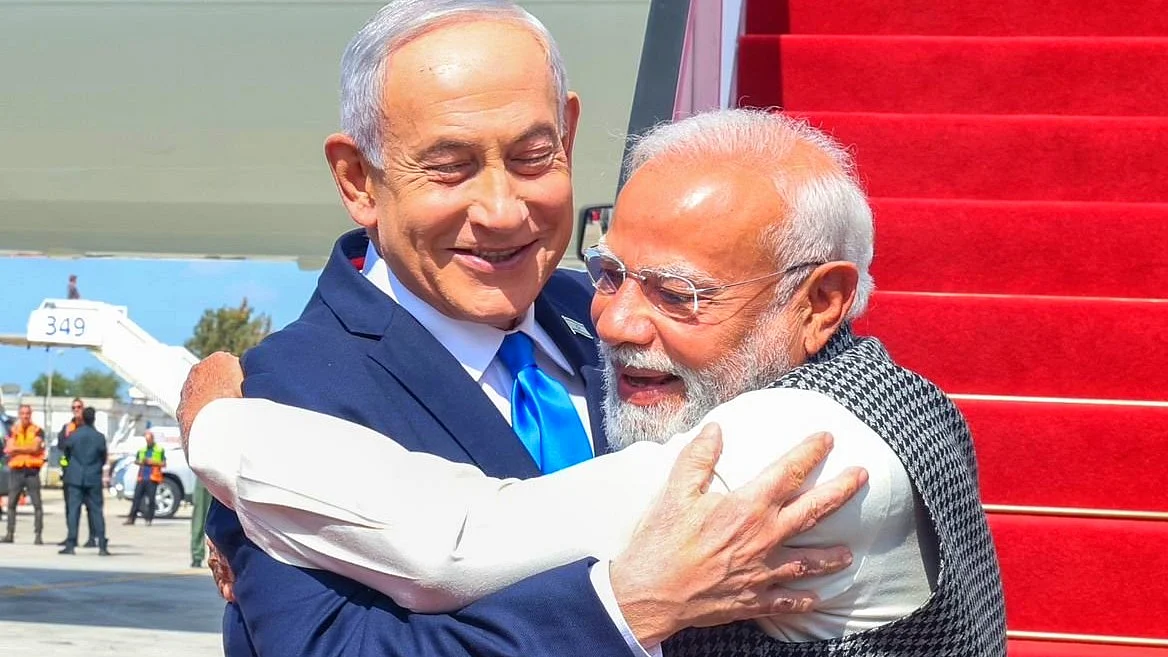
Lastly, for the first time since 1947, we are faced with a large and popular political movement that is hostile to the idea of India as plural, secular and liberal. Our newfound deep friendship with Israel is to be understood in this light. Israel is our 49th largest export and 48th largest import partner, one of the lowest. Why are we so besotted with Israel? It is because we ache to do to our minorities what Israel is doing to Palestinians.
This is where we stand and this is what we have chosen to do. If we think we require to correct course, then Manmohan Singh’s wise, kind and measured counsel from a decade-and-a-half ago is a fine place to start.
Views are personal. More of Aakar Patel’s writing may be read here
Join our official telegram channel (@nationalherald) and stay updated with the latest headlines
Published: 12 Apr 2026, 2:53 PM