


Surprise, surprise, it’s advantage Adani
Why Odisha opted for Adani’s 3,000 MW nuclear plants over the Tatas’ offer of smaller modular reactors
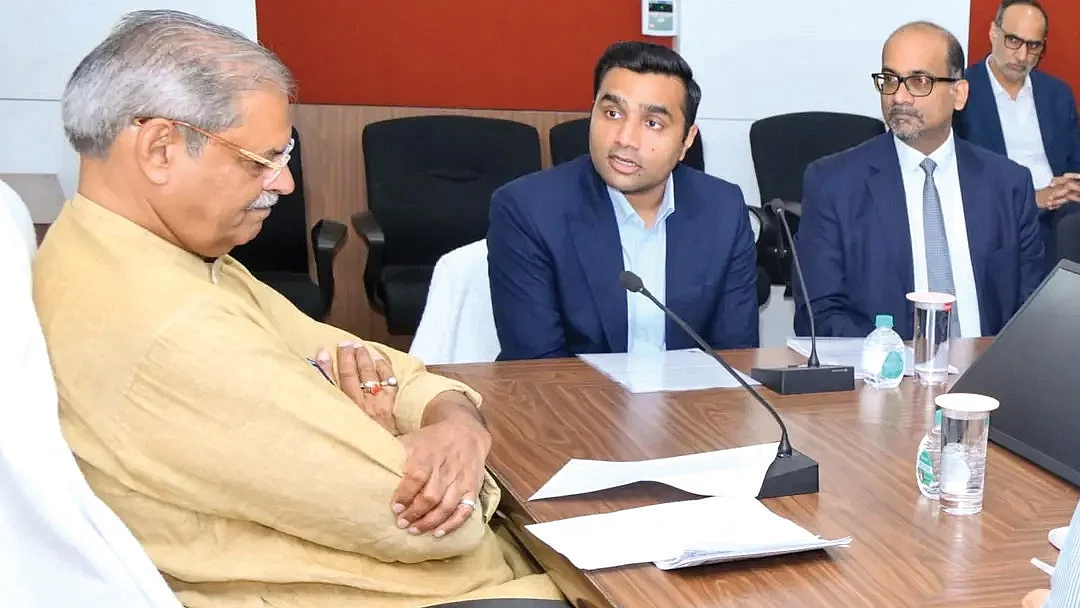


Two meetings and a little less than two months. That’s all it took for the BJP government in Odisha to sanction two 3,000 MW nuclear plants proposed by the Adani Group. Observers did not miss the speed at which an administration, virtually paralysed by internal squabbles, moved. On 30 July, Karan Adani had his first meeting with K.V. Singh Deo, the energy minister. A second meeting followed on 13 August, when the Adani scion also called on the CM. On 23 September, the green signal was given.
Such alacrity has not been extended by the Mohan Majhi government to others. Energy secretary Vishal Kumar Dev admitted that both the Adanis and the Tatas had submitted proposals soon after the Modi government passed the SHANTI (Sustainable Harnessing and Advancement of Nuclear Energy for Transforming India) Act in December 2025. (The act allows the private sector to own and operate nuclear power plants).
Tata Power, which manages the distribution of electricity in Odisha, had expressed interest in setting up four smaller nuclear power units of 200 MW each in Malkangiri district. These small modular reactors (SMRs) are sized-down versions of conventional nuclear reactors. It has been authoritatively argued that SMRs should be the preferred choice in populous countries like India, as they involve minimal dislocations.
In fact, Odisha’s ‘Vision 2036’ and ‘Vision 2047’ documents identify SMRs as the appropriate technology to make the state an energy hub over the next two decades. The Adani Group, however, pitched for two mega plants: each with a capacity of 2,800-3,000 MW, one near the Balimela Dam in Malkangiri district and the other near Marjorie Dam in Angul district. Both would involve the large-scale displacement of local populations.
Tata Power’s proposal, which aligned with the government’s own purported vision, was brushed aside for the Adani Group.
While 27 per cent of India’s electricity in 2025 was generated from clean sources, nuclear power comprised just about 3 per cent. Around 9 per cent of our electricity comes from hydro installations; solar (9 per cent) and wind (6 per cent) together account for 15 per cent of total supply. Experts admit that dramatically scaling up the generation of solar and wind power is difficult in the short run.
Grid constraints, however, can be overcome with the latest technological advancements; batteries can provide highly sustainable wind and solar energy storage for both commercial and residential purposes.
Most energy experts believe solar and wind power should be the preferred non-fossil option compared to nuclear power installations which involve massive dislocation and dispossession, robbing the poor of both land and livelihood. Moreover, there’s always the disturbing possibility of nuclear fallout; accidents could affect far too many people. Should private parties be entrusted with such risky ventures? Did Odisha weigh the pros and cons and consult experts before indicating its preference for the Adanis?
****
Power installations require extraordinary precautions for reasons of public safety. In case of nuclear disasters, the costs can be astronomical, which is another reason why nuclear power plants are not a hugely profitable enterprise. India has not seen any major nuclear hazard in the last seven decades because nuclear installations have remained strictly a public enterprise. The threat is so palpable that even America has not allowed the private sector into this domain. Putin’s Russia, despite institutionalising crony capitalism, has not granted the President’s cronies a toehold in the nuclear sector.
An exception is Japan, where private players are allowed to own nuclear power plants — at a prohibitively high cost. In the aftermath of the Fukushima nuclear disaster of 2011, the Tokyo Power Company (which owned the 1,800 MW power plant at Daiichi) had to shell out $187 billion (that’s approximately Rs 18 lakh crore).
Since 3,600 MW plants and above would have to pay a maximum of Rs 3,000 crore in case of accidents, the Adani group has strategically opted for the lower slab!
With the risks for operators minimised, it’s no surprise that private players are making a beeline to set up nuclear power plants. It’s doubly attractive for the likes of the Adani Group which is also muscling into the data centre space, in collaboration with international players. Data centres are power guzzlers and who would benefit from the increased demand for power? Nuclear power plants and data centres: hand-in-glove win-win projects for cash-rich companies.
****
Being government-owned is, as history tells us, no guarantee of safety. The Chernobyl disaster of April 1986 still remains the darkest chapter in the annals of nuclear power. Directly controlled and supervised by the Soviet government, the explosions were the result of a deadly combination of design flaw and human error.
Internationally acclaimed scientists, assembled by Greenpeace, estimated that almost 90,000 people died because of the direct and indirect effects of radiation. It was estimated that it would take almost 20,000 years for radiation to come down to human tolerance levels in the areas surrounding the plant. Children across Europe were diagnosed with thyroid cancer for decades after the disaster.
The entire population had to be evacuated from the city of Pripyat where the Chernobyl plant was located. A 30 km exclusion zone was created and the new city of Slavutych built to accommodate and rehabilitate more than 1,50,000 people.
Those affected were ensured lifelong financial and healthcare support. As many as 6,00,000 emergency workers — including soldiers, miners and engineers — were mobilised to clean up the wreckage. In the process, they too were affected by high radiation and were granted lifelong hazard pay and healthcare. It was estimated that the Chernobyl disaster cost the Soviet exchequer more than $700 billion over three decades — approximately Rs 70 lakh crore in today’s prices.
Odisha and other states need to wake up to the risks inherent in the SHANTI Act, which privatises profit and socialises loss. In India, the taxpayer, not the private operator, would bear the brunt of the burden if, heavens forbid, there was an accident.
Join our official telegram channel (@nationalherald) and stay updated with the latest headlines