


'Payback time': Adani's 25-year power deal in Bengal draws Opposition fire
Adani Energy Solutions subsidiary secures contract to supply 1,750 MW of renewable power, triggering allegations of favouritism
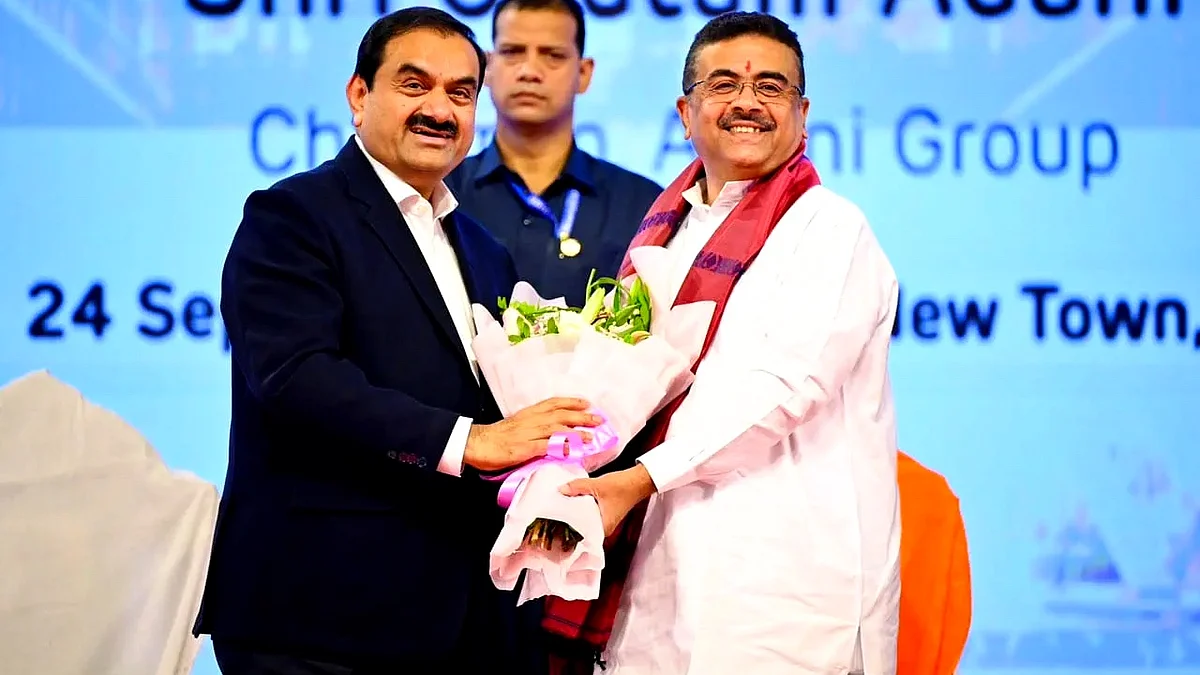


Adani subsidiary Powerpulse Trading Solutions secures a 25-year contract to supply Bengal 1,750 MW of renewable power.
CPI(M), Congress and TMC question the deal, raising concerns over transparency, corporate favouritism and consumer costs.
AESL says the contract was secured through competitive bidding and will strengthen reliable renewable energy supply.
Opposition leaders in West Bengal have attacked the state BJP government after an Adani Group subsidiary secured a 25-year contract to supply 1,750 MW of renewable electricity to the state, questioning the transparency of the deal and alleging that it favours corporate interests at the expense of consumers.
The agreement has triggered criticism from the Communist Party of India (Marxist), Congress and the Trinamool Congress (TMC), with questions raised over the terms of the contract, private participation in the state's power sector and its potential implications for consumers.
The contract has been awarded to Powerpulse Trading Solutions Limited (PTSL), a wholly-owned subsidiary of Adani Energy Solutions Limited (AESL), by the West Bengal State Electricity Distribution Company Limited (WBSEDCL).
In a press release, AESL confirmed that PTSL had received a Letter of Award (LoA) to supply 1,750 MW of renewable energy on a round-the-clock basis for 25 years. The company said it had secured the contract through an e-reverse auction, a competitive bidding process.
The agreement also includes a green shoe option for an additional 750 MW, which could take the contracted capacity to 2,500 MW if exercised. Supply of the initial 1,750 MW is scheduled to begin on 1 July 2028, while the additional capacity, if approved, is expected to come online from 1 April 2029.
AESL described the agreement as a significant development in India's energy transition. Its chief executive, Kandarp Patel, said, "Uninterrupted renewable power will be crucial for India's energy transition, as it will optimise the use of the transmission infrastructure while ensuring the sustainability of renewable energy."
He added, "This significant contract further strengthens our commitment to providing scalable energy solutions and offers an opportunity to partner with WBSEDCL in meeting West Bengal's long-term, sustainable electricity requirements."
The announcement, however, has drawn political criticism, with opposition leaders questioning the need for private participation in the state's electricity sector and raising concerns over the impact on consumers.
CPI(M) leader Md Salim launched a direct attack on the Adani Group and the BJP, alleging that corporate funding of the ruling party was being rewarded through government contracts. "BJP has been funded by corporates like Adani and others to win the elections illegally in India. This is payback time. Hence, all contracts will be bagged by these organisations in Bengal, henceforth," Salim said.
His remarks reflect the Left's concerns over what it sees as the growing influence of large corporate groups in public infrastructure and essential services.
Criticism also came from within the TMC, with senior party leader Sovandeb Chatterjee questioning the need for private players in the state's electricity supply. "When I was the state electricity minister, there was excess of electricity in the state. We used to sell 200 megawatts of electricity to Bangladesh," Chatterjee said.
He alleged that greater dependence on private suppliers could undermine public power generation and push up electricity costs for consumers. "This private entry will ensure that state machinery produce less electricity and automatically people will have to pay more for private services," he said.
Congress president Suvankar Sarkar also termed the agreement anti-people, warning that consumers in West Bengal would ultimately bear its cost. He said the issue was part of a wider pattern of government contracts being awarded to select corporate groups.
"Our leader Rahul Gandhi has been raising this issue for a long time. This move is completely anti-people, and the people of the state will have to bear the brunt. We will continue our fight against the BJP's practice of awarding government contracts to select corporate companies," Sarkar said.
The TMC, meanwhile, questioned the transparency of the agreement in a post on X, sharing AESL's press release and demanding greater accountability in long-term power contracts. 'There should be transparency regarding West Bengal's resources and long-term power agreements; the priority should not be given to large corporate entities,' the party said.
It also demanded answers over alleged favouritism, adding, 'Questions regarding bias and accountability must be answered.'
The party referred to an earlier statement by its all-India general-secretary Abhishek Banerjee, alleging that some individuals were receiving 'undue, irregular benefits' while ordinary people continued to struggle to access basic services.
'To whom is this government actually accountable, and why this favouritism? The people demand an answer!' the party asked.
AESL has maintained that the contract was secured through a competitive auction and presented it as a step towards ensuring reliable renewable energy supply. However, the political controversy over the agreement, its transparency and its implications for the state's power sector and consumers is likely to persist.
Join our official telegram channel (@nationalherald) and stay updated with the latest headlines