


Of bail pleas and how courts learn to do better
Why did one SC bench deny bail to Umar Khalid and Sharjeel Imam while another granted it to Syed Iftikhar Andrabi months later?
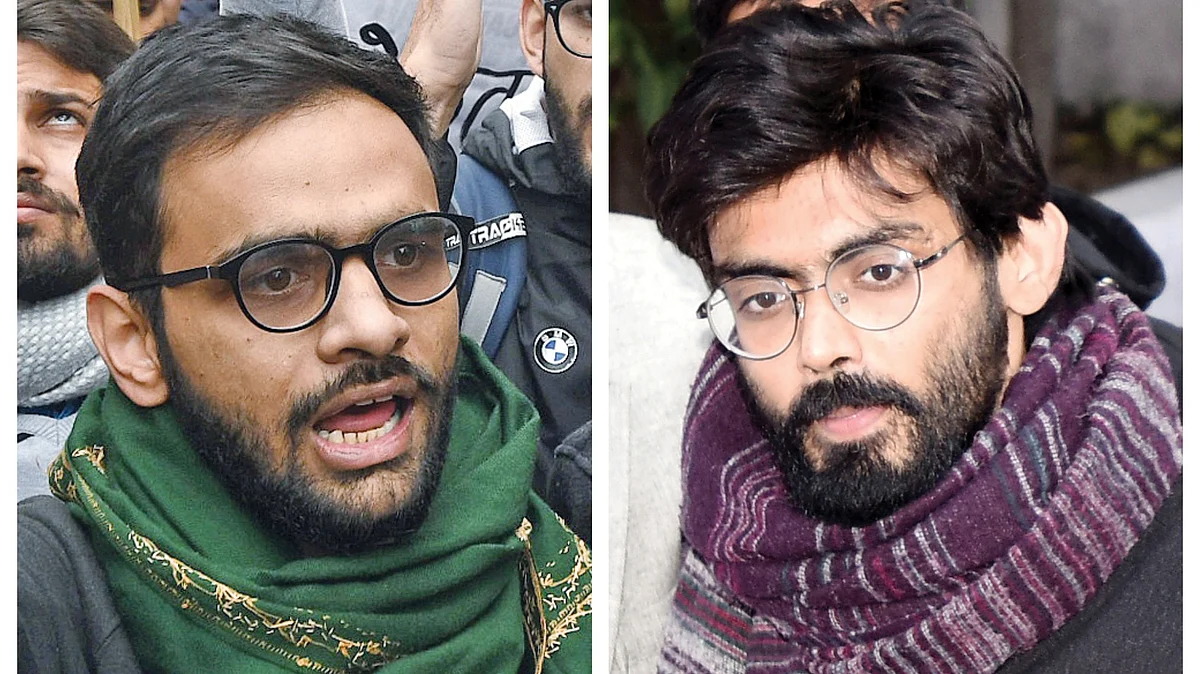


In January this year, the Supreme Court refused bail to Umar Khalid and Sharjeel Imam. In May, it granted bail to Syed Iftikhar Andrabi. Both men are charged under the Unlawful Activities (Prevention) Act. Both have spent more than five years in jail awaiting trial. The same statute applies to them. Two different benches, sitting four months apart, read it in two very different ways. The story of those four months is worth telling. It is the story of how the Supreme court, talking to itself, is slowly correcting its own drift.
The statute at the centre of all this is Section 43-D(5) of the UAPA. It tells a judge that bail must not be granted if, on the face of the police case, the court has reasonable grounds to believe the accusation is true. Read literally, it is a tall order. The judge is asked to assume that the police story is correct, and then to refuse liberty on that assumption.
For some years the law moved between two poles. In 2019, in Zahoor Ahmad Shah Watali, the court took a strict view. A High Court order that had granted bail by sifting evidence too closely was reversed. In 2021, in K.A. Najeeb, three judges took a different view. They held that where trial was nowhere in sight and a man had already served much of his possible sentence, the rigours of Section 43-D(5) would, in the court’s striking phrase, “melt down” before Article 21. The principle was sensible. Liberty is the rule. Detention without trial cannot become a sentence by stealth. A statute is subordinate to the Constitution.
Then came the slow unwinding. Two-judge benches began to read Najeeb narrowly, treating it as a rare exception. They emphasised Watali again. By the time Gurwinder Singh was decided in 2024, the court had practically differentiated Najeeb out of existence. When the Delhi Riots conspiracy case reached the Supreme Court bench in January 2026, the default embargo on bail had stiffened back into something close to its original form.
In that case, Justices Aravind Kumar and N.V. Anjaria granted bail to five accused. Gulfisha Fatima, Meeran Haider, Shifa-ur-Rehman, Saleem Khan and Shadab Ahmed walked free after more than five years in custody. But the same bench denied bail to Umar Khalid and Sharjeel Imam. It treated them as principal conspirators. It allowed them to renew their bail prayer only after the protected witnesses had been examined, or after one year, whichever came first.
For all the careful sifting, the judgment carried an unhappy assumption. It treated <Najeeb> as a narrow safety valve, not as a constitutional principle. It read Section 43-D(5) as the governing rule, with Article 21 hovering somewhere in the background.
Four months later, Justices B.V. Nagarathna and Ujjal Bhuyan saw the matter differently. The man before them was Syed Iftikhar Andrabi. He was a village-level worker in the Rural Development Department at Kupwara. He was also a political activist with the Jammu and Kashmir People’s Conference. He had been arrested in June 2020, when a vehicle stopped at the Kuhroo Bridge yielded heroin and currency notes. The NIA took over the case. He was charged under the NDPS Act and the UAPA. By May 2026, he had been in jail for five years and eleven months. The prosecution had over three hundred and fifty witnesses still to examine. The end of his trial was not in sight. The two judges granted him bail. They could have stopped there. They did not.
What followed was an unusually candid explanation of how a three-judge bench decision had been quietly hollowed out by benches of lesser strength. The judgment named the cases. Gurwinder, it said, had read Watali as if Najeeb had not happened. Gulfisha Fatima, decided four months earlier, had reduced Najeeb to a footnote.
The reasoning was direct. Najeeb was the law. It had been rendered by three judges. Smaller benches were bound to follow it. If they could not, the only honourable course was to refer the matter to a larger bench. To rewrite Najeeb while pretending to follow it was not judicial discipline; it was something else.
The judges then did something rarer still. They turned to the statistics. In December 2025, the minister of state for home affairs had placed figures before the Lok Sabha. Across India, between 2019 and 2023, nearly 10,500 persons were arrested under the UAPA while 335 were convicted. The conviction rate hovered between two and six per cent. In Jammu and Kashmir, it was below one per cent. Ninety-nine times out of a hundred, the case ended in acquittal.
The judges asked the only question that mattered. With such numbers staring at the court, was it tenable to keep a man like Andrabi in jail year after year because the charges sounded serious? They answered it by setting him free. Surrender his passport, they said. Report to the Handwara Police Station once a fortnight. Cooperate with the trial. Do not threaten witnesses.
The judgment carried a grace note at the end. The author Justice Bhuyan noted that the order was based on the invaluable inputs of his sister judge, Justice Nagarathna. In a court not famous for collegial acknowledgement, the line meant something.
What does all this leave us with? It leaves us with two propositions worth holding together. The first is that the Constitution is not a slogan. Article 21 does not float over a statute. It runs through it. Section 43-D(5) does not suspend the right to a speedy trial; it must be read in the company of Article 21.
The second is that judicial discipline cuts in only one direction. A bench of two cannot quietly walk back what a bench of three has settled. The way to disagree is to say so, and to refer the matter up. The way best avoided is to keep citing the older case and treating the newer one as an aberration.
Umar Khalid and Sharjeel Imam remain in jail. Their year is running. Their renewed prayer for bail will fall to be considered in months that lie ahead. They will be heard by a court that has thought a little more clearly, between January and May, about what it owes them. That is something. That is, in fact, how courts grow up.
Sanjay Hegde is a senior advocate in the Supreme Court of India. More of his writing here
Join our official telegram channel (@nationalherald) and stay updated with the latest headlines