


The perils of learning in the time of AI
Instructors have their hands full dissuading a new generation of learners from outsourcing their thinking
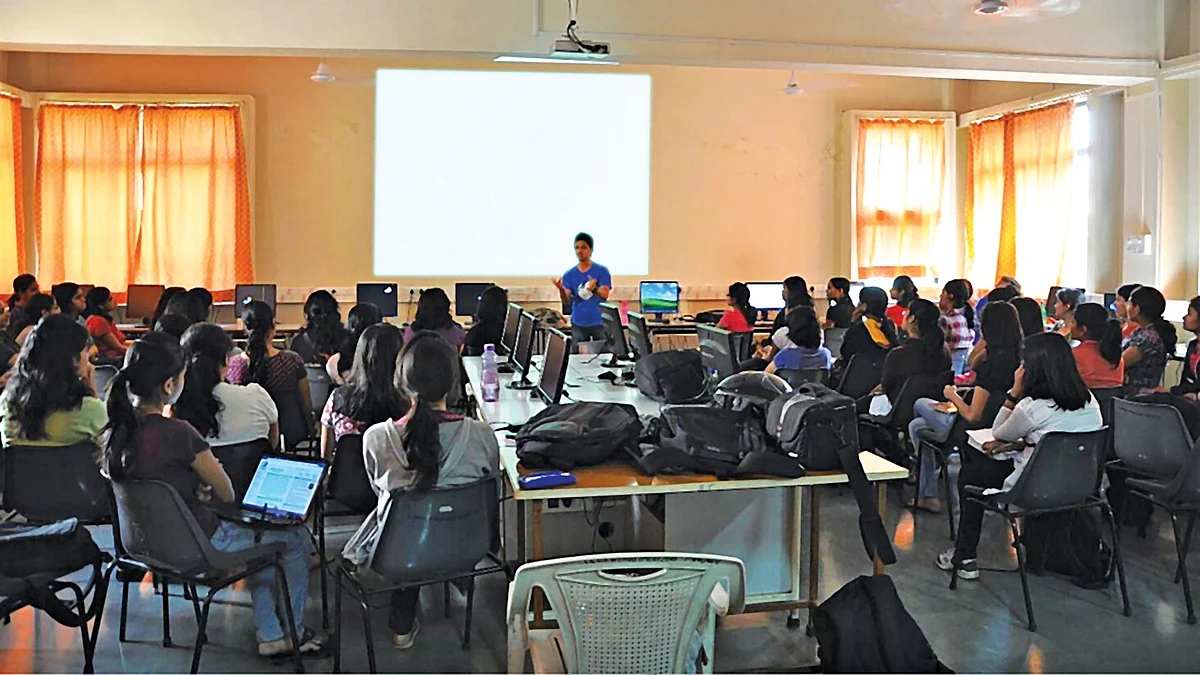


Over the last two years, we have felt the ground shift beneath our feet in higher education. AI has transformed what we do in college classrooms. The generation of students we now teach, fresh from school, first encountered AI in their formative years and (most) took to it like fish to water. Their reliance on it is exceptionally high. All elements of university life — teaching, learning, thinking — have been touched by this sea-change.
Public conversations around AI and its pitfalls usually circle around its effects on the environment and commerce rather than what it does to our minds. Concerns about its environmental degradation are often raised, for example, the hyper use of water resources as coolants at burgeoning AI data centres. We also hear fears being voiced regarding the large-scale theft of copyrighted material, indicated in recent reports about rare books being purchased, scanned and fed as training data for AI, only to be destroyed afterwards.
These public concerns also extend to the nightmarish scenarios around AI’s capacity for learning, and eventually replacing forms of manual labour, captured in widely circulating images of factory workers in the Global South being forced to wear cameras on their foreheads, effectively training AI robots to replicate their hand movements. “It feels like working in your own grave,” one of the workers remarked, reckoning with his own eventual redundancy.
And most recently, apocalyptic dread around the super-rapid development of super-intelligence, which can quickly get out of hand on a planetary scale, as has been confessed by AI’s big three — Altman, Amodei and Musk.
Also Read: Welcome to an all-new digital dystopia
At universities, though, where the development of the mind is the central focus, we have a unique problem at hand. Here, a kind of ‘cognitive colonisation’ is palpable, striking at the very heart of what we do, which is the work of reading, writing and thinking.
In the last five years or so, AI has crept into our institutions and altered how these three activities take place. Inside and outside the classrooms, we find students outsourcing this crucial work to AI tools. This is not simply a shortcut. Experts have called this a form of ‘cognitive offloading’ which implies that, in the long run, it effectively shrinks what our minds are capable of.
As teachers of literature, we know that the task of reading and thinking for yourself can be both beautiful and hairpulling. It is meant to be that way. For any student, wrestling with a literary text — the particularity of its lines and words — is part and parcel of the maturation of their thinking. In turn, and with practice, this allows them to read their surrounding worlds and its peculiarities, eventually becoming curious and critical citizens.
At the university stage, they must go through the rites of passage where they fumble with each sentence, quibble over its meaning, and struggle individually to stencil their thoughts on a page. We consider this initial struggle a necessary and joyous baptism. In the post-AI landscape though, we see this happening less and less.
Many (if not all) students opt for the easy transaction of asking Claude or Gemini: ‘tell me the point of this text’, ‘summarise this essay for me’ or simply feed the assessment prompt into the AI engine. As teachers of literature, this has, frankly, been disastrous.
As we know, AI does not, properly speaking, think. Instead, it processes patterns. It takes in the raw material of billions of words and sentences at its disposal, a vast jumble of other people’s frames of thinking, and generates what it estimates to be the most probable result.
This is often conformist, reached via a path of least resistance, and inevitably absents any possibility of genuine breakthroughs in terms of thought and expression. It leaves little to no room for an individual way of thinking, let alone the outlier-ness of eccentricity, which is the delight of a university classroom.
Such forms of thought emerge from patience, practice, poring over texts, and many enjoyable and frustrating face-to-discussions with peers and instructors, each sedimenting inside us slowly and chiselling the way we think about the world. Not by ChatGPT-ing an answer.
This means that when students rely extensively on AI, they effectively inhibit the possibility of developing their own individual voice. Voice, that distinct thing that gathers the alchemical combination of all their life experiences, readings, agreements, disagreements, evolving worldviews.
Voice is so central to our pedagogy that one of our key aims is to encourage each student to write as differently as possible from the other; each piece to carry their distinct signature. Whenever we are able to identify a student just by their writing, we know something has worked. AI has short-circuited this possibility.
AI-influenced writing demonstrates uniformity in the place of uniqueness, conformity instead of critical thinking. In such work, we see a mass of correct-sounding, reasonably cogent writing hollowed out of much of the signs of human intentionality.
This kind of writing often includes the same examples, their descriptions of events and characters use the same words, they come to the same tepid conclusions, topping it off with ornamental adjectives, as if a shadow assembly line of ideas was at work, instead of quirky, individual minds. For higher education, this confounds our guiding aim of enabling critical thought and imagination. Such cognitive colonisation implies a seismic turn of events. It marks an alarming moment both inside and outside academia.
At the universities, our job then At the universities, our job then becomes to preserve the endangered species of individual thought. Everything about the university — the way we teach, the way we assess, the way our students interact with knowledge — needs to be attended to and wrenched away from the long arm of AI.
We need to find a way to demonstrate to students how joyous and fulfilling the work of thinking on one’s own can be. How the long route, instead of the shortcut, can be deeply enabling, both for their professional lives and for them to grow into people who are fully rounded, always curious and aware of each of their capacities.
In the face of the availability of quick AI answers, this will often feel like David taking on Goliath. That’s the sort of task ahead of us.
Lavina Jhangiani and Akhil Katyal work at the BITS Law School Writing Centre
Join our official telegram channel (@nationalherald) and stay updated with the latest headlines