


Starlink in India: Security debate or policy paralysis?
Security concerns are real, but unresolved approvals and regulatory delays raise questions about India’s satellite internet policy


Ukraine’s Starshield disruption highlights the security risks of relying on foreign-controlled satellite communications.
Starlink, OneWeb and Jio remain awaiting final approvals despite holding GMPCS licences.
Unclear timelines and outstanding regulatory requirements fuel questions over whether India’s satellite internet policy has stalled.
The Ukraine war has added a new layer to the Starlink controversy in India. This week, Ukrainian officials said speed restrictions of roughly 100 mph on Starshield, SpaceX’s military-focused satellite communications service, disrupted drones and other weapons mid-mission. Ukrainian President Volodymyr Zelenskyy criticised the restrictions, while Elon Musk said Starshield is controlled by the US government and that any limits are decided by the US military and, ultimately, the president.
Either way, the point for New Delhi is the same. A foreign-controlled satellite network can be restricted or switched off by an authority other than the host country. That makes national security a legitimate concern, and the government’s caution is not baseless.
But security is not the whole story, and several other factors raise questions about how the matter has been handled.
A timing question
Starlink received its Global Mobile Personal Communications by Satellite (GMPCS) licence in June 2025, when Musk’s relationship with US President Donald Trump was in a very different place. After the two fell out, the company was reminded that it could not begin services without the requisite national security clearances. Questions over spectrum allocation and the final regulatory conditions have also held up commercial launches. Whether coincidence or not, the sequence invites scrutiny.
A personal equation that soured
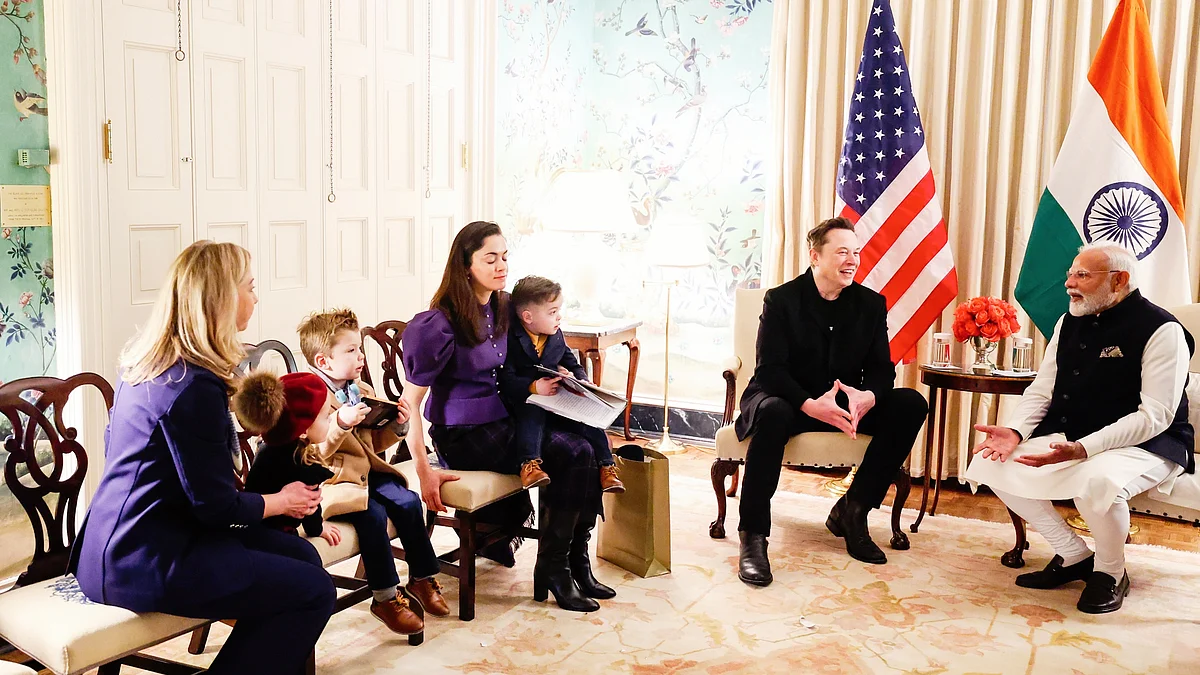
Musk once said he was a fan of Prime Minister Narendra Modi, who has repeatedly praised him as an innovator. The two met in 2015 and 2023, and again in February 2025, when Musk brought some of his children along.
After his relationship with Trump deteriorated, Musk also took aim at India’s business establishment. In a post on X, he addressed Modi as ‘Prime Minister Ambani’, mocking Reliance chairman Mukesh Ambani and accusing unnamed ‘oligarchs’ of protecting a monopoly.
The Union ministry of communications and industry experts have rejected the allegation that Starlink is being deliberately obstructed to favour a rival. Officials maintain that the company is moving through the same regulatory process as competitors Eutelsat OneWeb and Jio Satellite Communications. The companies have different application timelines and stages of compliance, making comparisons of their positions in the queue important.
Bharti Enterprises chairman Sunil Bharti Mittal said on Wednesday, 14 October that OneWeb, which applied five years ago, was well ahead of Starlink in the queue and hoped to receive the go-ahead ‘at least in a few days’. Jio, owned by Ambani, has also maintained that it has been waiting for the remaining approvals.
What it really shows. If no operator is being favoured and everyone is waiting, then the real story may not be a conspiracy but policy paralysis. Three operators — Starlink, OneWeb and Jio Satellite Communications — hold GMPCS licences, yet commercial services have not begun.
Although the Digital Communications Commission has approved a 5 per cent adjusted gross revenue-based spectrum charge for satellite operators, final approvals and the completion of security requirements remain outstanding. The framework for foreign investment is also subject to conditions that companies must meet.
A sector that could expand connectivity in remote and underserved areas remains stuck in the regulatory pipeline. The government is entitled to impose security safeguards, but it should also explain what remains unresolved, what conditions operators must satisfy and when decisions can be expected.
There is one more factor. India has repeatedly ranked among the world’s leading countries for internet shutdowns, including during protests against the government. Satellite communications can complicate such restrictions because terminals do not depend on local mobile towers or terrestrial broadband infrastructure. In Iran, Starlink terminals have been used to maintain connectivity during internet blackouts, despite restrictions on the service and efforts to prevent access.
A government that relies on internet shutdowns may therefore have an additional reason to be wary of satellite internet. That possibility does not establish that such concerns are driving the delay in India, but it raises a legitimate question about how the government balances security, control over communications and citizens’ access to the internet.
None of this means security checks should be waived. But when national security is the stated reason for delaying a service, the public deserves clarity on the timelines, the conditions and the outstanding questions. Without that, the delay will continue to look less like a carefully calibrated security policy and more like regulatory drift.
Join our official telegram channel (@nationalherald) and stay updated with the latest headlines