


Takes more than two to make a market economy
Amal Chandra on the risks India faces from its monopolistic business environment


There was a time when Indian capitalism was narrated as a story of liberalisation. The 1991 reforms dismantled the old licence/permit raj and promised a more competitive marketplace. Three decades later, a new question shadows India’s economic growth story — do a handful of big business groups command disproportionate influence over our markets, infrastructure and public policy?
It’s a no-brainer to identify the two corporate giants that control some of the most strategic sectors of the Indian economy today — ports, airports, telecom, digital services, data infrastructure, petrochemicals, power, logistics, green energy, retail, media...
Their scale, reach and speed of expansion have no parallels in India’s business history — and for many, they are our national champions who have made India globally competitive. But their rise has also raised concerns about the concentration of economic power, barriers to real competition and the role of state policy in private accumulation.
Crony capitalism is not merely about corruption in the narrow legal sense. It describes a political economy where access to power becomes a decisive business advantage, where regulation, licensing, state financing and public assets disproportionately favour those closest to the governing establishment.
The concern is not that successful businesses become large; scale is often a natural consequence of efficiency. The concern arises when scale becomes self-reinforcing through privileged access to capital, policy and state resources, making markets less competitive.
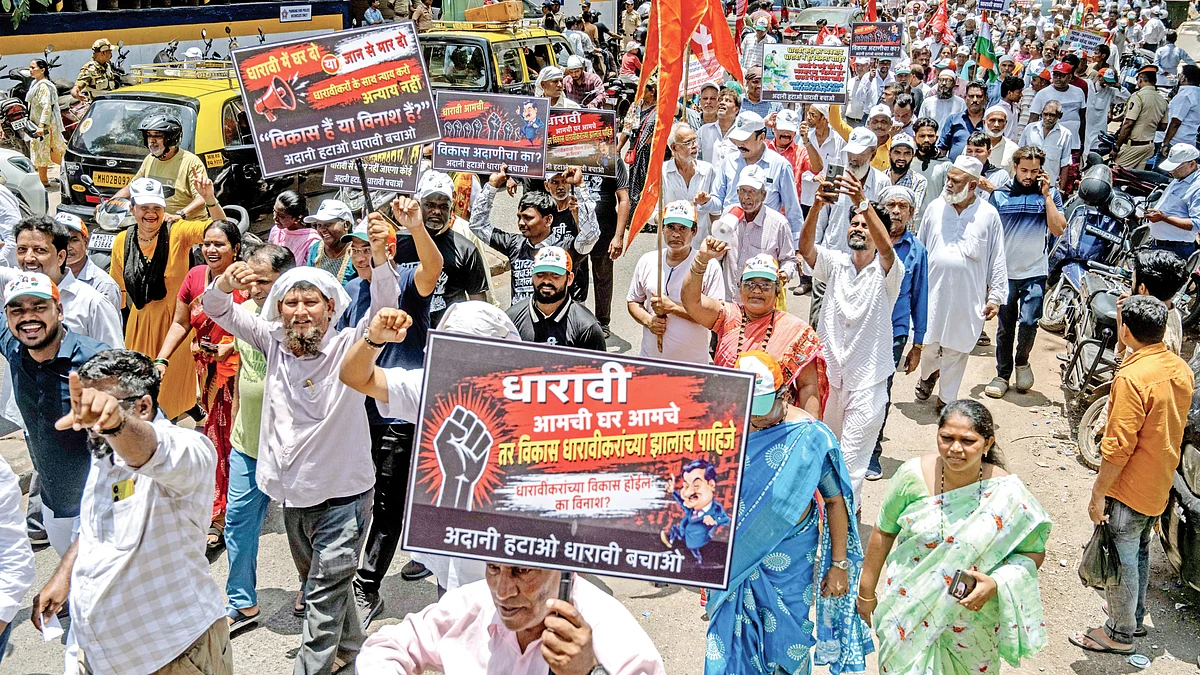
The rise of Gautam Adani has become emblematic of this anxiety. The Adani Group’s expansion from ports into airports, power transmission, data centres, renewable energy, media, cement and defence has been strikingly rapid.
From handling roughly a quarter of India’s cargo through Adani Ports & SEZ Ltd, it became India’s largest private airport operator. It owns/controls key international airports in Ahmedabad, Lucknow, Mangaluru, Jaipur, Guwahati, Thiruvananthapuram and Mumbai.
In Mumbai, India’s financial capital, it owns both Chhatrapati Shivaji Maharaj International Airport and the under-development Navi Mumbai International Airport.
Also Read: Move over FCI, Adani is here
It has a major presence in power and renewables through Adani Energy Solutions and Adani Green Energy, has forayed into cement manufacture by acquiring ACC and Ambuja Cements, and expanded into media via NDTV — creating an extraordinary strategic footprint across trade, energy, infrastructure and information.
The strategic nature of assets acquired is as noteworthy as the speed of this growth. Airports are not simply commercial properties but gateways of national infrastructure. Ports shape trade flows. Power transmission influences energy distribution. Media ownership shapes public discourse. The concentration of such assets in a single group naturally raises questions about overwhelming influence in policymaking.
In the wake of the 2023 Hindenburg exposé about ‘brazen stock market manipulation and accounting fraud’ by the Adani Group — which wiped out over $100 billion in market value at one stage — other damning details came to light, such as the substantial exposure of public sector institutions like LIC and State Bank of India to Adani-linked assets. Critics warned that such exposure had scary implications for financial stability and for crores of Indians whose savings are managed by these institutions. But those warnings fell on deaf ears.
Reliance Industries, the Mukesh Ambani group flagship, represents another form of concentration. Unlike Adani’s expansion led by infrastructure, Reliance built dominance through petrochemicals before moving into telecom, retail, digital commerce, media and platform infrastructure. The launch of Jio Platforms fundamentally reshaped India’s telecom market. Consumers benefited enormously from cheap data, accelerating India’s digital transformation, but the telecom sector shrank to a few big players, effectively weakening competition.
Reliance’s retail and digital ambitions similarly reveal how great scale can also create unfair advantage. In network industries, size is power. The more users a platform acquires, the harder it becomes for competitors to challenge it. It creates a feedback loop of market dominance that conventional antitrust/anti-monopoly frameworks often struggle to address.
The issue, then, is not simply whether Adani and Ambani run efficient businesses. Both have executed large projects on an extraordinary scale, but the question here is whether India’s institutional architecture nurtures competition.
Also Read: The freedom to think critically
Indian economists and public intellectuals have long warned against the dangers of excessive concentration of economic power. As former RBI governor Raghuram Rajan cautioned: “Crony capitalism is about the misuse of public office for private gain,” a warning perhaps especially relevant in emerging economies.
The monetisation of public assets further complicates the picture. As the government accelerates privatisation and infrastructure leasing, large conglomerates with deep pockets enjoy an enormous advantage. Smaller firms simply cannot bid at comparable scale. This creates a structural bias towards concentration, with strategic assets gravitating towards a few dominant players.
Large conglomerates often secure financing at more favourable terms because lenders perceive them as systemically important or politically insulated. This lowers their cost of capital relative to smaller competitors. Over time, cheap capital becomes a competitive moat. When public banks and insurers are involved, the stakes become even higher because losses, if they occur, are socialised.
This dynamic is not unique to India. The United States confronted similar concerns during the Gilded Age of the 1870s to the 1890s, an era of rapid economic growth and industrialisation marked by flashy materialism, great wealth inequality and political corruption. It was in this period that industrial titans like John D. Rockefeller and Andrew Carnegie amassed extraordinary wealth and market power. The policy response was antitrust law, a.k.a. as anti-monopoly law. The lesson was clear: capitalism requires competition and competition requires guardrails.
India today faces its own version of the same economic conundrum.
Defenders of the current model argue that India needs large conglomerates to rapidly build capital-intensive infrastructure, much like scale and state coordination helped accelerate China’s industrial rise.
Yet scale without competition also suppresses innovation and creates systemic fragility, where the failure of a single giant player becomes a national risk. The issue goes beyond the current stranglehold of the Adanis and Ambanis; a larger concern is whether India’s institutions can preserve transparency, competition and regulatory independence as this concentration deepens.
Amal Chandra is an author, policy analyst and columnist. Find him on X @ens_socialis
More by the author here
Join our official telegram channel (@nationalherald) and stay updated with the latest headlines