


A lifetime of living as political pariahs
For Sri Lankan Tamil refugees in India, the Citizenship Amendment Act has only sharpened the edge of exclusion
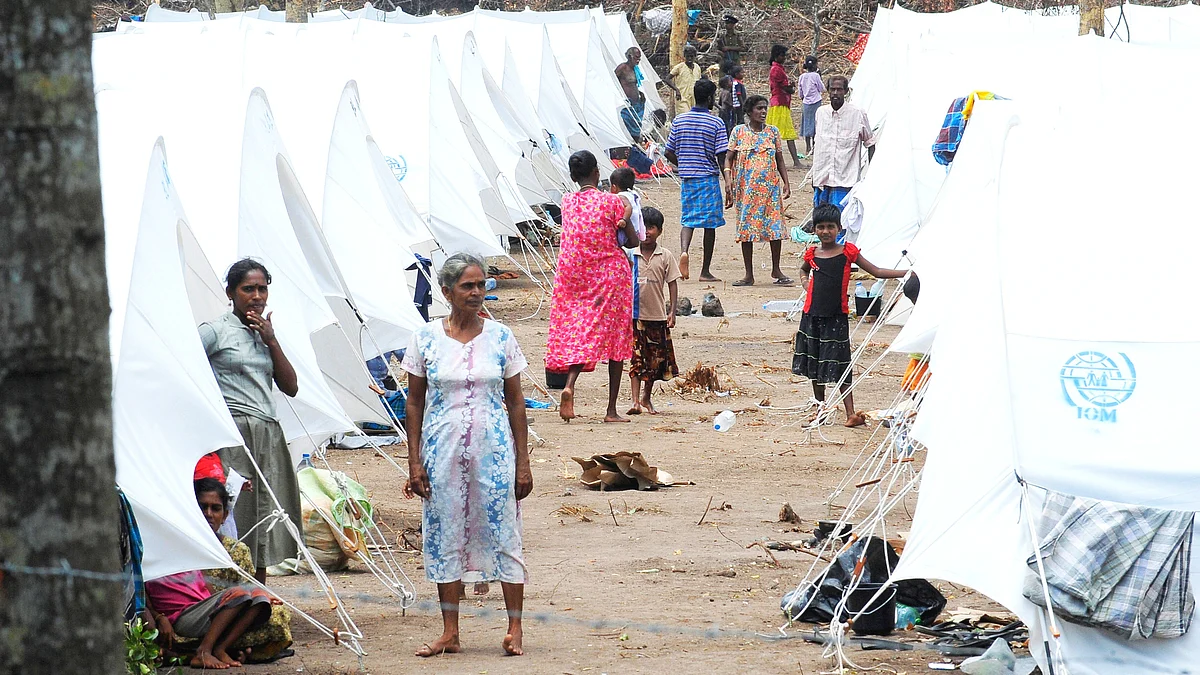


When Tamil Nadu votes for a new Assembly on 23 April, the ritual of democracy will unfold with familiar precision. Polling booths will open at dawn, voters will queue up in the heat, fingers marked with indelible ink will affirm participation in the Republic.
But across more than a hundred refugee camps scattered through the state, nearly 60,000 Sri Lankan Tamil refugees will watch from the margins. Many arrived as children fleeing war. Their children were born in India, raised in its schools, shaped by its politics and anchored in its society. Yet none of them will vote. Four decades after crossing the Palk Strait in search of safety, they remain outside the democratic compact of the country they call home.
This exclusion is not new, but in the years since the Citizenship Amendment Act was passed, it has acquired a sharper edge and become more visible than ever before.
The story begins with a week of violence in 1983, a ‘Black July’ that altered the course of Sri Lanka’s history. Anti-Tamil riots erupted across the island following the killing of 13 soldiers by Tamil militants. Mobs attacked Tamil neighbourhoods, burned homes and businesses. Hundreds were killed and thousands displaced.
The violence deepened into a civil war that would last more than two decades. For civilians caught between the State and militant groups, escape became the only option. Many crossed the narrow stretch of sea to Tamil Nadu in fishing boats and makeshift vessels. The arrivals came in waves through the 1980s and 1990s. At its peak, more than 200,000 Sri Lankan Tamil refugees were living in India. Camps were set up as temporary shelters — they would go back when it was safe to return. That moment never came.
While tens of thousands live in towns and villages, more than 58,000 refugees continue to live in government-run camps in Ramanathapuram, Tiruchirappalli, Madurai, Salem and Coimbatore….
Also Read: How Tamil Nadu fell into the freebie trap
Rows of modest houses line narrow lanes. Schools, small shops and tea stalls sustain everyday life. Families receive modest assistance from the state in the form of a monthly allowance, subsidised housing and access to education and healthcare. Over time, many refugees have entered the local workforce as daily wage labourers, while others run small businesses or pursue skilled occupations. Socially and economically, they are part of Tamil Nadu. Legally, they are not.
“We came here when I was eight years old,” says S. Tharmalingam from Mandapam camp in Ramanathapuram district. “At that time, we thought we would return in a few years. Now I am over forty. My children were born here, but we still live as refugees.”
Under the law, only citizens can vote. Refugees, lacking citizenship, cannot be included in the electoral rolls. This exclusion is painfully evident during elections. Campaign vehicles move through nearby towns, television debates dominate public discourse, and political parties make promises. Camp residents follow these developments closely. But on polling day, they remain at home.
“We watch the news and discuss politics like everyone else,” says Jeyarani Selvaraj from Kottapattu camp near Tiruchirappalli. “But when election day comes, we cannot vote.”
Jeyarani was born in the camp in the early 1990s after her parents fled the war. “I have never seen Sri Lanka. My whole life is here in Tamil Nadu. But when people ask about citizenship, we do not know what to say.”
India does not have a dedicated refugee law. Sri Lankan Tamil refugees are governed through administrative arrangements rather than a clear legal framework. They are allowed to stay, without belonging fully. They receive welfare support, but their rights are limited. Their movement, employment opportunities and access to property are constrained. Citizenship by birth applies only to those born before 1 July 1987.
Also Read: “It’s strange to apply to be alive”
Naturalisation requires documentation and administrative approval that many refugees struggle to obtain. Applications often remain pending for years. Time passes, but their legal status remains unchanged.
The Citizenship Amendment Act of 2019 introduced a fast-track route to citizenship for non-Muslim minorities from Pakistan, Bangladesh and Afghanistan. It was presented as a humanitarian measure for persecuted communities. Sri Lankan Tamil refugees were not included.
The CAA is based on a specific idea of persecution, one that is defined through religion and limited to Muslim-majority countries. Sri Lanka does not fit this framework. The persecution of Tamils, rooted in ethnicity and language, falls outside its scope. The consequence is a new line of exclusion.
A refugee who entered India from Bangladesh may now access a defined pathway to citizenship within a shorter period. A Sri Lankan Tamil who has lived in India for forty years must still navigate uncertainty and inaccessibility. The contrast has sharpened the sense of exclusion and unfairness. Why does one kind of refugee qualify for recognition while another does not? Why does duration of residence not translate into belonging?
Legal scholar B.S. Chimni has argued that India’s refugee policy operates through selective recognition rather than universal principles. The State treats different groups differently. This results in what he describes as a hierarchy of refuge, where some displaced populations are prioritised over others. Sri Lankan Tamils are low in this hierarchy. By formalising selective inclusion, the CAA has made this hierarchy more obvious.
Scholar V. Suryanarayan, who has studied Sri Lankan Tamil refugees for decades, sees a shift in the State’s approach. “What began as a humanitarian response has become a system of management,” he says. “The camps have become long-term administrative spaces.”
He points out that the State has not moved from relief to integration, even after decades of settlement. Many refugees are economically active and socially integrated yet remain outside the political community. Granting citizenship, he argues, would resolve this contradiction.
The issue has returned to the political arena. Chief minister M.K. Stalin recently wrote to the prime minister urging the Union government to grant citizenship to Sri Lankan Tamil refugees who have lived in Tamil Nadu for decades.
“Forty years is not a temporary stay, it’s a lifetime,” says Salem Dharanidharan, the DMK’s national spokesperson. “These families fled war and built their lives here. Their children and grandchildren have grown up here. Yet they continue to live as refugees without political rights. Every policy decision affects them, but they have no voting rights. Democracy should not leave people in permanent uncertainty.”
The first generation of refugees can still recall villages left behind and lives disrupted by war. For the younger generation, Sri Lanka is distant. Having grown up in Tamil Nadu and studied in its institutions, they imagine their futures here. The civil war ended in 2009, but for many, return is neither practical nor desirable. Their lives are rooted in India. Their legal identity is not.
The CAA was presented as a solution to the problem of statelessness for certain refugee groups. For Sri Lankan Tamil refugees, the law does not change their status, it just changes how that status is understood, by creating a palpable divide between those who can become citizens and those who must continue to wait.
Join our official telegram channel (@nationalherald) and stay updated with the latest headlines