


The subterfuge of women’s reservation
Behind the veil of ‘Nari Vandan’ lay a bid to reshape Parliament in a way that makes the next election easier for the BJP, writes Yogendra Yadav
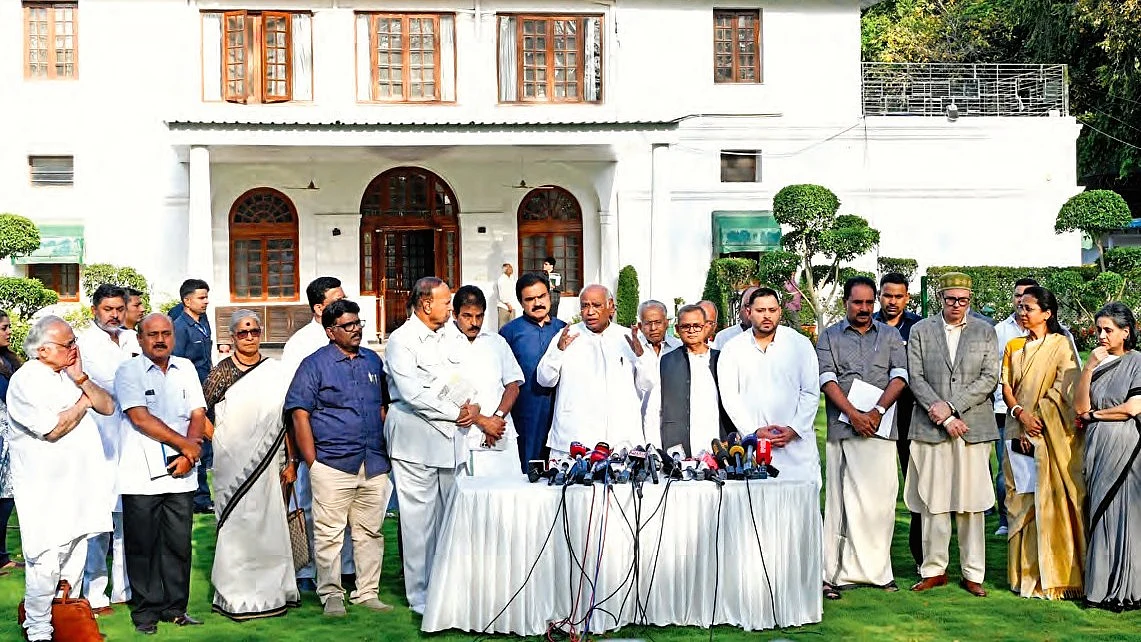


The suspense has finally been laid to rest. The ‘revolutionary’ step we were primed to expect, ostensibly to empower India’s women, was suddenly so urgent that a special session of Parliament was convened bang in the middle of elections in four states.
It had all the signs of a subterfuge and behind the veil of ‘Nari Vandan’ lay a bid to reshape Parliament in a way that makes the next election easier for the BJP. The text of the Constitution 131st Amendment Bill finally surfaced barely 36 hours before the special session (16–18 April) got under way. Wonder why this pathbreaking move was kept under wraps for so long, from the public and more importantly the women it sought to empower.
The amendment required a two-thirds majority in Parliament, which the government did not have. The Bill wouldn’t pass without Opposition support. Prime Minister Narendra Modi himself appealed to Opposition parties to back it. But why weren’t they given the text earlier, so that they had enough time to carefully assess its merit? Why was there no all-party meeting to build consensus, despite repeated demands? And what was the tearing hurry that required a special session in the midst of election campaigns in Bengal and Tamil Nadu, barely a week before polling?
The fog began to lift when the text was finally out. As suspected, the amendment was less about increasing women’s representation and more about restructuring Parliament.
On women’s reservation, the change was modest: it amended Article 334A to remove the need to wait for fresh Census data before reserving seats. This meant that reservation for women could, in theory, be implemented by the 2029 Lok Sabha elections.
Also Read: It’s not really about reservation for women…
But we shouldn’t forget who introduced the condition that tied women’s reservation to a new Census and delimitation exercise. It was the Modi government, when it brought in the one-third reservation amendment in 2023.
That condition effectively pushed implementation by a decade. At the time, Congress president Mallikarjun Kharge had demanded that the clause be scrapped and reservation implemented from the 2024 election. The Modi government had rejected the demand — and now, three years later, was trying to take credit for a historic breakthrough.
In any case, the real focus of the amendment was the proposed restructuring of the Lok Sabha and state Assemblies. At first glance, increasing the maximum strength of the Lok Sabha from 547 now (with 543 elected members) to 815 may seem reasonable. After all, constituencies have ballooned in size, and more seats could mean better representation.
But that’s not the crux of the matter.
The most consequential — and potentially dangerous — change is the removal of the decades-old freeze on the redistribution of seats among states. For nearly 50 years, under Article 82, seats have been allocated based on the 1971 Census, with the freeze intended to preserve a delicate federal balance. This freeze is set to expire in 2026.
For months, the prime minister and senior BJP leaders tried to reassure non-Hindi-speaking states that the proportional share of each state would remain unchanged when the total number of seats increased. So, if the Lok Sabha expanded by 50 per cent, the seat share of Uttar Pradesh would rise from 80 to around 140 and Kerala’s from 20 to 30. But the amendment Bill made no such promise.
Instead, it proposed changes to Articles 55, 81, 82, 170 and 332, removing the 1971 benchmark — without any provision to preserve the current proportions. If the amendment went through, Article 82 would require seats to be allocated strictly according to population.
Run the numbers. If delimitation is carried out using the 2011 Census and the Lok Sabha expands by 50 per cent, Kerala’s seats will inch up from 20 to 23, while Uttar Pradesh’s will surge from 80 to 132. In relative terms, states like Kerala, Tamil Nadu, Andhra Pradesh, Karnataka, Telangana, Odisha, West Bengal and Punjab will lose out, while Hindi-speaking states will gain significantly.
This will obviously unsettle the fragile federal equilibrium between Hindi and non-Hindi regions. The warning issued by Tamil Nadu chief minister M.K. Stalin is not to be taken lightly. Ignoring it could come at a serious cost to national unity.
There is more. If this amendment passed, the allocation of seats among states would no longer be fixed in the Constitution — it would be determined by ordinary legislation. Which means future governments could alter the basis of allocation — deciding which Census to use—without needing a constitutional amendment, and therefore without requiring Opposition consent. The power would effectively shift to the Delimitation Commission.
Alongside this amendment, the govern-ment also introduced a delimitation bill that proposes using the 2011 Census as the basis. But with a simple majority in Parliament, it could later switch to, say, the 2027 Census — whenever it suits its political calculus.
The BJP knew full well that such a sweeping, divisive amendment was not likely to get a two-thirds majority. Which brings up another question: if passage was improbable, what is the game?
Views are personal. More of Yogendra Yadav’s writing can be read here
Join our official telegram channel (@nationalherald) and stay updated with the latest headlines