


What a 15 per cent rainfall deficit foretells
Half of India has had a bad monsoon, and while the national deficit figure may look manageable, it disguises large-scale distress
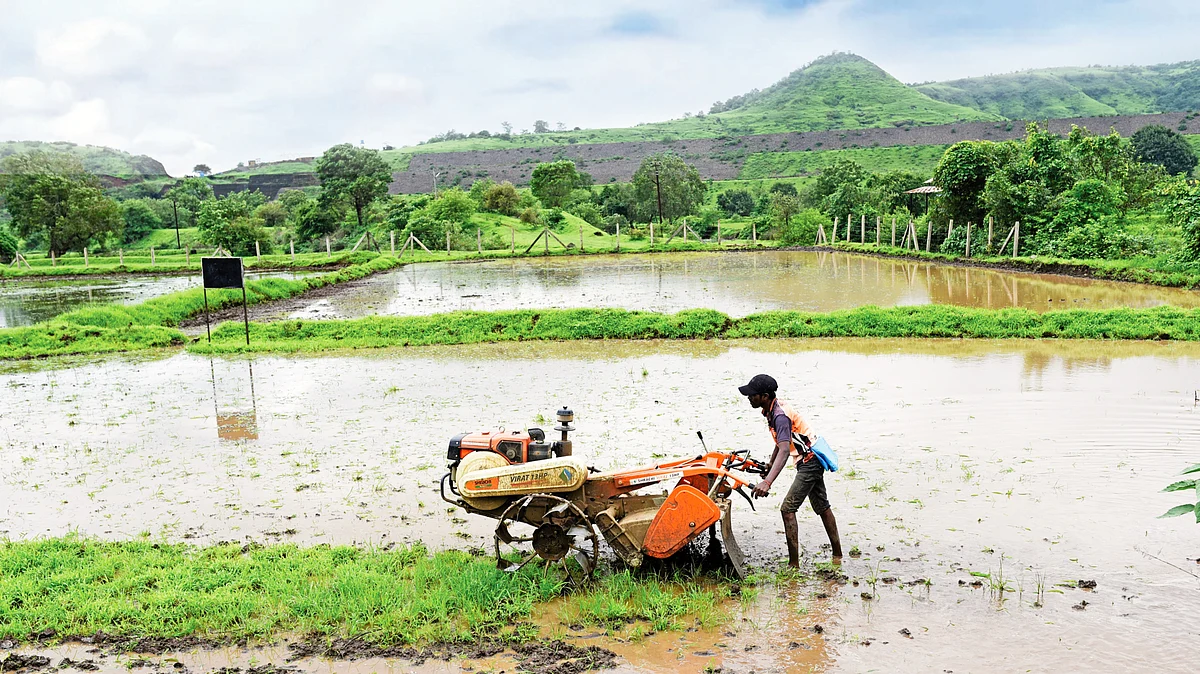


In 2025, it was a problem of too much rain. Rain and flood fury in southeast and central Maharashtra ravaged thousands of hectares of crops, flattened homes, washed away livestock and devastated thousands of households. A year on, the same villages in the same region are a study in contrast.
Take Dharashiv in the state’s Marathwada region. Normal rainfall in June and July was followed by 27.9 per cent (of normal) rain in August and only 3.7 per cent till 20 September. Just when soya bean, a major crop in the district, was flowering and forming pods, there was practically no rain. Overall, this season, the district has received just 310.7 mm against a long-period average expected rainfall of 603.1 mm (a deficit of nearly 50 per cent) and there has been no rain in the district for 80 days.
The consequences are devastating: the groundwater level has dropped by over seven metres, and is below the five-year average. Revenue officials estimate crop losses of 80–85 per cent. Distraught farmers are cutting up their dried soya bean plants to feed cattle.
Dharashiv is not an isolated story.
India’s southwest monsoon is receding, and the expected national rainfall deficit is 15 per cent. That bit of data does not reveal the full extent of the problem, though.
The IMD’s (India Meteorological Department) district-wise data for 1 June to 30 September shows that 342 of 734 districts for which data is available received ‘deficient’ (-20 to -59 per cent) or ‘large deficient’ (-60 to -99 per cent) rainfall. Of these, 303 districts are listed as ‘deficient’ and 39 as ‘large deficient’. Only 305 districts are listed under ‘normal’ (-19 to +19 per cent) rainfall.
In other words, half of India has had a bad monsoon, and while the national deficit figure (of 15 per cent) may look manageable, it disguises the distress of large swathes of rain-deficit India.
Also Read: What if the monsoon fails the farmer again
As per the latest signals, the southern peninsula is looking at an average deficit of 29 per cent, with Andhra Pradesh the worst affected in this region (-43 per cent); eastern and northeastern India will see an average deficit of 25 per cent, with Bihar (-36 per cent) looking the worst hit in the east and Meghalaya (-59 per cent) in the northeast. Punjab, which also witnessed heavy rains and flash floods last year, is likely to see a 40 per cent rain deficit.
The overall rainfall deficit in Maharashtra is about 17 per cent, according to the IMD’s district-wise dataset. Yet 20 of its 36 districts are listed as ‘large deficient’. The eight districts of Marathwada have recorded 30-50 per cent below normal rainfall.
This is a region with low annual average rainfall of about 550 mm. Western Vidarbha’s cotton basket has also been deficient—30-40 per cent below normal; August deficits (50-85 per cent) were especially bad. So, while the national average and, in cases like Maharashtra, even the state-level average deficiency may look manageable, it is anything but, when you drill down to the district level.
The rain deficit has a cascading impact on the farm economy and rural incomes. The monsoon deficit affects winter sowing as well.
The first economic consequence of a failed monsoon is the cash crunch. For rainfed crops, a rainfall deficit means a drop in yields, higher expenditure on protective irrigation and inputs, lower farm-gate income and hardship servicing the crop loan taken at the beginning of the season. Across India, farmers will experience a cash crunch.
Then comes the credit crunch. A farmer who borrowed at the beginning of the kharif season must repay the crop loan irrespective of whether the monsoon failed or was deficient. If the crop fails, the household will struggle to repay the loan and consequently to finance the next crop. The problem then moves beyond the farm household. If crops fail or yields fall, farm labour demand falls too.
Also Read: Jumping through hoops for debt relief
The pattern is similar nationally, though some crops are worse affected. The soya bean and cotton belts of Maharashtra, Telangana and Karnataka are under stress. Likewise pulses, across Maharashtra, Karnataka, Telangana, Andhra Pradesh, Rajasthan and Madhya Pradesh. Paddy is under pressure in several southern and eastern states.
Rice provides the clearest national warning. Reuters has reported that India’s 2026 rice production could fall by about 10 million tonnes, the largest decline in nearly two decades.
Food inflation was already 5.95 per cent in August. A weak monsoon and lower production may pressure food prices.
As of 17 September, water storage in 178 key reservoirs monitored by the Central Water Commission stood at 131.17 billion cubic metres, which is 21 per cent below the level at the same time last year and almost 9 per cent below the 10-year average.
A separate drought assessment by IIT Gandhinagar’s India Drought Monitor that combines rainfall data with other hydro-climatic indicators found that 53.2 per cent of India’s land mass was under some degree of drought — 33.4 per cent in moderate drought or worse, 15.4 per cent in severe drought or worse and 3.8 per cent in extreme drought.
****
There is another clock ticking rather ominously.
On 16 September, a collective of 188 ecologists and conservation scientists across India put out an urgent statement for colleagues, funders and government agencies to prepare for what they call a ‘Super El Niño’ in 2026-27. They warn of hotter and drier conditions across India, of marine heatwaves and changes in forest/grasslands/freshwater/coastal ecosystems.
Pacific sea-surface temperatures, the scientists say, reached 2.6°C above normal in August, and they project anomalies of up to 4°C, exceeding levels reconstructed from coral records over the previous 1,000 years.
To be clear, these are the scientists’ projections, and ‘Super El Niño’ is not an operational classification the IMD uses. But the warning is important for another reason: they expect the main effects to be felt from November 2026 onwards into 2027, well after the monsoons retreat next year. The Indian Ocean Dipole a.k.a. as ‘Indian Niño’ could amplify or dampen the effects of the El Niño, say the scientists, and the intensity will vary geographically.
Seasonally dry ecosystems such as grasslands, savannahs and dry deciduous forests could experience reduced biomass and tree survival due to fires and drought, their note reads. Reduced precipitation at higher altitudes could mean less grass for wild and domestic grazing. Urban heat could worsen the effects on trees and other vegetation.
The ecologists are appealing for a joint effort to establish the baseline before the crisis fully unfolds. India’s current drought maps indicate where rain-deficit stress has accumulated, but not what that stress will mean for crop yields, livestock, forests, labour, water availability and rural livelihoods six months down the line.
Crop-loss assessments by the Centre and state governments will start coming in from 5 October, but the relief will come much later, if at all.
Jaideep Hardikar is a senior Nagpur-based journalist and author of Ramrao: The Story of India’s Farm Crisis. More by him here