


What’s a valid passport to Indian citizenship?
A.J. Philip writes an open letter to the Union EAM after an official in his ministry said the passport was no more than a travel document


Dear Dr S. Jaishankar,
I obtained my first passport in 1979, soon after the Passport Office in Bhopal was inaugurated by one of your predecessors, Atal Bihari Vajpayee. It was my assignment to report the inauguration for The Hitavada, whose office happened to be in the same building.
Though it was an official function, Vajpayee delivered a remarkably humorous speech. I do not know whether my report fully captured the flavour of the occasion.
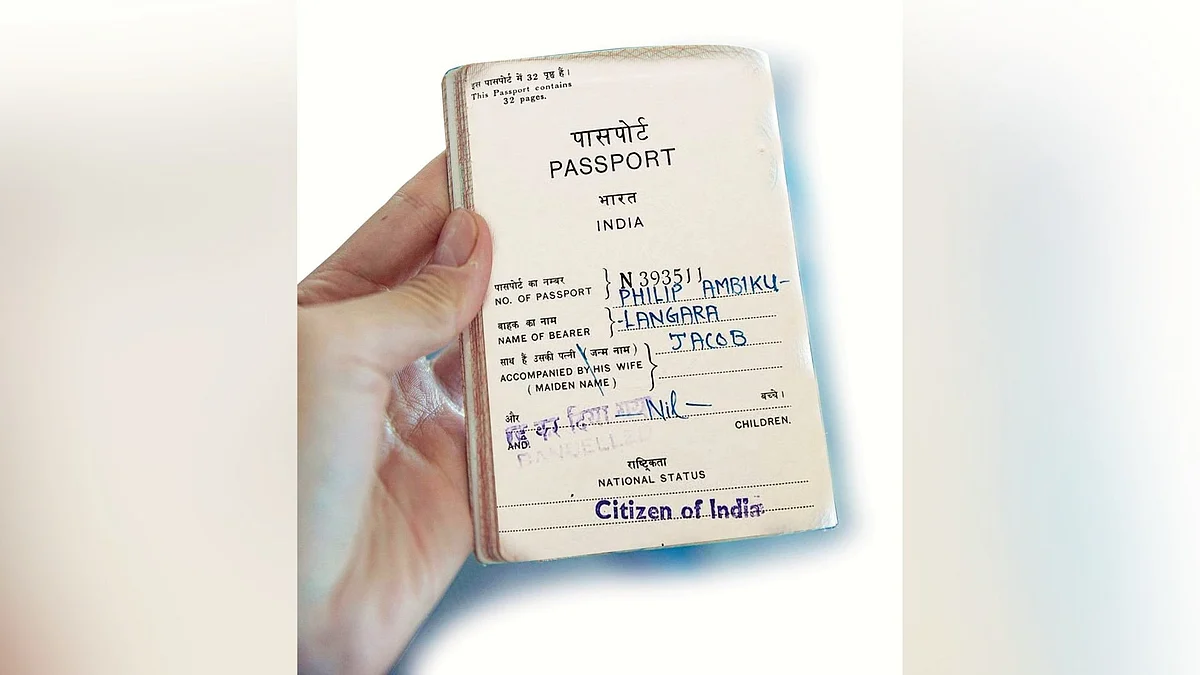
Soon afterwards, I obtained my passport. All the entries were handwritten. On the front page was a prominent stamp bearing the words ‘National Status’. Beneath it, in much larger letters, appeared the words: ‘Citizen of India’.
I was delighted, believing I’d obtained the most authoritative document certifying my status as an Indian citizen, entitled to all the rights and privileges that citizenship entails.
I still possess all my old passports and each one records my nationality simply as ‘Indian’.
So I was deeply shocked when a spokesperson of your ministry recently said that a passport is no proof of citizenship, that it is just a document intended to facilitate international travel. This clarification was issued on Passport Seva Divas — a day whose existence, I confess, I hadn’t known until then.
Two years ago, I visited Sri Lanka, where Indian citizens are entitled to obtain a visa on arrival. If your ministry now maintains that a passport is no proof of nationality, how is an Indian traveller supposed to establish his nationality in this situation?
Your predecessor as foreign secretary, Nirupama Rao, wrote a piece trying to clear the confusion. Rao, who now dabbles in singing and writing poetry, argued that no immigration officer anywhere in the world will question the authenticity of an Indian’s nationality as stated in his passport. She may have been a distinguished ambassador, but that does not mean she can predict how every emigration officer’s mind works.
Also Read: Prove again that you belong
I was once stopped by an immigration officer in Los Angeles. I had an invitation from Star TV. He asked me whether I’d report from America. I said yes. In that case, I should’ve had a work visa, he said. I was finally allowed to proceed after about 45 minutes, and only after I told a senior officer that I’d been invited to interview stars from shows like Baywatch, The X-Files and The Simpsons, and that I’d return in a fortnight as soon as the work was done.
During those 45 minutes, I even visualised catching a return flight from LA. Like the Bangladeshi official whom your government detained for about two hours at Delhi airport. I’m not a handsome person like you. If an immigration officer in, say, North Macedonia or São Tomé and Príncipe doesn’t like my face and doesn’t want me to enter his country, he could ask: “What’s your nationality?”
When I say I’m Indian and show my passport, and if perchance he asks ChatGPT and learns what your ministry said on Passport Divas, what then? What can I do in such a situation, except return without the tamarind toffee my grandson Nehemiah loves so much?
Let me ask you this: what proof would you show in a foreign country if asked about your identity? You are a minister and hold a diplomatic passport. Is your passport weightier than my ordinary passport when it comes to proving nationality?
In many countries, citizens are issued identity cards with a unique number. They only need to quote that number to prove their citizenship.
You’ll remember the fanfare with which the Manmohan Singh government had introduced Aadhaar. It was to be a single document that served all purposes of identity within the country. Since it involved collecting biometric data, I was initially opposed to it. The Supreme Court too had reservations.
Today, when almost everyone has an Aadhaar number, the government says it is nothing more than a proof of address. You can use it to enter an airport or book a train ticket, but it is not proof of nationality. Likewise a PAN card merely proves you are an income-tax payer; it doesn’t establish your nationality. I thought the voter ID served that purpose, until the Election Commission of India came up with its own rules.
In West Bengal, Bihar and Assam, even those who had these IDs and had voted in the 2024 Lok Sabha elections were still disenfranchised if they belonged to certain identifiable communities. The Election Commission had the temerity to ask Prof. Amartya Sen, a Nobel laureate, to prove his eligibility to vote in the recent assembly elections.
I don’t know how I will prove my nationality. One proof I have is an old Bible in which my mother recorded the date and time of birth of all her five children. Fortunately, my father was in the Army, and I have his discharge certificate signed by a British officer. But neither a Bible nor a British signature is acceptable to you.
This is not my problem alone. Prabhu Chawla, a senior journalist known for his right-leaning views, writes: ‘So, am I an Indian citizen? I wield an Aadhaar etched with biometrics, a voter ID baptised in ballots, a PAN card chained to every tax I’ve ever paid. Yet, because I was born beyond today’s borders, in a place now [known] as Pakistan, and because my parents’ papers have perished with time, the courts declare I am no one—nameless, nationless, until I summon proof from the shadows.’
You are a diplomat and a minister. You are expected to find solutions, not create problems. Can’t you clarify that passports will be considered proof of nationality unless proven to be fake or fraudulently obtained?
No document is valid if it’s obtained fraudulently. Then why devalue the passport? It is your responsibility to ensure that Indian passports are issued to only genuine Indian citizens; you cannot shy away from this responsibility.
I have reason to believe that your statement about passports and nationality is deliberate. Not many people would have noticed one surreptitious change the Modi government has introduced in passports.
Earlier, a passport showed both the permanent address and the present address of the holder, as well as the full address of the father/guardian and details of previous passports. Now these details are omitted. The official argument is that such information is already with the immigration authorities and that addresses may change during the validity of a passport. But this is a cover-up. The real intent was to strip the passport of its status as proof of identity.
I recall another scheme your ministry tried to impose: issuing orange passports to people requiring Emigration Clearance Certificates for travel abroad. Today I checked my first passport. When renewed in Patna in 1984, the Superintendent had stamped ‘emigration check required’ — even though I was a postgraduate and exempt from such checks. Since I could not use the passport, I did not have to get any emigration clearance.
To justify the orange passport for the poor, you made the farcical argument that it would raise their aspirations—that those with orange passports would strive to get blue ones by studying and earning degrees. We would have been the only country in the world to issue passports in two different colours to its citizens — not counting the maroon diplomatic passports.
Let me conclude with a humble request. Please issue a clarification that a passport will ordinarily be accepted as proof of Indian citizenship. Exceptions are exceptions and can be dealt with separately. I hope you’ll do the needful.
Yours etc.
A.J. Philip
This is an abridged version of the open letter that originally appeared in Indian Currents
Join our official telegram channel (@nationalherald) and stay updated with the latest headlines