


'Why don’t you shut it down?'
Now protests at Jantar Mantar are also a problem. Aakar Patel on why we must assert and reassert our right to peaceful assembly
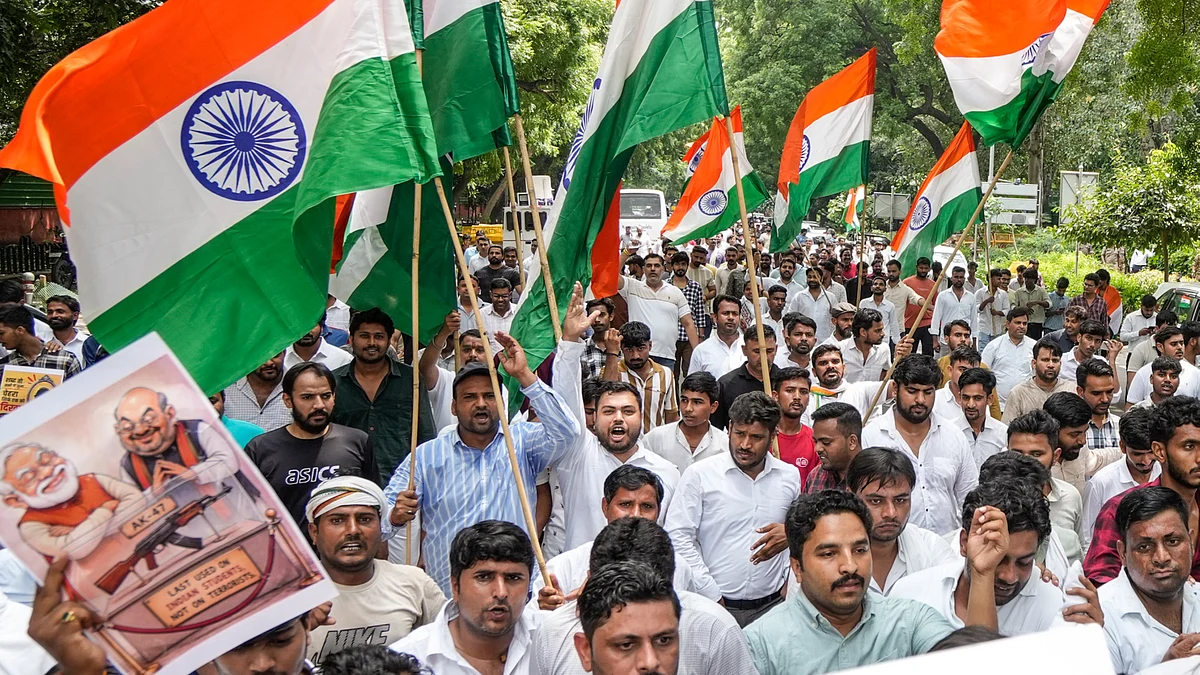


There was a remarkable exchange in the Delhi High Court this week. The government was asked why it was not considering shutting down the Jantar Mantar area as a venue for protests. “Why don’t you shut it down? According to me, these things should not happen in the city, but it’s the government’s call. Why should the city be put (sic) to ransom unnecessarily?” the court asked.
It was hearing a plea filed by the All India Dalit Christian Rights Protection Committee, seeking directions to the Delhi Police to decide on the committee’s plea for permission to hold a protest at Jantar Mantar. The group’s advocate then asked whether it was the Centre’s stand that there could be no protests in Delhi. To this, the judge replied, “That’s for the police to decide.” The advocate said: “Fair enough, let them say so that there will be no democratic, peaceful protests in Delhi. We will accept it.”
The bench’s position was that the “city should not be put to ransom” by protesters. The government’s response was not known, but all governments in India think — and have thought — that protest is a nuisance that gets in the way of ‘good governance’.
It is important to examine the issue at some depth, and therefore this column today. Article 19 of the Constitution says: ‘All citizens shall have the right (a) to freedom of speech and expression; (b) to assemble peaceably and without arms; (c) to form associations or unions; (d) to move freely throughout the territory of India; (e) to reside and settle in any part of the territory of India; (g) to practise any profession, or to carry on any occupation, trade or business’.
The reality is that today we have no such rights. Do Indians have the right to ‘assemble peacefully and without arms’? No. We have the right to apply for permission to hold a peaceful assembly from the local police station. The police have the right to approve or deny it, or simply not respond — which was the reason the Dalit Christians moved court. That is where the real right is held.
Also Read: Whose movement is it anyway?
Scenes of groups of protesters, some as small as half a dozen, holding placards and chanting slogans outside business establishments and government offices, and even political rallies, are common in the United States and Europe. In India, such a gathering would be broken up or not allowed to take place. India has criminalised protest.
Where it is allowed, usually after written permission, it is confined to so-called ‘designated areas’ allocated for protests. Some see even these as a nuisance.
Jantar Mantar in Delhi is such a place, a tract of land cordoned off at both ends, with protest stalls, some of them there for months, unseen and unheard. In Bengaluru, you have Town Hall and Freedom Park; in Mumbai, Azad Maidan, where protests, after permission is granted, may be allowed during specific periods of time.
This does not constitute the right to peaceful assembly. It is a denial of a fundamental right given to us by the Constitution. We have to claim this right as we need to claim the others.
Freedom of speech and expression is qualified by so many laws that it is hard to know where to begin. India has criminalised free speech through sedition, criminal defamation and criminal contempt of court. The mother country we borrowed these laws from no longer has them. There is no right to dissent in India, and anything offensive to majoritarian Hindutva is called anti-national. The Kashmiri can teach you a thing or two about freedom of speech and expression if you claim that India is free.
Forming associations is not easy in India, and registration can be denied or cancelled. Those who work in the organised civil society space, meaning professional NGOs, know just how difficult the State makes it for them to exercise this fundamental right.
Also Read: A victory that may still fall short
We have seen the problem with the right to carry out a trade, which has been struck off for butchers and, by extension, for restaurants. Many of these rights have become ossified. The State has a strong investment in denying them to us, and we have not been as strong in claiming them.
The footnote under Article 19 reads: ‘Nothing shall affect the operation of any existing law, or prevent the State from making any law, in so far as such law imposes reasonable restrictions on the exercise of the right…’ The question is whether the restrictions imposed are reasonable. They are not.
Reclaiming our fundamental rights is the only way to realise and unlock the value of our Constitution. We have to peacefully reclaim our rights, both at the level of the individual and at the level of civil society.
India has a weaker civil society than other democracies. It is vibrant, yes, and it is defiant and brave. But it is small. India needs to create a bigger space for that part of our nation which is neither government nor business corporations. That is civil society. It comprises groups, formal and informal, and individuals, and the space that they create through their actions.
These groups must be encouraged and given space to express themselves. They should not be seen as a nuisance, but unfortunately that is precisely how those in power and those with authority see them.
The reason governments do not want protests to be held is that every time Indians are mobilised — against the farm laws, against the NRC, against exam paper leaks — the government succumbs. And it is for this reason that we must ensure that we do not lose this right of ours to peaceful assembly.
Views are personal. More of Aakar Patel’s writing here
Join our official telegram channel (@nationalherald) and stay updated with the latest headlines