


Would He consider walking into the protest site?
Shah Rukh Alam reflects on this and other imponderables of the Jantar Mantar protest
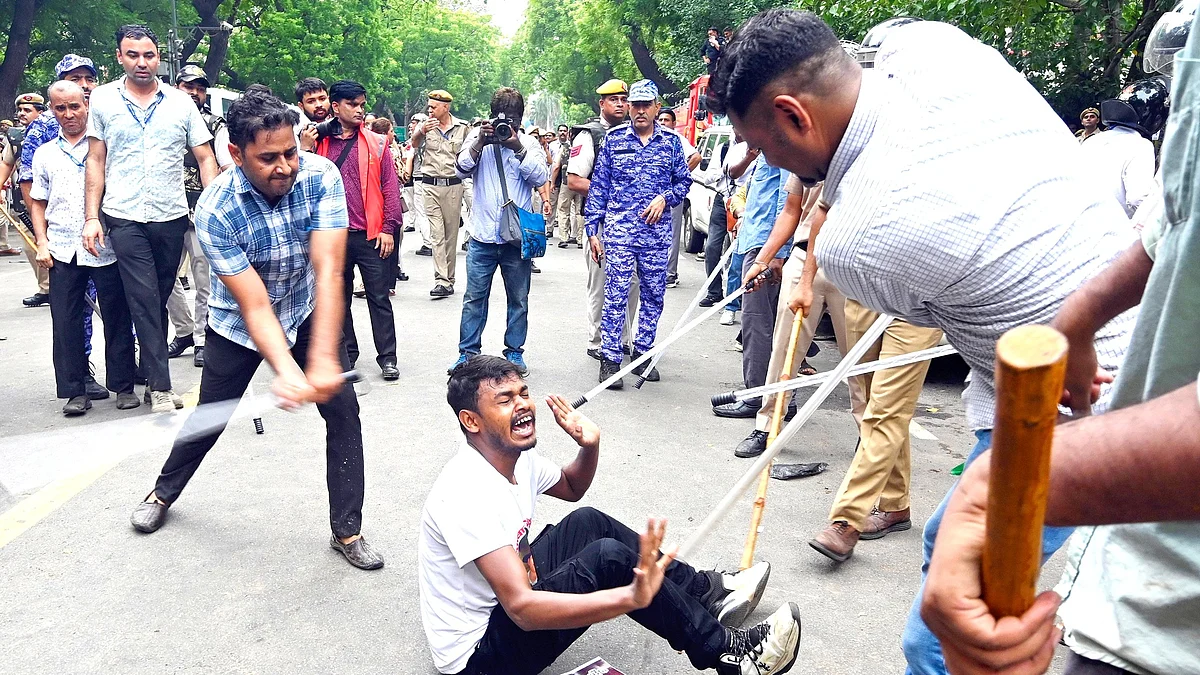


Lutyens’ Delhi is replete with hoardings that carry the prime minister’s beaming face, being congratulated for one thing or another. That grin is particularly incongruous in the aftermath of the brutal police attack on protesting students: injured youth flailing below and a conceited smile overhead. He might cry too in due course, moved belatedly by the treatment of students, who were assaulted by police under the command of his trusty home minister.
But he’ll more likely focus on how the moment was politicised by the Opposition and other ‘anti-nationals’. In any case, in that moment, the visual discordance of that smiling face amidst the chilling reminders of the day was too evident.
I wondered why he wouldn’t just stroll into the protest site. A man with that degree of residual popular support, he could own the space. The dynamic of power would be such that he could even talk down to protesters and they might still listen. Demands for resignation would likely dissolve. Nehru, the apparent constant challenger, is known to have walked into agitated crowds and addressed them directly. So, it wouldn’t be a climbdown.
Why then does the leadership not engage directly with the people? Do they seriously fear personal risk in crowds?
I feel that even more than the slippery-slope argument — if the government concedes one demand, it will look weak and will have to cede more space — it is the shift in popular expectations that is significant. In a democracy, common sense dictates deference to the will of the people. The ‘will of the people’ can be manipulated but still requires engagement.
However, present-day discourse begins by first questioning the legitimacy of people. ‘Do you represent the majority view? No? Does that not make you anti-national, not-legitimate people?’ The burden of proof is on the people to first establish that they are worthy citizens before asking for an audience with the leadership.
Also Read: To Be Young Was Very Heaven
Astonishingly, constitutional courts have also made oral remarks questioning petitioners’ ‘people-hood’ and consequently their locus to invoke rights. This movement began by reappropriating one such slur and turning it on its head. It is important then to also address the question of the legitimacy of people, all people — something the movement is struggling with at this moment. It requires a broader vision of politics and a place for all people in it.
On the same day that the Supreme Court of India refused to hear a plea relating to the disproportionate use of force at the protest, and described the petition as a ‘waste of time’, I saw a reporter grilling a young protestor, asking him if he thought anti-nationals like Umar Khalid deserved a trial. The most common response thus far has been: this protest is not about Umar Khalid or Sharjeel Imam. But I think it is — in the final analysis, it is about restoring the balance of power between all citizens and the government. It is about questioning the relentless attempts to disenfranchise, delegitimise and dehumanise some.
****
A famous restaurant on Parliament Street, an apparent favourite of Rahul Gandhi’s too, was closed for business. Its restive staff was on the pavement, smoking, chattering, watching proceedings. There were others too not happy with the ‘politicisation’ of the issue, because apparently ‘others’ had joined the issue. ‘They are not students, or if they are, they never sat for the NEET exam.’ Some said: “If it’s about education, why are they talking about other things?”
It speaks to the bureaucratisation of protests: first show your eligibility — are you directly affected? Next, come with one complaint at a time — this can’t be a single-window clearing house for complaints. No random sloganeering, no broad-based concerns.
New India has produced a hustle economy. You are suspect if you empathise with or participate in a cause that does not directly affect you. Some suggest the narrow-focus education issue is being hijacked and politicised, as if fund cuts in public education, privatisation, the rewrit-ing of history, motivated changes in curriculums exist in silos and can be challenged without invoking the worldview they stem from.
It appears there is an access protocol for public spaces. Imagine concentric circles of people. At the centre are those model citizens who never ask questions of the government and instead berate those who do.
Then there are those who must protest but come from ‘good backgrounds’ and are able to show a track of support for the government i.e., they are not ideologically, inherently opposed to it. They can come back to the fold if their ‘single-point issue’ is amicably resolved.
Then there are those who are perennially suspect: the Muslim, the Kashmiri, the anti-CAA protester, the ‘urban Naxal’, the farmer, the Adivasi, the Dalit. Those are outlying circles, which must not be allowed to pollute protests on middle-ground issues like paper leaks.
Strategically, the CJP seems to have aligned with this logic, even rationing out permissible slogans, but organically, emotionally, the movement has gone beyond momentary strategic thinking. The slogans have not been contained. It remains to be seen whether the government will double down on this and create a wedge between what is permissible at a stretch and what is absolutely not.
****
The importance of peaceful protest is paramount. Yet it must be reite-rated that the promise of peace is always only made by the protesters. The lawful threat of violence from the State, which is always discretionary, hangs thick in the air all the time. We must demand a promise of peaceful response from the State too.
It is not an impossible thing. The police are expected to be trained to act in a particular way in the face of public anger, heckling, and even mild pushing and shoving. Much like teachers in primary schools when engaging with their most undisciplined pupils.
Instead, police action becomes retributive, often reflecting anger at the auda-city of people questioning the State. The easy, unques-tioned insertion of private, ideologically aligned militia into this melee is a slide into the dark abyss.
****
And what must the Muslim do? There is some debate on social media about whether Muslim youth should participate in the movement or stay away? Some are urging them to join in while others advise caution, mindful that the Muslim is as vulnerable on the streets as in the courts.
I don’t think Muslims necessarily take advice from the ulema, or from any secular leadership. They are not a political monolith. Likewise, Muslim youth do as they please — they will go to the protests if they wish, because they belong here. Some might stay away because of the disproportionate costs they might have to bear.
But in all of this, I thought of a slogan. Apropos the concentric circles of public-space behaviour, the rioting self-proclaimed sanatani can, of course, do no wrong, but we must consider the question: Koi karey toh democracy, koi aur karey toh conspiracy?
Shah Rukh Alam is a constitutional lawyer and human rights activist
Join our official telegram channel (@nationalherald) and stay updated with the latest headlines