


Bengal: New BJP govt ‘implements’ already existing BNS, promises welfare continuity and border push
CM Suvendu Adhikari's first cabinet meeting mixes legal confusion, Modi branding and tough border messaging
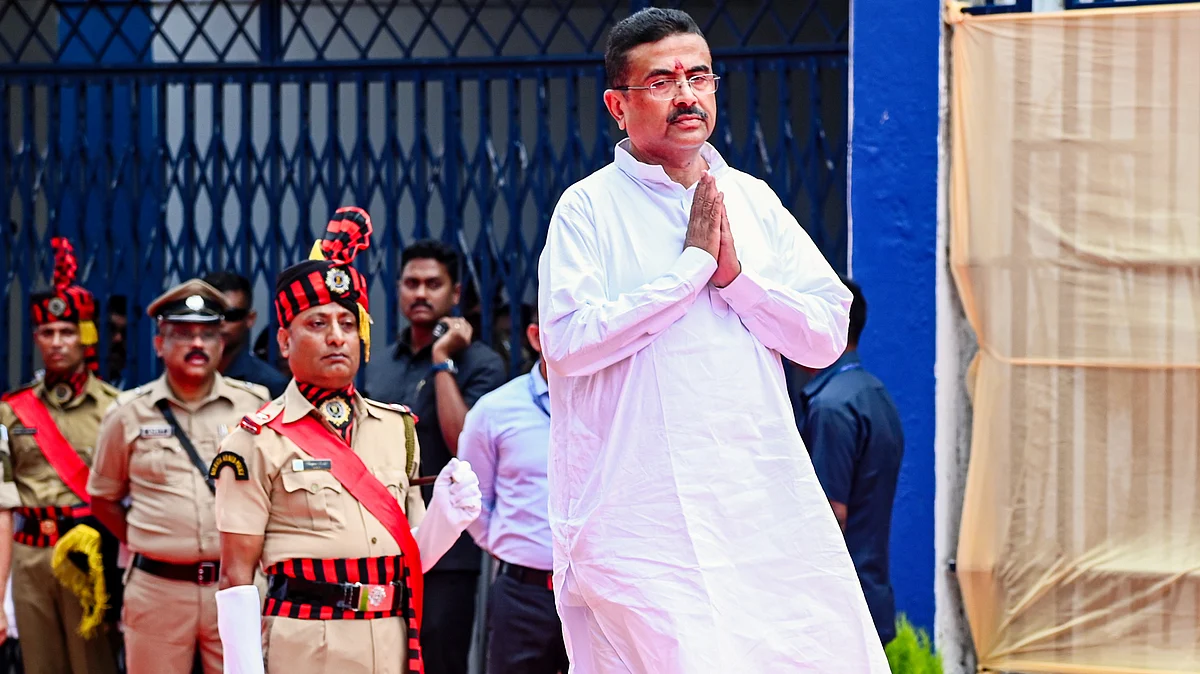


The first cabinet meeting of West Bengal’s new BJP government on Monday, 11 May offered an early glimpse into the priorities — and occasional contradictions — of the Suvendu Adhikari administration.
A key point of the meeting was chief minister Suvendu Adhikari’s announcement that the Bharatiya Nyaya Sanhita (BNS) would now be implemented in West Bengal, accompanied by accusations that the previous Trinamool Congress (TMC) government had delayed adopting the new criminal laws.
There is, however, one complication: the BNS has already been in force in West Bengal — along with the rest of India — since 1 July 2024.
Like every other state, West Bengal automatically came under the Bharatiya Nyaya Sanhita, Bharatiya Nagarik Suraksha Sanhita and Bharatiya Sakshya Adhiniyam after Parliament replaced the IPC, CrPC and Indian Evidence Act in 2023. States are free to adjust administrative preparedness, police training and implementation mechanisms, but not to opt in or out of Central criminal laws once notified.
Which made the new government’s triumphant declaration of implementation sound less like a policy breakthrough and more like a knowledge gap.
Still, the BNS confusion did not stop the cabinet meeting from laying out the BJP government’s broader political roadmap: retain existing welfare schemes for now, foreground Narendra Modi-branded Central programmes and push an aggressively securitised border narrative.
“No ongoing social welfare scheme is being discontinued,” Adhikari said after the meeting at Nabanna.
The assurance was politically necessary. During the election campaign, the TMC had repeatedly warned that a BJP government would dismantle or dilute Bengal’s sprawling welfare architecture associated with the Trinamool Congress. The BJP, meanwhile, had campaigned on a parallel promise of introducing its own welfare benefits and expanding central schemes.
Also Read: Reform or retribution?
Now in office, the government appears to have concluded that abruptly withdrawing popular welfare programmes may not be the wisest opening move. Instead, the administration seems to be attempting a careful balancing act: preserve existing schemes while gradually shifting political ownership towards the Centre and PM Modi’s welfare branding.
That strategy was visible in the government’s decision to formally join the Ayushman Bharat Pradhan Mantri Jan Arogya Yojana after years of resistance from the Mamata Banerjee government. “Modiji had promised that, in our very first cabinet meeting, we would join Ayushman Bharat,” Adhikari declared.
The cabinet also announced full implementation of schemes such as the Pradhan Mantri Fasal Bima Yojana, PM-SHRI, Vishwakarma, Beti Bachao Beti Padhao and the Ujjwala Yojana — effectively turning the first cabinet meeting into a demonstration of the BJP’s “double engine government” template.
But the Ayushman Bharat rollout may not be entirely frictionless. The previous TMC government had long argued that Bengal’s Swasthya Sathi scheme offered broader and near-universal coverage irrespective of income category, unlike Ayushman Bharat, which is restricted largely to economically vulnerable households identified through the 2011 Socio-Economic Caste Census.
Eligibility under Ayushman Bharat depends on deprivation criteria in rural areas and occupational categories in urban areas. Critics have argued that sections of lower middle-class families who were covered under Swasthya Sathi could fall through the cracks unless the state continues parallel coverage mechanisms.
The second major pillar of Monday’s cabinet meeting was border security — a theme the BJP has consistently used both administratively and politically in Bengal.
The government announced that the long-pending process of transferring land to the Border Security Force (BSF) for fencing along the India-Bangladesh border had officially begun and would be completed within 45 days. “With the security of Bengal as the paramount concern, approval has been granted to initiate the land transfer process required to secure our borders,” Adhikari said.
The BJP had repeatedly accused the previous government of delaying land transfer for fencing and thereby 'weakening national security'.
West Bengal shares a 2,216.7-km border with Bangladesh. According to official figures, fencing has already been completed along 1,648 km, while 569 km remain unfenced. Around 113 km are riverine stretches where fencing is not feasible, while the Union home ministry says another 456 km can still be fenced if land disputes are resolved.
The state government said 105 acres of land would now be transferred to the BSF. The matter had earlier reached the Calcutta High Court, which directed the state to hand over acquired border land by 31 March.
A senior TMC leader, speaking on condition of anonymity, dismissed the cabinet announcements as political score-settling dressed up as governance. “BJP is just trying to settle scores with us. Have they announced any compensation for those who would lose land in the process?” the leader asked.
Adhikari also revived the BJP’s familiar demographic (read Muslim) rhetoric, claiming that “the demographic profile of the state has undergone a transformation” — remarks likely to sharpen already polarised debates over migration and identity politics.
The cabinet additionally announced a five-year relaxation in the upper age limit for state government job applicants, with Adhikari arguing that irregular recruitment examinations since 2015 had left many candidates overage.
The government also unveiled a wider bureaucratic shake-up. Nominated chairpersons and directors appointed under the previous TMC administration have reportedly been removed from boards and public bodies, while IAS, IPS and state civil service officers will now be required to participate in Central training programmes.
Adhikari further accused the previous government of deliberately delaying Census work to obstruct delimitation and women’s reservation measures — another charge that fit neatly into the BJP’s larger narrative of institutional obstruction by the former regime.
Join our official telegram channel (@nationalherald) and stay updated with the latest headlines