


BJP govt opts for urban polls first as Rajasthan heads for local elections
After high court intervention, Bhajan Lal Sharma government announces municipal polls ahead of panchayat elections
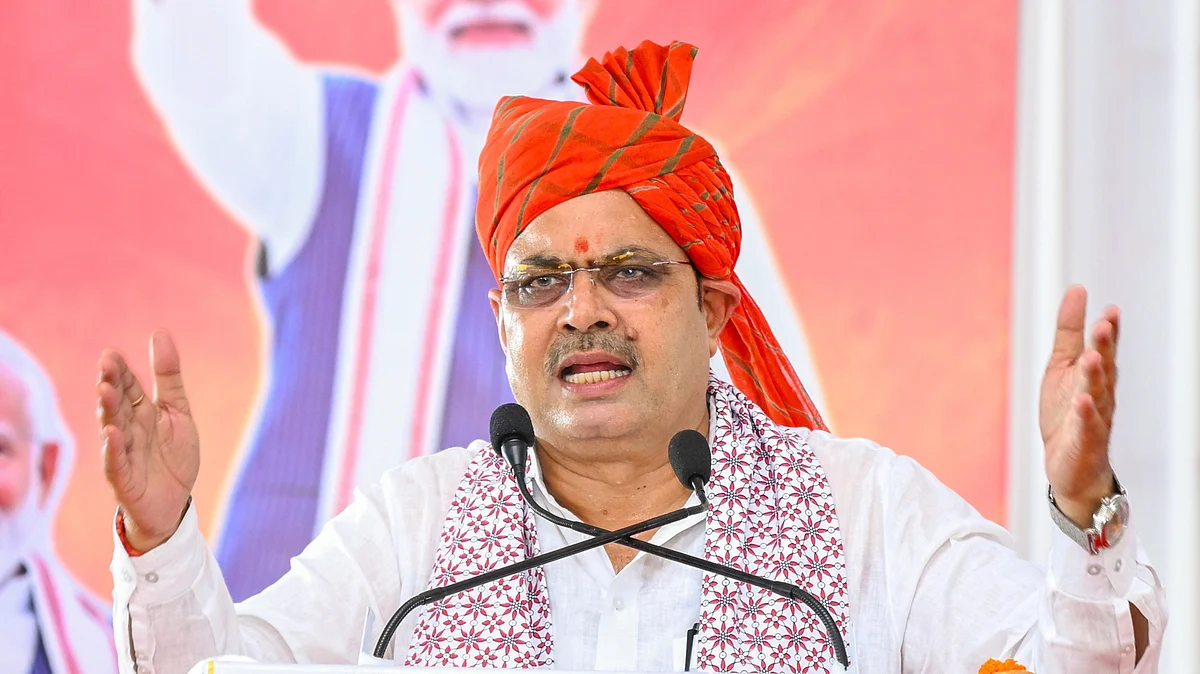


The Bhajanlal Sharma-led BJP government in Rajasthan, which had been delaying panchayat and urban local body elections amid fears of a potentially adverse electoral outcome, has now decided to hold municipal polls before panchayat elections.
The government, which had repeatedly deferred the elections on one pretext or another, was eventually compelled to announce the schedule after the Rajasthan High Court directed it to do so.
"The BJP is unsure of success in the panchayat polls and the surveys conducted by the party are not very encouraging," Leader of Opposition Tika Ram Jully said.
The BJP, however, is believed to be more confident of its prospects in the municipal elections and hopes to leverage a favourable performance there to build momentum in rural Rajasthan by projecting what it describes as its record of governance.
Former chief minister Ashok Gehlot dismissed that assessment. "The Congress will sweep both the local body and panchayat elections. People have suffered under the BJP government's misrule. The state is in financial distress, payments to contractors and suppliers have been withheld, and MGNREGA, even after being rechristened by the BJP government, has failed to provide rural employment. The results of the local body and panchayat elections will pave the way for the Congress' return to power in the 2028 Assembly elections," he said.
Meanwhile, the OBC Representative Commission has submitted its long-awaited report, clearing the way for the government to finalise reservations before the polls.
The commission, headed by Madan Lal Bhati, was expected to submit its findings within three months but took 18 months, doing so only after the Rajasthan High Court pulled it up for the delay. Constituted on 9 May, the commission's tenure was extended three times.
The commission was constituted in compliance with a Supreme Court directive requiring states to collect comprehensive and contemporary empirical data on the political, social and economic backwardness of OBC communities before determining reservations in local bodies. The court had directed that reservation quotas should be based on empirical evidence rather than arbitrary figures.
The report also reiterates that the combined reservation for Scheduled Castes, Scheduled Tribes and OBCs cannot exceed the Supreme Court-mandated ceiling of 50 per cent.
According to the commission, of the 92 OBC communities identified in Rajasthan, only 11 have significant political representation. It found that political power within the OBC category is concentrated largely among dominant communities such as Jats, Gujjars, Malis and Kumawats. Members of these communities not only win seats reserved for OBCs but are also elected from general constituencies. Consequently, the remaining OBC communities have little political representation in panchayats and urban local bodies.
"We surveyed 74.85 lakh OBC families across the state, covering 92 communities. The survey examined their socio-economic conditions and levels of backwardness. Our report clearly identifies the dominant groups within the OBC category and recommends that all 92 communities should benefit from political reservation. An analysis of previous local body and panchayat elections shows that OBC candidates won nearly 40 per cent of the seats, with a substantial number of victories coming from general constituencies," Bhati said.
The commission has estimated Rajasthan's OBC population at 3.80 crore, accounting for about 45 per cent of the state's population. According to the report, Jaipur has the largest OBC population, followed by Sikar, Jodhpur, Jhunjhunu and Bhilwara. In these districts, Jats, Gujjars and Malis remain the dominant politically influential communities.
By contrast, OBC populations are relatively low in Salumber, Pratapgarh, Banswara, Dungarpur and Jaisalmer, where Scheduled Tribes constitute a majority. The report is expected to result in OBC reservations of up to 21 per cent even in these districts.
Rajendra Sain, former AICC national coordinator of the OBC cell, questioned the findings, saying the commission had rushed its survey. "The report puts the OBC population at about 45 per cent, but the data was collected in haste. The actual OBC population in Rajasthan is closer to 55 per cent," he said.
Rajasthan has 14,403 gram panchayats and 309 urban local bodies, comprising 10,245 municipal wards. Based on the proposed 21 per cent reservation, around 2,500 seats in panchayats and nearly 2,000 seats in urban local bodies are expected to be reserved for OBC candidates.
The report will now be examined by the state cabinet, following which the government will notify the reservation matrix and conduct the draw of lots for reserved seats.
The state government has already submitted its roadmap for the elections to the Rajasthan High Court, under which the entire process is to be completed by 15 November.
Nominations are expected to begin on 22 August, with polling to be conducted in three phases beginning on 6 September. Nominations for the panchayat elections are scheduled to begin on 1 October.
Join our official telegram channel (@nationalherald) and stay updated with the latest headlines