


Centre has 'sinister design' in linking women's quota to delimitation: D Raja
CPI general secretary questions government's sincerity in implementing the 33% reservation for women
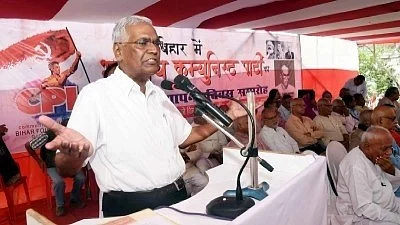


CPI general secretary D Raja on Sunday questioned the Centre's “sincerity” in implementing women's reservation in Parliament and state assemblies by linking it to delimitation, and accused the Narendra Modi-led government of having a “sinister design”.
Raja was in Lucknow to meet Samajwadi Party president Akhilesh Yadav, a day before a special session of Parliament scheduled to begin on November 30. The Lok Sabha session will run from November 30, while the Rajya Sabha will begin its session on December 2.
Three constitutional Bills are expected to be taken up during the session. These include the Constitution (One Hundred and Thirty-Second Amendment) Bill, 2026, which links delimitation with the implementation of 33 per cent reservation for women in the Lok Sabha and state legislative assemblies.
The proposed legislation seeks to increase the maximum strength of the Lok Sabha to 850, with up to 815 members from states and 35 from Union Territories. It also proposes raising the upper limit on the strength of state legislative assemblies from 500 to 650.
The other proposed legislations are the Delimitation (Second) Bill, 2026, which provides for delimitation of constituencies, allocation of seats and implementation of women's reservation, and the Union Territories Laws (Amendment) Second Bill, 2026, which seeks to amend laws governing Union Territories with legislatures to implement the quota.
Speaking to PTI Videos, Raja said the women's reservation legislation had already been passed by Parliament and the government should focus on implementing it rather than linking it to delimitation and the Census.
“Women reservation (Bill) has been passed in Parliament. It is an Act. Now the question is how to implement (it) and the Modi government has not shown any sincerity or any seriousness in implementing the women reservation. Now, through this Bill, they are linking it with delimitation. Then delimitation will be linked with the Census. How long will this process take? What is going to be the composition of the Delimitation Commission?” he said.
Raja also alleged that the NDA government had not consulted state governments and political parties on the proposed changes.
Questioning the convening of the special session, he said the government had not followed established parliamentary conventions and was taking Parliament for granted.
“If Parliament is made redundant, if Parliament is not allowed to be vibrant, if opposition parties do not have any opportunity to raise issues, then what is democracy? What will happen to democracy? The government must be having its own sinister design. That is what we should try to understand. Tomorrow many things will come out. Let us wait and see,” he said.
Asked about the DMK's support for the proposed Bills, Raja said he did not know whether the party had discussed the impact and implications of taking such a position.
On his meeting with Yadav, Raja said the two leaders discussed the political situation in Uttar Pradesh and at the national level. They also discussed the forthcoming Assembly elections in Uttar Pradesh, Uttarakhand, Punjab, Manipur and Goa, he said.
“Particularly, UP elections, because it will have a big impact on the political course at the national level,” Raja said.
He added that they agreed to work together to defeat the BJP and remove the Yogi Adityanath government in Uttar Pradesh.
Raja called on secular democratic parties to unite and put up a collective fight against the BJP and its allies. He said Yadav, as the leader of the largest secular democratic party in Uttar Pradesh, should take the lead in coordinating with other opposition parties.
He also stressed that seat-sharing arrangements should be settled amicably, with parties accommodating one another to avoid misunderstandings.
Join our official telegram channel (@nationalherald) and stay updated with the latest headlines