


Congress slams women’s quota bills as ‘mischievous’, flags delimitation risks
Opposition backs reservation in principle but rejects proposed legislation over fears of political imbalance


The Congress on Thursday strongly criticised the Centre’s proposed legislation to implement women’s reservation, alleging that the measures are driven by “mischievous” intent and should be rejected in their current form.
Addressing the issue, party general secretary Jairam Ramesh said the bills, scheduled for introduction in the Lok Sabha, were being presented as a step towards women’s empowerment but were fundamentally linked to delimitation changes that could alter the political balance between states.
He argued that concerns had been raised nationwide about proposals that may favour more populous states, where the ruling party currently holds stronger influence, potentially reducing the relative representation of other regions in Parliament.
Ramesh also pointed to previous delimitation exercises in Assam and Jammu and Kashmir as examples of what he described as problematic implementation, accusing the leadership of pursuing a calculated political strategy.
“The intent behind these bills is questionable, their provisions troubling, and their consequences far-reaching,” he said, reiterating the party’s demand for their outright rejection.
The Congress and other opposition parties have maintained that they support women’s reservation in legislatures but oppose linking it to delimitation. Ramesh reiterated the Opposition’s long-standing position that one-third of the existing 543 Lok Sabha seats should be reserved for women, including quotas for those from Scheduled Castes, Scheduled Tribes and Other Backward Classes.
The government has listed three key pieces of legislation for introduction and passage: the Constitution (One Hundred and Thirty-First Amendment) Bill, 2026, the Delimitation Bill, 2026, and the Union Territories Laws (Amendment) Bill, 2026.
The first two will be introduced by Union Law Minister Arjun Ram Meghwal, while Union Home Minister Amit Shah will table the third.
According to the draft amendment, the strength of the Lok Sabha could be expanded from 543 to as many as 850 seats to facilitate the implementation of the women’s reservation law ahead of the 2029 general election. The proposal also includes increasing the number of seats in state assemblies and Union territory legislatures to ensure 33 per cent reservation for women.
The allocation of reserved seats would rotate across constituencies following a delimitation exercise based on the 2011 Census.
Opposition leaders, including Congress president Mallikarjun Kharge, have criticised both the timing and structure of the proposal, alleging it is politically motivated. A meeting of leaders from several INDIA bloc parties, along with representatives from the Aam Aadmi Party, was held on Wednesday to coordinate a joint parliamentary strategy.
The special three-day sitting of Parliament, beginning Thursday, is expected to see intense debate over the proposals. While the ruling National Democratic Alliance holds 292 seats in the Lok Sabha, the opposition commands 233, making the passage of a constitutional amendment contingent on securing a two-thirds majority of members present and voting.
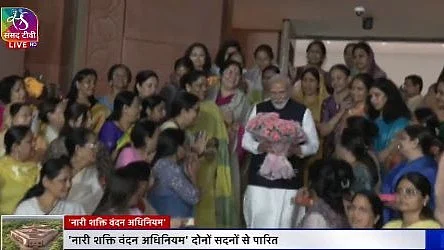
The legislation seeks to operationalise the Nari Shakti Vandan Adhiniyam, which mandates one-third reservation for women in Parliament and state assemblies. However, the linkage with delimitation has emerged as a key point of contention, setting the stage for a heated political confrontation.
With PTI inputs
Join our official telegram channel (@nationalherald) and stay updated with the latest headlines