


Gerrymandering: How partisan redrawal of electoral map can benefit BJP
SIR of electoral rolls and subsequent constituency delimitation have raised concerns over possible gerrymandering to favour a party or candidate
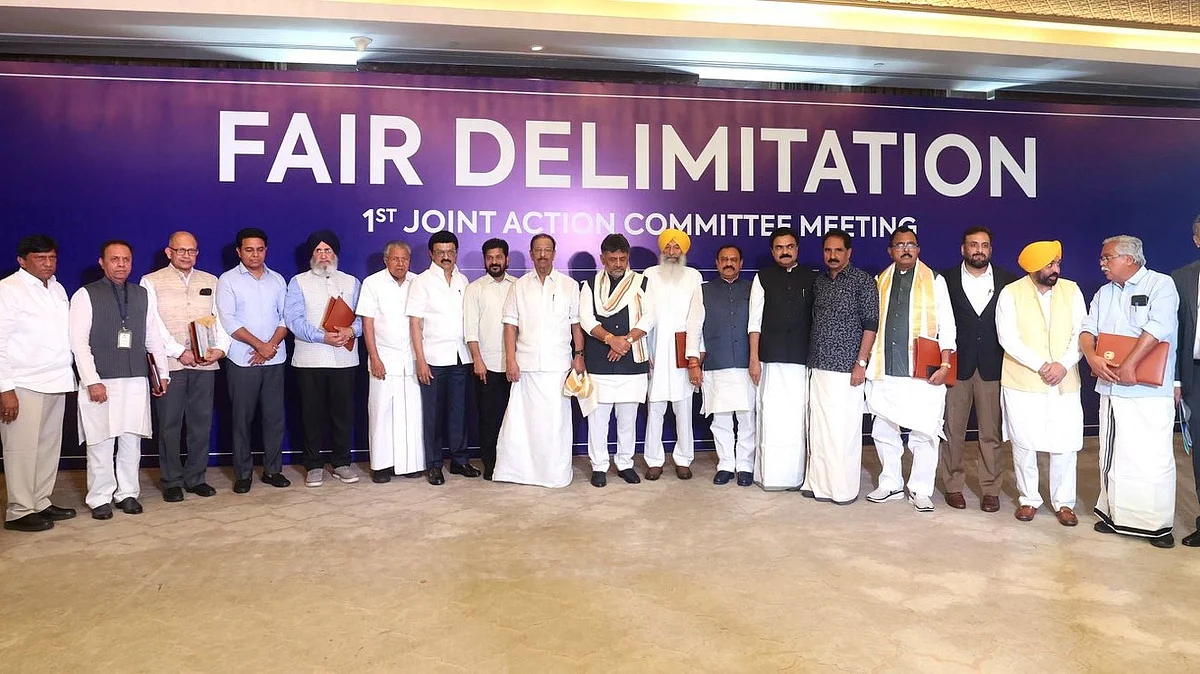


The Opposition alleges that delimitation in Jammu and Kashmir and Assam raises concerns over gerrymandering, allowing the BJP to gain seats without increasing its vote share
Concerns over the Delimitation Commission’s independence, lack of judicial review and the Election Commission’s role have deepened distrust
Critics fear that voter data, demographic patterns and AI could be used to redraw constituency boundaries to give the ruling party an electoral advantage
The word ‘Gerrymandering’ was used by a cartoonist in Boston in 1812 to describe electoral districts in such unusual shapes that they resembled a lizard-like creature, the salamander. The cartoonist of Boston Gazette called the electoral maps ‘Gerry-mander’ after governor Elbridge Gerry who approved them.
Imagine a state with 100 voters and five constituencies, of whom 60 support political party A and 40 support political party B. A neutral electoral map would lead to party A winning three seats and party B winning two. Electoral maps drawn to a design might, however, enable A to win four or even all five seats.
This is what the Opposition suspects happened in Jammu and Kashmir and in Assam. With the Delimitation Commission, comprising a chairman nominated by the government and the ruling party, the chief election commissioner Gyanesh Kumar as member and an election commissioner in-charge of the particular state as one of the members, the commission looks far from independent structurally. What is more, the commission’s recommendations cannot be challenged in court. In addition, the BJP government granting in 2023 life-long immunity to the CEC from criminal prosecution has also added to the distrust.
The distrust has deepened following delimitation of constituencies in Jammu and Kashmir and Assam before the last assembly elections in the Union Territory and in the eastern state. People this week recalled the widely reported statement of the Assam chief minister Himanta Biswa Sarma. Delimitation, he had exulted, would do what NRC (National Register of Citizens) could not”. Delimitation in both the states came in for sharp criticism and were challenged before the Supreme Court, which refused to intervene.
At his press conference on Saturday, 28 November, in New Delhi, Leader of Opposition in the Lok Sabha dared assembled journalists to give the following prompt to AI chatbots: “Can you effectively rig elections in India by increasing the number of constituencies from 543 to 850?”
“Pucho, Kar ke dekh lo, pata lag jayega,” he said. Many took his advice and one of them tweeted the reply he received from ChatGPT. “The real danger isn’t simply increasing the number of seats. It is how constituency boundaries are drawn, how representation is distributed and whether the process can be manipulated to manufacture an electoral advantage without manipulating a single vote,” the chatbot replied.
Cockroach Janata Party founder Abhijeet Dipke put out a post on “Delimitation: How BJP Can Gain More Seats Without Gaining New Votes.” He wrote on X: “Imagine a constituency with 1,000 voters. BJP: 400 votes. Opposition: 600 votes. Result: Opposition wins the seat. After delimitation (2 constituencies of 500 voters each): Seat 1: BJP 260, Opposition 240. Seat 2: BJP 140, Opposition 360. Result: BJP wins 1 seat. Opposition wins 1 seat,” he wrote, adding, “The Opposition holds on to its existing ground (perhaps this is why some are supporting delimitation), but they need to understand that the BJP gains a new seat in an area where it previously had none.”
“That’s the electoral advantage delimitation will give the BJP going forward. The voters remain the same, their voting patterns remain the same but the redrawn boundaries change the electoral outcome,” he added.
Someone else gave the example of Haryana in the 2024 election. Both BJP and the INDIA bloc won five seats each in the Lok Sabha although the INDIA bloc was marginally ahead in vote share (47.61 as against 46.1 per cent). However, the Delimitation Commission under Gyanesh Kumar could break up Opposition-leaning areas like Ambala and Hisar and pair them with a BJP
stronghold like, say Karnal; similarly, two or more Opposition-leaning seats could be merged to ensure that the Opposition wins one seat and not two. “With the exact same vote percentage, BJP in 2029 can win 8 of the 10 seats in Haryana and the Opposition could go down from five to two” is the apprehension voiced.
Election watchers suspect that the SIR has been used to collect and map street-wise data of voters, their affiliations and which way they lean politically. Using Artificial Intelligence, it would be easy for the Election Commission to re-draw constituencies to benefit the ruling party, some of them believe.
“The BJP has access to years of election results, voting patterns, demographic information and vast amounts of social media data. With data analysis, they can predict political preferences at every level: constituencies, villages, wards, streets and even individual voters. And when those predictions are used to draw constituency boundaries for political advantage, the voters haven’t chosen the winners. The people drawing the boundaries have tilted the contest. That’s the danger of gerrymandering,” one of them said.