


Inside ED raid on I-PAC: Did BJP 'leak' it all, as Trinamool claims?
West Bengal's ruling party says BJP’s Bengal unit posted about ED's operation, key talking points of ED's statement, on X beforehand
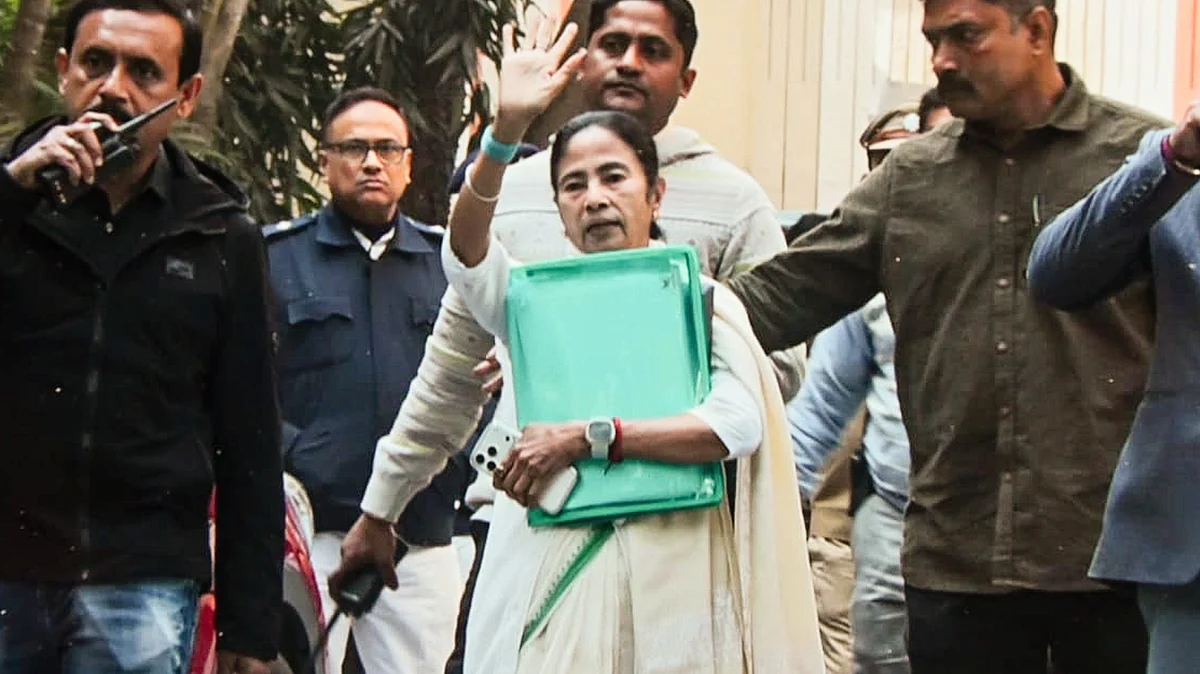


The political meaning of Thursday’s ED raid on I-PAC's Kolkata offices has come down to chronology. Before the Enforcement Directorate issued its formal statement, the BJP’s Bengal unit had already posted about the operation on X, narrating it in political language and with an air of prior knowledge.
That timestamp became the Trinamool Congress’ (TMC) primary weapon. “ED statement? BJP already leaked the script,” the party declared, arguing that the Centre’s investigative machinery and the BJP’s communication apparatus were not merely aligned but synchronised.
On paper, the raid was rooted in something much older than 2026 politics. The ED’s action stemmed from a coal smuggling case first registered by the CBI in late 2020, which alleged large-scale diversion of coal consignments and hawala transfers linked to the syndicate’s proceeds.
That FIR, and the subsequent Enforcement Case Information Report (ECIR), led to questioning, arrests and financial tracking over the following years, making the ED’s involvement a continuation of a multi-year money-laundering investigation under the Prevention of Money Laundering Act (PMLA). By that legal logic, Thursday’s searches were just another phase in a long chain of enforcement steps.
Yet, the timing raised eyebrows. Why, after more than three years of probing, did the ED choose January 2026, when West Bengal is gearing up for Assembly elections, to hit the Salt Lake office of a consultancy deeply embedded in the ruling party’s campaign strategy?
The most straightforward explanations — that evidence only recently surfaced, that witness cooperation crystallised, or that financial trails only now became actionable — are plausible. Still, in political terms, one cannot dismiss the possibility that the action’s arrival so close to a major electoral cycle both reflected and amplified existing tensions between the Central and state governments.
Coming back to the TMC's X post, whether the BJP-ED coordination can be proven in a legal sense is almost irrelevant at the level of public perception, because in Bengal politics, the sequence of who speaks first is itself treated as evidence. If the party frames the action before the agency even acknowledges it, the impression of back-channel information writes itself in the public mind.
From there, the entire confrontation acquired a script-like logic: the ED raids, the BJP narrates, and the TMC claims that the narration reveals the real purpose of the raid. It helped that the location was not an anonymous corporate firm but I-PAC’s Salt Lake office, a building that houses the data, surveys and electoral planning for West Bengal chief minister and TMC supremo Mamata Banerjee’s campaigns.
The day’s true pivot, therefore, came when Banerjee herself entered the frame. She arrived unannounced at I-PAC director Pratik Jain’s residence, then at the I-PAC office, stayed inside for an extended period and eventually emerged holding a laptop and several files, trailed by police and administrators.
To the ED, this was interference in an active search; to Banerjee, it was a rescue mission. Speaking to reporters in Bengali, translated here from Anandabazar Patrika’s on-ground reporting, she said the ED had “taken away” and “transferred” her party’s election strategy and internal material, describing this as “loot before the elections” and insisting that “stealing strategy is a crime.”
She insisted that I-PAC was not some private consultancy but “the authorised team of the Trinamool Congress,” and therefore, its files were not ordinary third-party documents that central agencies could seize at will.
She pushed the framing further, telling journalists that the ED had tried to take “hard disks, financial records, candidate lists and party planning documents”, linking the raid to what she described as a broader attempt to interfere in the electoral process, including the ongoing Special Intensive Revision of voters’ lists.
She used words like “transfer” and “copy” to suggest that information had been extracted rather than merely inspected. She then swivelled to a direct attack on her adversaries: “The BJP is the biggest criminal party,” she said, adding that Central agencies were being used as political instruments. And in a line that captured both her defiance and her understanding of symmetry, she asked rhetorically, “What would happen if we raided the BJP party office?”
By the time she walked away and the ED finally issued its statement, the narrative was no longer about coal, hawala or the Prevention of Money Laundering Act. It was about electoral data, party sovereignty and the possibility that federal investigative procedure was being used as reconnaissance.
The BJP’s early post, arriving before the ED’s statement, now sat like a piece of corroboration inside the TMC's narrative
The TMC did not need to argue that the BJP literally had the ED’s press note in advance; it only needed to point to the timestamps and ask who benefits from being first. In a political environment where Central agencies are widely perceived to operate on political timelines, the optics require no embellishment.
The ED’s response was legalistic, stressing that the raids were evidence-based, that no party office had been searched and that elections had nothing to do with it. But rational explanations rarely extinguish political interpretations, particularly in West Bengal, where Delhi’s power is viewed through a colonial, federal and cultural lens.
Banerjee understood that instantly. She announced statewide block-level and ward-level protests for Friday, 9 January, turning procedural grievance into democratic mobilisation. Her quotes, especially the ones about “loot before the elections” and about I-PAC as her “authorised team”, were designed to shift the emotional terrain: this was not about financial crime, it was about stealing sovereignty — the sovereignty of data, of organisation, of electoral autonomy.
The ED has now moved Calcutta High Court alleging that Banerjee “misused constitutional authority” by removing material from a federal raid. That legal dispute will unfold within the disciplined pace of judicial procedure. But the political narrative has already outrun it. A raid became a leak, the leak became a script, and the script became a claim that elections are being fought not in rallies but in back-end systems and federal enforcement offices.
Whether the “BJP leaked it all” storyline holds up to forensic scrutiny is a question for institutions; its potency in the political theatre comes from something simpler — that for a few hours on Thursday, the BJP seemed to speak for the ED before the ED spoke for itself.
Join our official telegram channel (@nationalherald) and stay updated with the latest headlines