


I-PAC row: Mamata hits streets, leads march in Kolkata against ED action
Hearing for both ED and TMC suits pushed back to 14 January as packed courtroom impedes proceedings
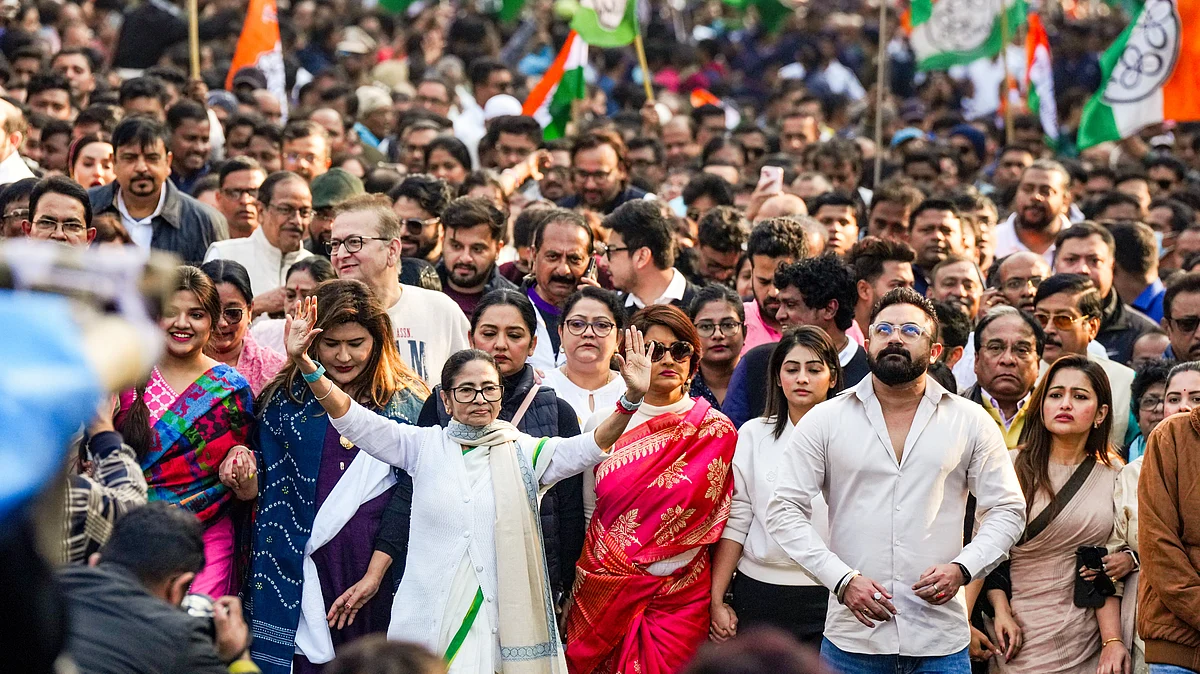


From the moment West Bengal chief minister and Trinamool Congress (TMC) supremo Mamata Banerjee arrived in Kolkata's Jadavpur area on Friday afternoon, it was clear she intended to turn the city’s pavements into stage and battlefield at once. Ministers clustered close, film actors in Ray-Bans threaded through party cadres, and television stars waved at residents leaning out of balconies.
There was noise, sweat, chants, camera booms, and that unmistakable Mamata energy — a leader who treats a footpath like home turf. “Against Delhi’s deprivation, humiliation, torture, insult — we take to the streets. This is Netaji’s line,” she declared, offering New Year greetings in the same breath, before setting off towards Hazra crossing with film stars Dev — also the sitting MP from Ghatal — on one flank and Soham on the other.
The street thrummed; phones rose in unison; the chief minister looked completely at ease, like someone who never really left the barricades of her youth.
But the real charge behind this march lay just beneath the choreography. On Thursday, the Enforcement Directorate (ED) landed heavily on I-PAC — the political consulting outfit long associated with the TMC's electoral strategy — raiding its Salt Lake headquarters and the Loudon Street home of its director Prateek Jain.
Devices and documents were hauled out, and TMC insists what was taken amounted to its “campaign brain”. Banerjee called the raids political espionage, a “crime” aimed at stealing strategy and handing it to the Centre. Hearing of the raid, she drove to both locations herself, waded through rooms while the search was on, and pulled out files, papers and laptops in full public view — a gesture half legal theatre, half bare-knuckle message.
By nightfall, she was outside the Salt Lake office under television lights, declaring that the people would answer what she called an attack on Bengal’s political rights. The rally was announced then and there.
Even as she marched from Jadavpur on Friday, Delhi supplied the next twist. A cluster of Trinamool MPs staged a sit-in outside home minister Amit Shah’s North Block office demanding answers for the raids, only to be bundled into police vans and taken to Parliament Street police station after a brief scuffle.
Videos of raised slogans and dragged MPs shot across social media and landed instantly back in Kolkata, feeding the narrative Banerjee was already leaning into — that the Centre was trying to muzzle Bengal’s voice while its chief minister strode defiantly down her capital’s streets.
While the political street-fight unfolded, the court battle over the raids acquired its own drama. The ED had rushed to Calcutta High Court alleging that its investigation at I-PAC had been obstructed. A hearing was scheduled for Friday before Justice Shubhra Ghosh, but what unfolded was closer to pandemonium than procedure.
At around 2.00 pm, Justice Ghosh entered the courtroom; by 2.30 pm, the matter was to be taken up. But interns, juniors and curious advocates packed the room to suffocation. A court officer pleaded with interns to leave so the hearing could proceed. “There’s too much crowd, the court cannot function,” he said.
Justice Ghosh tried to impose order: “I’ll give five minutes — lawyers not connected to the case must leave. Otherwise I will have to rise,” she announced. TMC counsel Kalyan Banerjee echoed the plea, but arguments broke out over who counted as “connected,” pushing and shoving broke out in the aisles, and finally, the judge simply walked out and adjourned the I-PAC matter until 14 January, leaving the ED visibly displeased at the delay.
Minutes later, the agency hurried to acting Chief Justice Sujay Paul seeking an urgent hearing. First, they made their request verbally at the chief justice’s office; then, when told to reduce it to writing, submitted a formal plea to have the matter heard before another judge if Justice Ghosh’s bench was too crowded to function.
But the acting chief justice did not grant the request. Since a judicial order adjourning the case had already been passed, lawyers noted, the chief justice declined to interfere. The ED’s bid for acceleration failed, and the case will resume on 14 January.
For Banerjee, all of this — the march, the raids, the detentions, the courtroom crush — only served to deepen the terrain she knows best. She is a creature of the march, the dharna, the impromptu address — a leader for whom confrontation is not a moment but a method.
On Friday, she did not look like a besieged chief minister but like the opposition figure she once was, using the city as amplifier, its pavements as retort. The I-PAC raids may have triggered the rally, but the rally supplied something bigger: drama, grievance, and the unambiguous message that if the contest is to be fought on the street, few are more comfortable there than Mamata Banerjee.
With PTI inputs
Join our official telegram channel (@nationalherald) and stay updated with the latest headlines