


Will the cult of personality be the unmaking of Pinarayi Vijayan?
Is Keralam endorsing a model of governance that looks more and more like the centralised structures under Narendra Modi?


Smoke rose over the Parassinikadavu Snake Park, one of Asia’s finest reptile sanctuaries, long before Pinarayi Vijayan became the most powerful political figure in Kerala. In the late 1980s, after a stinging electoral defeat at the hands of his political mentor turned rival M.V. Raghavan, CPI(M) workers in Kannur turned their rage not on their opponents, but on the snake park run by a trust associated with Raghavan who had crossed over to the Congress-led UDF, challenging the party in its own citadel.
What followed was carnage. Flames engulfed enclosures. King cobras and rare serpents were burned alive. Birds fell from trees. Monkeys and smaller animals were hunted down as they fled. For hours, the spectacle unfolded in full public view.
Vijayan was then the all-powerful district secretary of Kannur. Instead of distancing the party from the incident, he invoked Newton’s third law, describing the violence as an equal and opposite reaction. It was a glimpse of the political instinct that understands how response makes the boundaries of excess negotiable.
In hindsight, Parassinikadavu was not an aberration. The methods were crude, carried out openly by cadres. Today, the methods are more sophisticated, embedded within the machinery of the state. But the underlying message, critics say, is the same: power must not appear to bend.
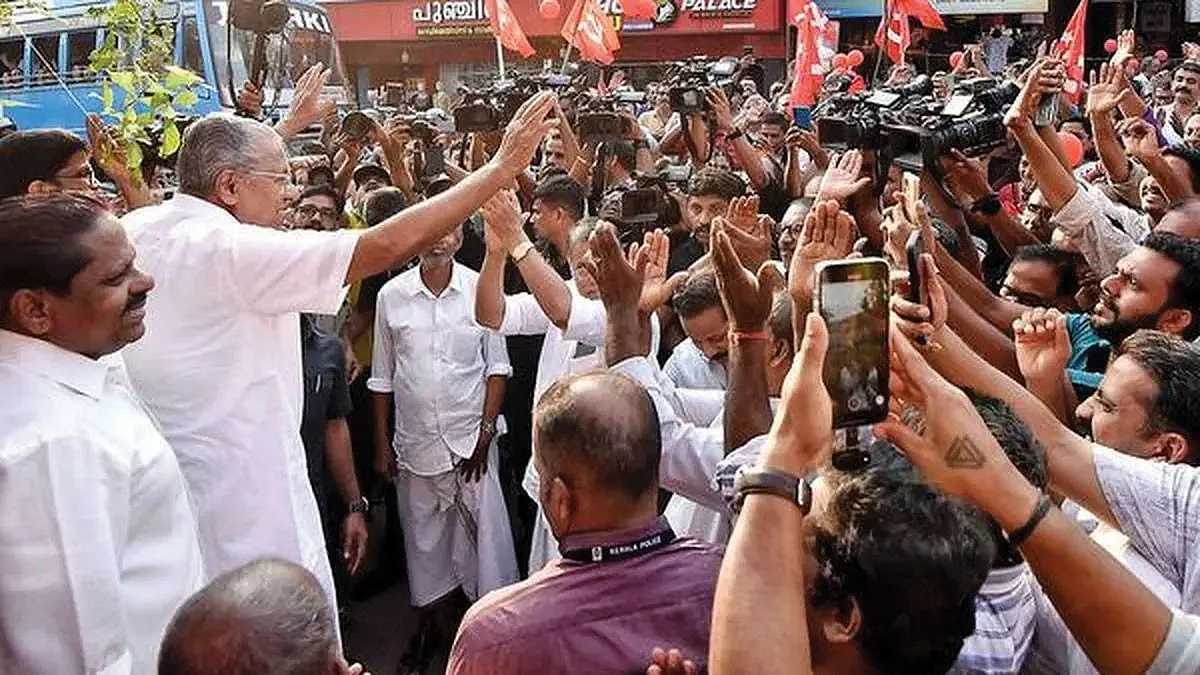
As Keralam approaches a decisive assembly election on 9 April, Vijayan is not merely contesting for a third consecutive term from Dharmadam, his home turf in Kannur. As chief campaigner for the ruling Left Democratic Front (LDF), he is asking voters to legitimise a decade of governance that has steadily hollowed out the democratic and ideological foundations on which India’s Left once stood.
Critics within and outside the LDF say what began as a promise of stable administration has become a tightly controlled political system centred on a single leader. This election is thus less about continuity and more about whether Kerala is willing to endorse a model of governance historically opposed by the Left, one that increasingly resembles the centralised structures under prime minister Narendra Modi.
To his supporters, Vijayan’s political life is a story of grit and upward mobility. Born into a poor toddy tapper family in Pinarayi village near Dharmadam, his rise through the ranks of the CPI(M) reflected an acute understanding of power within a faction-ridden party.
From a milieu where cycles of retaliatory killings involving CPI(M) and BJP-RSS cadres, crude bombs and machetes were instruments of political messaging, Vijayan emerged as a figure who could consolidate control, neutralise opponents and enforce discipline. The shadow of that political culture never entirely receded.
The 2012 murder of rebel CPI(M) leader T.P. Chandrasekharan, who was hacked to death, continues to be cited as emblematic of intolerance towards dissent. Vijayan has consistently denied any role, but the controversy persists, sharpened by allegations of repeated paroles and preferential treatment for the CPI(M) workers who were convicted.
Chandrasekharan’s widow, K.K. Rama, now a UDF-supported candidate from Vatakara, alleges that “the politics of violence patronised by Vijayan is making democracy a mockery in an otherwise progressive Kerala.” From student politics to his years as CPI(M) state secretary, Vijayan cultivated a reputation for being methodical and uncompromising. His prolonged battle with senior party colleague V.S. Achuthanandan ended with Vijayan asserting near total control over the party apparatus.
Also Read: Congress-led UDF raring to make a comeback
When Vijayan assumed office in 2016, there was little to suggest that he would fundamentally alter Kerala’s political culture.
“The turning point, paradoxically, came through crisis — the 2018 floods, followed by the Nipah outbreak and the Covid pandemic,” observes veteran journalist K.A. Antony, who has closely followed Vijayan’s political trajectory. “His daily press briefings during Covid, widely praised for their clarity and consistency, also served to concentrate political attention on a single figure.”
Dr Azad Malayattil, retired college professor, writer and former CPI(M) cadre, adds: “Repeated crises over the last decade led to power being consolidated in a chief minister who combined authority with public relations. He became the system, and even the inner party democratic mechanisms vanished.” The Modi-model arrived in Keralam.
This consolidation of authority has not gone uncontested. The Sabarimala issue was one of the most volatile flashpoints of Vijayan’s tenure. The arrest of students Alan Shuhaib and Thaha Fasal under UAPA triggered concerns about criminalising dissent.
Allegations of fake encounter killings and repeated instances of police excess deepened anxieties over the expanding coercive role of the state. Black flag protests were treated as security threats, and Youth Congress workers attempting to protest were met with force — attacks that Vijayan described as “life-saving missions”.
“The excessive reliance on police power,” notes N. Subrahmanyan, a social worker based in Payyannur, “reflects a deep discomfort with dissent and the need to control rather than engage in dialogue.”
Allegations have also surfaced regarding financial dealings linked to the chief minister’s daughter in corporate transactions. The elevation of his son-in-law, P.A. Mohammed Riyas, to ministership is seen as evidence of limiting power to a closed circle.
Veteran CPI(M) leader G. Sudhakaran, once a trusted associate, turned openly critical in his later years, and is now contesting as a UDF-backed independent in Ambalapuzha, the constituency that is home to Punnapra and Wayalar, two uprisings that stabilised the Left in Kerala.
“Both the CPI(M) and the government have become privately controlled entities of the chief minister. Alliance partners like the CPI are subservient,” observes Bhadran Bhaskaran, an environmental activist from Kuttanad who broke with the party over coastal mineral sand mining and ecological damage.
“What we have witnessed under Vijayan is the subordination of institutions,” says C.P. John, former CPI(M) leader who left the party along with M.V. Raghavan, a UDF candidate from Thiruvananthapuram. “The party has not just abandoned its principles,” asserts J. Reghu, thinker and academic, “it has reinterpreted them in ways that suit it.”
“Despite their ideological differences, both Modi and Vijayan have centralised authority, cultivated leader-centric political narratives and relied on tightly controlled communication strategies. In Kerala, this has resulted in a political culture where elections revolve less around policy debates and more around the persona of the chief minister,” observes writer and cultural critic M.N. Karassery.
Opposition leader V.D. Satheesan, the face of the Congress in this election, is blunt: “The government spent crores from the exchequer to support his PR. Wherever you look, you see his face — on public transport buses, roadside hoardings, on TV, on newspaper jackets… His omnipresent cutouts are making us wonder whether we are living in Kerala. It reminds me of the infamous ‘India Shining’ campaign. Such campaigns are counterproductive.”
A. Suresh, former CPI(M) leader who left the party and is now contesting under the Congress symbol from Malampuzha, says, “The party has become stronger under Pinarayi, but it has also become narrower.”
Pinarayi Vijayan’s decade in power has undeniably reshaped Kerala. But it has also raised fundamental questions about the cost of that success. And so the story circles back to Pinarayi village. To Parapram. To the modest spaces where Kerala’s Communist movement once took shape through quiet conversations and collective imagination.
Join our official telegram channel (@nationalherald) and stay updated with the latest headlines