


Lok Sabha nod to G RAM G Bill amid Opposition uproar
Lok Sabha clears renamed rural jobs law after marathon debate, as government says 20-year-old scheme finally needed “fixing”
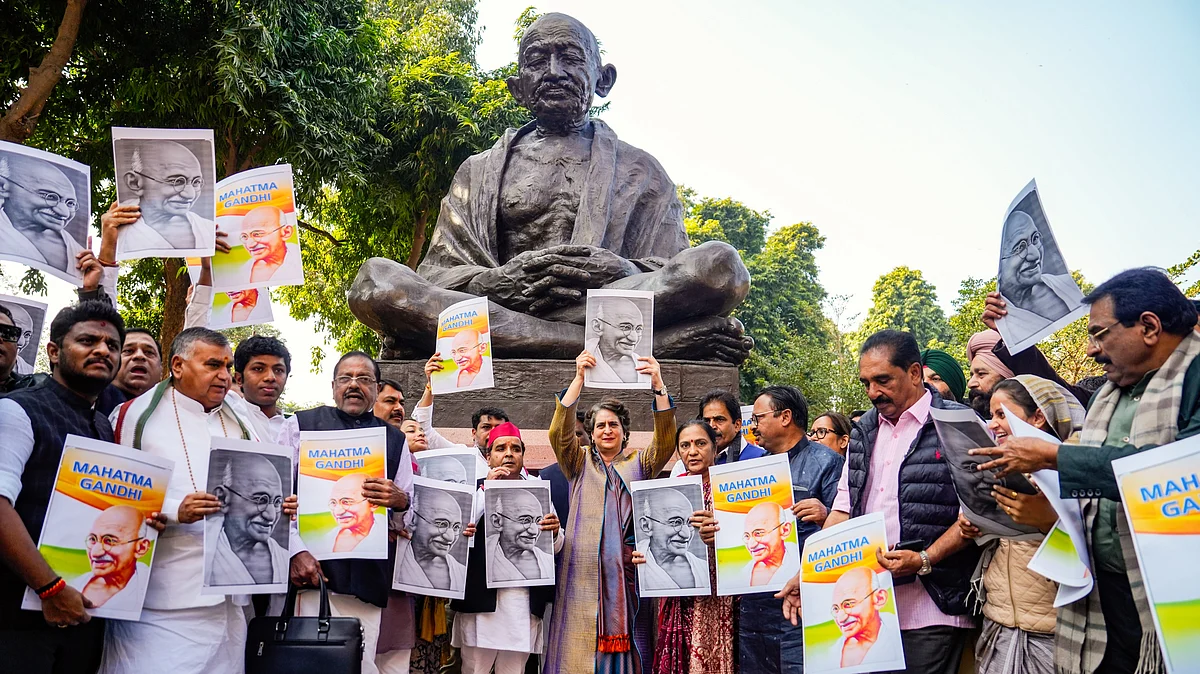


The Lok Sabha on Thursday passed a Bill to retire the two-decade-old Mahatma Gandhi National Rural Employment Guarantee Act (MGNREGA) and replace it with a freshly christened initiative promising 125 days of rural employment a year, amid loud protests from the Opposition and repeated assurances from the government that the change was, in fact, in Mahatma Gandhi’s best interests.
Replying to an eight-hour debate on the Viksit Bharat Guarantee for Rozgar and Ajeevika Mission (Gramin) — abbreviated into the more manageable VB-G RAM G — rural development minister Shivraj Singh Chouhan said the overhaul was necessary to “fix” a scheme that had only managed to function for 20 years, several governments, and a few lakh crore rupees.
Before its ceremonial retirement, MGNREGA had quietly become one of India’s largest social safety nets, guaranteeing wage employment during agricultural lean seasons, distress migration and crises ranging from droughts to the pandemic. For millions of rural households, it functioned less as a development experiment and more as a fallback employer of last resort, with legally guaranteed work and time-bound wage payments — at least on paper.
It was precisely this statutory guarantee, along with the decentralised planning process and social audit provisions, that made the scheme politically inconvenient. Critics of the new law have flagged concerns that while the promised increase in workdays sounds generous, the shift in emphasis from wage employment to asset creation and infrastructure aggregation could dilute the employment guarantee itself, leaving rural workers dependent on administrative discretion rather than legal entitlement — and a scheme once identified by its clarity now rebranded into an acronym few can pronounce.
State governments, particularly those ruled by the Opposition, have also flagged an older and more immediate concern: money. Under MGNREGA, delays in fund releases, pending wage payments and mounting arrears had already turned the scheme into a centre–state friction point, with several states accusing the Union government of using funds as a lever of compliance.
Critics now worry that the new framework, with greater centralised control over asset creation and infrastructure 'stacks', could further weaken states’ fiscal autonomy while leaving them to manage the political fallout of unpaid or delayed work.
There is also apprehension that without an explicit, enforceable guarantee backed by predictable funding flows, rural employment could become contingent on annual allocations and administrative approvals rather than statutory obligation. For states with high demand for wage employment, the fear is that the promise of more workdays may exist on paper, while the burden of implementation — and public anger — remains firmly at the state and panchayat level.
Chouhan used much of his reply to explain that while the scheme carried Mahatma Gandhi’s name, its ideals had apparently been “killed” multiple times by the Congress, which, he said, had used Gandhi largely as a political accessory.
Under the UPA, the minister argued, MGNREGA was plagued by corruption, poor planning and misplaced spending priorities. “Funds were not allotted to the states as expected. MGNREGA was riddled with problems,” he said, adding that while the Act mandated a 60:40 labour-to-material spending ratio, only 26 per cent was spent on material, with the rest allegedly siphoned off.
The new Bill, Chouhan said, was the result of extensive deliberations that led the government to conclude that Rs 10–11 lakh crore should not be “merely” spent on wages, but instead redirected towards creating permanent assets — an insight that, by implication, had escaped policymakers for two decades.
“We have made provisions to improve employment,” he said, explaining that the same money would now also be used to build “fully developed villages”, neatly aligning rural wages with the broader vision of Viksit Bharat.
The new scheme will focus on water security through lakes, micro-irrigation channels, core rural infrastructure, livelihood assets and special works to mitigate extreme weather events.
All assets created will be aggregated into the Viksit Bharat National Rural Infrastructure Stack, completing what the government described as a long-overdue conceptual upgrade.
At the start of the debate, Congress MP K.C. Venugopal urged Speaker Om Birla to refer the Bill to a parliamentary committee for closer scrutiny. Birla declined, noting that the House had already debated the Bill for eight hours, with 98 members speaking well past midnight — a process evidently deemed sufficiently thorough.
As Opposition MPs shouted slogans and tore copies of the Bill, Chouhan accused them of insulting Mahatma Gandhi and “murdering” his ideals. “Just having your say and not listening to others too is violence,” he said, after listening to members until 1.30 am.
The minister asserted that the Modi government was now the true custodian of Gandhi’s legacy, listing pucca houses under PM Awas Yojana, LPG connections under Ujjwala, toilets under Swachh Bharat and healthcare under Ayushman Bharat as proof that Gandhi was alive and well — administratively speaking.
He also reminded the Opposition that the Congress had originally launched the scheme as NREGA, adding Mahatma Gandhi’s name only in 2009, conveniently close to a general election. “It was Prime Minister Narendra Modi who implemented MGNREGA in a proper manner,” Chouhan said.
As Opposition MPs crowded the well, tore copies of the Bill and flung them towards the Chair, the Lok Sabha passed the VB-G RAM G Bill by a voice vote. The House was adjourned for the day soon after.
The government described the Bill as a “major overhaul” aligned with the vision of Viksit Bharat 2047 — offering more workdays, fewer references to Mahatma Gandhi, and the assurance that this time, the rural jobs programme has finally been fixed.
With PTI inputs
Join our official telegram channel (@nationalherald) and stay updated with the latest headlines