


Stalin issues ‘final warning’ to Centre, burns delimitation Bill in protest
Tamil Nadu chief minister escalates opposition with black flag demonstrations and sharp message to Modi government
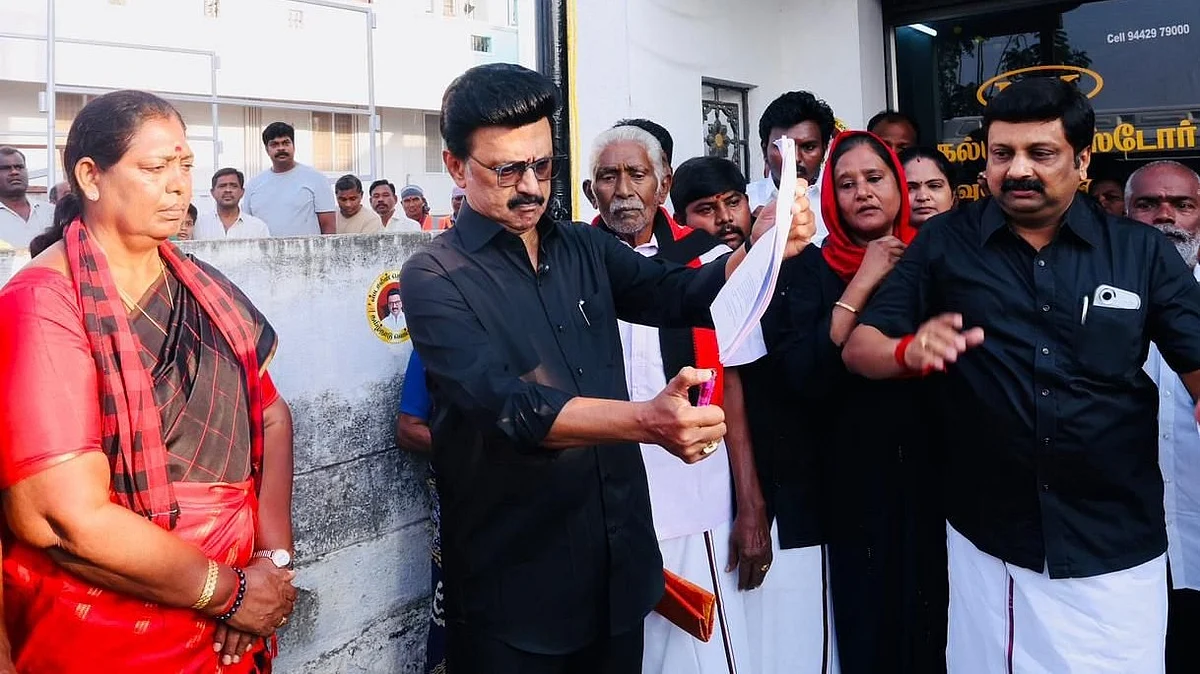


Tamil Nadu chief minister M.K. Stalin on Thursday stepped up his protest against the Centre’s proposed delimitation exercise, issuing what he described as a “final warning” while publicly burning a copy of the draft legislation.
Leading a demonstration in Namakkal, Stalin set fire to the proposed Delimitation Bill and hoisted a black flag, signalling strong resistance to the Centre’s plans. In a parallel gesture, a black flag was also raised outside his residence in Chennai as part of a coordinated statewide protest.
The chief minister had earlier called on citizens across Tamil Nadu to display black flags atop their homes, branding the proposed law as a “black law” that could undermine the state’s political representation.
The protests coincide with a special session of Parliament scheduled from 16 to 18 April, during which the Union government is expected to introduce key measures, including the Constitution (131st Amendment) Bill and the Delimitation Bill. These proposals aim to redraw parliamentary constituencies and pave the way for implementing 33 per cent reservation for women in the Lok Sabha.
In a video statement shared on social media, Stalin warned the Centre and Prime Minister Narendra Modi against proceeding with delimitation in a manner that disadvantages southern states.
He questioned whether constituency delimitation was being used to penalise states like Tamil Nadu that had successfully implemented population control measures. He also alleged that the proposed changes would disproportionately favour northern states and were being pursued without adequate consultation with state governments.
“This is Tamil Nadu’s final warning,” Stalin said, adding that if the state’s interests were harmed, it would trigger widespread resistance. He further cautioned that the country could witness a resurgence of the DMK’s earlier, more assertive political stance if the proposals went ahead.
The chief minister emphasised that principles and ideology took precedence over electoral considerations, asserting his role not just as a political leader but as head of the Dravidian movement.
The Centre’s proposals are linked to a long-pending delimitation exercise based on updated population data. At present, the composition of the Lok Sabha is based on the 1971 Census, with 543 elected members. The new plan could increase the strength of the House to around 850 seats, including representation for Union Territories, and reserve a significant portion for women ahead of the 2029 general elections.
However, the move has sparked concern in several southern states, particularly Tamil Nadu, over fears that a population-based redistribution of seats could dilute their representation in Parliament.
Reiterating his opposition, Stalin said Tamil Nadu’s Members of Parliament would actively raise the issue during the special session. The black flag demonstrations across the state are being viewed as a strong political signal as Parliament prepares to debate the contentious proposals.
With IANS inputs
Join our official telegram channel (@nationalherald) and stay updated with the latest headlines