


'Arrogant' Modi govt treating students as ‘enemies of nation’: Sonia Gandhi
Congress leader says protests stem from a failing education system and government's unwillingness to engage with criticism
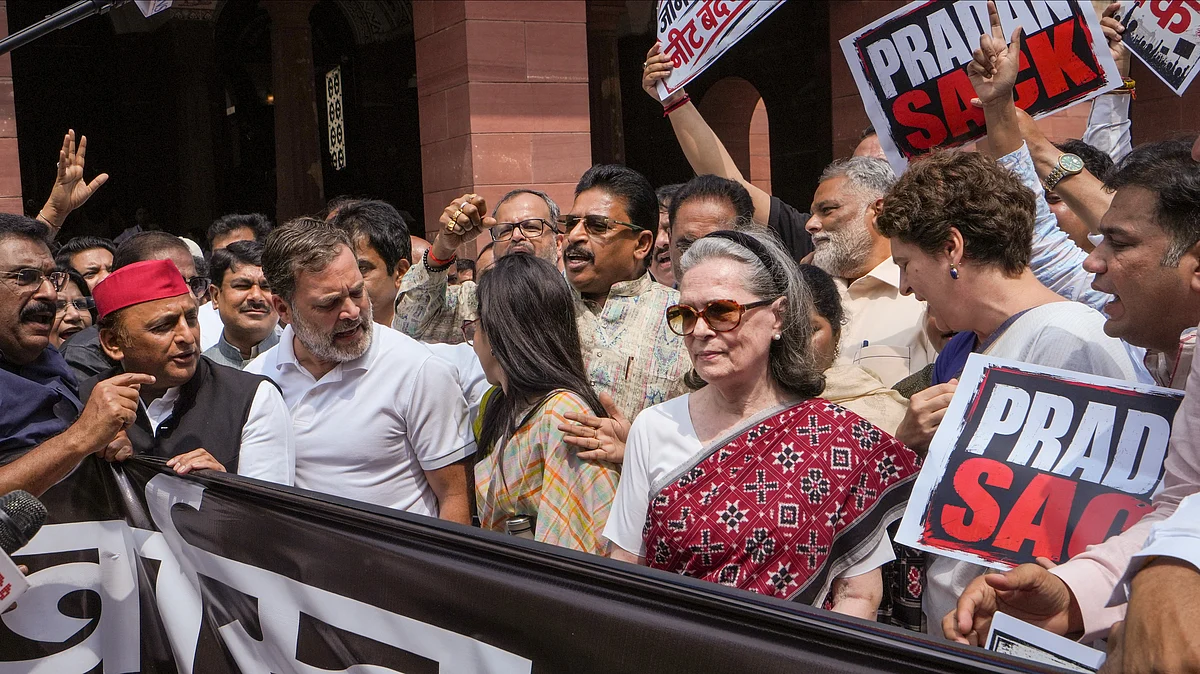


In a broadside against the Modi government, Congress Parliamentary Party chairperson Sonia Gandhi on Friday said students have demanded accountability and educational reforms, but the current regime has responded to their courage with "cowardice and wanton cruelty, treating them not as inheritors of the future but as enemies of the nation".
She accused the government of degrading India's education landscape and asserted that the country's students have called the Modi regime's bluff.
In a strongly worded opinion article titled "An education system's collapse, young India's trauma," published in The Hindu, Sonia Gandhi argued that the wave of student protests sweeping across the country is not an isolated outburst but the inevitable consequence of years of policy failures, institutional neglect and what she described as the Modi government's "arrogance" and refusal to accept accountability.
"Their demands have been straightforward and to the point: accountability from the Government of India and education reform. The Narendra Modi government has responded to their courage with cowardice and wanton cruelty, treating them not as inheritors of the future but as enemies of the nation," Sonia Gandhi wrote.
Calling it a "moral, political and constitutional duty" to stand with students, the former Congress president said the government's actions had not only degraded India's education landscape but had also left an entire generation disillusioned about its future.
According to Sonia Gandhi, the protests are rooted in two interlinked realities — a rapidly deteriorating education system and a government unwilling to engage constructively with criticism.
"The student protests are a natural consequence of these interrelated forces: today's bleak education landscape, which evokes only hopelessness, and the Modi government's trademark arrogance and unwillingness to be accountable or constructive," she said.
Drawing parallels with earlier movements, Sonia Gandhi alleged that the use of force against students follows a familiar pattern under the present regime.
She recalled the police action during the Citizenship (Amendment) Act-National Register of Citizens protests in 2020, when university campuses witnessed heavy deployment of police and paramilitary personnel, and also referred to the crackdown on protesting wrestlers.
"The brutality perpetrated by police personnel functioning under the direct authority of the Union Home Minister on student protesters is hardly unprecedented for this regime," she wrote.
Referring to the police action during the 20 July 'Sansad Chalo' march, Sonia Gandhi described the day as "a day of infamy", alleging that the Delhi Police and Central Armed Police Forces resorted to lathi charges, tear gas and pellet firing to disperse peaceful demonstrators.
She claimed numerous students were injured and alleged that even those returning home after the protests were not spared.
"The nation has seen some of the most depressing visuals of youth whose bodies have been scarred by pellets, the use of which would undoubtedly have been approved by Union home minister Amit Shah himself," she wrote.
"The videos from that day are seared into our memories and have stirred our collective conscience. Only the government and its captive media are spinning stories around this spontaneous rising tide of protest. It is time to say loud and clear: Stop, these are our sons and daughters, our young men and women," Sonia Gandhi added.
Accusing the government of consistently choosing confrontation over dialogue, Sonia Gandhi said the Modi administration had developed a pattern of suppressing dissent — whether from farmers, activists or now students.
"The pattern is clear, from farmers to activists. But this week, even a government as insensitive as the one that has set new standards of authoritarian governance sank to a new low. Instead of reaching out with understanding to our future doctors and engineers, teachers and civil servants, entrepreneurs and nation builders, it unleashed the repressive power of the state on them. This can neither be forgiven nor forgotten," she said.
She further alleged that the government had once again resorted to branding dissent as anti-national instead of examining the reasons behind the unrest.
"The Modi government has reached deep into its bag of tricks to cast aspersions and peddle conspiracies when what it should have done is to introspect on its policies that have motivated the protests," Sonia Gandhi said.
Turning to policy, Sonia Gandhi argued that the first major crisis stems from what she described as the government's steady withdrawal from public education.
She claimed the Centre had reduced the share of its overall Budget allocated to school education by 50 per cent and to higher education by 33 per cent, while nearly one lakh public schools had shut over the past 12 years even as around 43,000 private schools opened during the same period.
"Can anyone see the sense in such an absurd retreat?" she asked.
Sonia Gandhi also alleged that many of the newly established private schools are run by the Rashtriya Swayamsevak Sangh and its affiliated organisations.
She argued that shrinking access to affordable public education has forced families to spend heavily on private schooling and coaching, claiming that expenditure on NEET coaching alone now rivals the government's total investment in public education.
"The acute desperation of our students is a direct consequence of the privatisation and commercialisation of education," she wrote.
The Congress leader also questioned the functioning of India's public examination system, alleging that it has become increasingly centralised, privatised and politicised.
She criticised the National Testing Agency (NTA), saying the shift from university and state-level entrance examinations to centrally conducted tests such as CUET has exposed students to repeated administrative failures.
Describing the NTA as a chronically understaffed institution dependent on private contractors, Sonia Gandhi alleged that the examination body often relies on individuals with political affiliations rather than leading academics.
"The end result of this process has had stark consequences — 152 paper leaks occurring across the country in the past 12 years, including nine by the NTA itself since it was formed in 2017," she claimed.
Sonia Gandhi further argued that securing quality employment after graduation has become increasingly difficult, compounding the anxiety among young people.
"But the last nail in the coffin has been the Modi government's consistent and conscious policy of evading accountability and avoiding good-faith conversations on education," she wrote.
She also targeted Union education minister Dharmendra Pradhan, accusing him of disregarding recommendations made by Parliament's Standing Committee on Education to strengthen the NTA simply because Opposition members were part of the panel.
"His unwillingness to resign from office despite these monumental failures has only further inflamed public opinion," Sonia Gandhi asserted.
Concluding her article, Sonia Gandhi maintained that India's students have exposed what she called the government's failures and insisted that protecting their aspirations must remain a national priority.
"The country's students have called the Modi regime's bluff," she said, urging the government to abandon confrontation in favour of accountability, dialogue and meaningful education reforms.
With PTI inputs
Join our official telegram channel (@nationalherald) and stay updated with the latest headlines