


Not Modi or Shah, Prajapati from Surat most talked about Gujarati in Kolkata
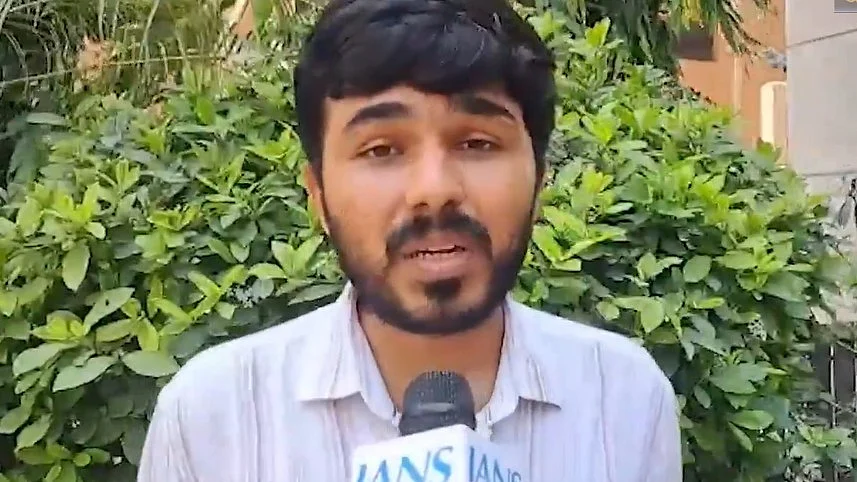
A young man, apparently a BJP worker from Surat, has been grabbing eyeballs on both TV channels and social media


Both Prime Minister Narendra Modi and Union home minister Amit Shah spent several days campaigning in West Bengal and camping in Kolkata. Besides other things, Shah declared that Kolkata was a "city of slums". In his turn, PM Modi declared that while the capital was not a "slum city", its pride Jadavpur University had descended into anarchy and had become a den of, what else, "urban Naxals".
Both comments drew attention in the media; but as West Bengal gears up for counting day tomorrow, 4 May, another Gujarati, a young man from Surat, is the one who has emerged as the most talked about Gujarati in the state.
Deep Prajapati first drew attention in the third week of April when a reel began circulating of him chatting with a group of young women sitting together on the stairs of what appeared to be a college or university. The video was shot by a companion from behind as Prajapati distributed forms for ‘Annapurna Bhandar’, the BJP election offer meant to counter Mamata Banerjee’s Lakshmir Bhandar scheme with a monthly cash transfer to women of Rs 3,000.
He had come all the way from Gujarat because he felt sorry for West Bengal, he was heard saying condescendingly. The women must vote for the BJP if they wanted a change for the better, he earnestly added. The women politely smiled and shook him off.
Possibly drawn by the reel, which was shared widely, Bengali TV channel ABP Ananda caught up with him. This time in chief minister Mamata Banerjee’s constituency Bhabanipur. Prajapati, asked what brought him to the city, claimed he was visiting relatives. As an Indian citizen he was free to travel anywhere he liked, he belligerently added.
As to why he was loitering in Bhabanipur — prompting Trinamool Congress workers to single him out as an outsider who was not a voter in the constituency, possibly referring to the West Bengal chief electoral officer's directive that non-voters were to leave the constituencies even if they were visiting — he said he was just a visitor to the city, not a BJP worker. But he was aware of the "pathetic situation" in West Bengal and it was his duty to document it. As a young citizen, he told ABP Ananda, it was his responsibility to highlight the plight of Bengal. He was not committing any crime, he added.
Despite claiming he was just a casual visitor, he shared videos of a table occupied by BJP workers — seven or eight of them — on polling day in Bhabanipur, gleefully pointing to an adjacent Trinamool Congress table being manned by just one fidgety worker.
He popped up once again at the strongroom where EVMs used in the Bhabanipur constituency were kept. TMC workers claimed the strongroom was opened to BJP’s agents without informing TMC, that BJP workers were being allowed to count postal ballots.
A ruckus followed as TMC workers, alerted by the scouts at the spot, gathered and started raising slogans. Banerjee herself appeared to find out what was happening. When she finally drove out of the complex, she stopped to speak to the media and showed a video clip of BJP workers inside. Sure enough, Prajapati was prominently visible.
This time, a national TV channel, NDTV, jumped in and reported the incident. The channel also apparently aired a brief conversation with Prajapati, who parroted the line that he was just visiting his relatives in the city. This time, the TMC delved into Prajapati’s social media pages and outed photographs that established him as a BJP worker from Surat.
Prajapati has generated considerable interest and triggered some sharp questions. “Can a Bengali go to Gujarat and campaign against the BJP or visit Uttar Pradesh and speak against Yogi Adityanath in public and on TV channels? Can anyone visit BJP-ruled states and move freely, openly abusing governance in the state on regional TV channels?” asked Bengalis on social media.
They seemed both proud of their state which allows dissent and such freedom; proud that West Bengal Police ignored the provocations directed at the ruling party, which did not lead to violence — contrary to the image of the state. They also sounded outraged at the impunity with which Gujaratis were abusing the state.
Join our official telegram channel (@nationalherald) and stay updated with the latest headlines