


ONOE and the question of federalism
The Kurian Joseph committee report calls for sweeping reforms to restore the balance of Centre-state relations


In December 2025, the Lok Sabha extended the tenure of the joint parliamentary committee examining the draft ‘One Nation, One Election’ (ONOE) Bill to the last week of the 2026 Budget session. The legislation is likely to be introduced and passed before the session ends on 2 April, unless deferred. It has already been ruled that the Bill will not need ratification from 50 per cent of the states.
The Centre has increasingly been flexing its muscles to show who’s the boss. States have been made to surrender both autonomy and finances without promised gains, while Union cesses and surcharges — rising from Rs 1.99 lakh crore in 2016-17 to Rs 5.82 lakh crore in 2026-27 — have shrunk the divisible pool. Politicisation of constitutional offices and interference in state policies, from education and health to language, has intensified, as seen in the abrupt reshuffling of governors.
All of a piece with the Centre showing the states the middle finger. And all the more reason why the Justice Kurian Joseph Committee report on Centre-state relations is so significant.
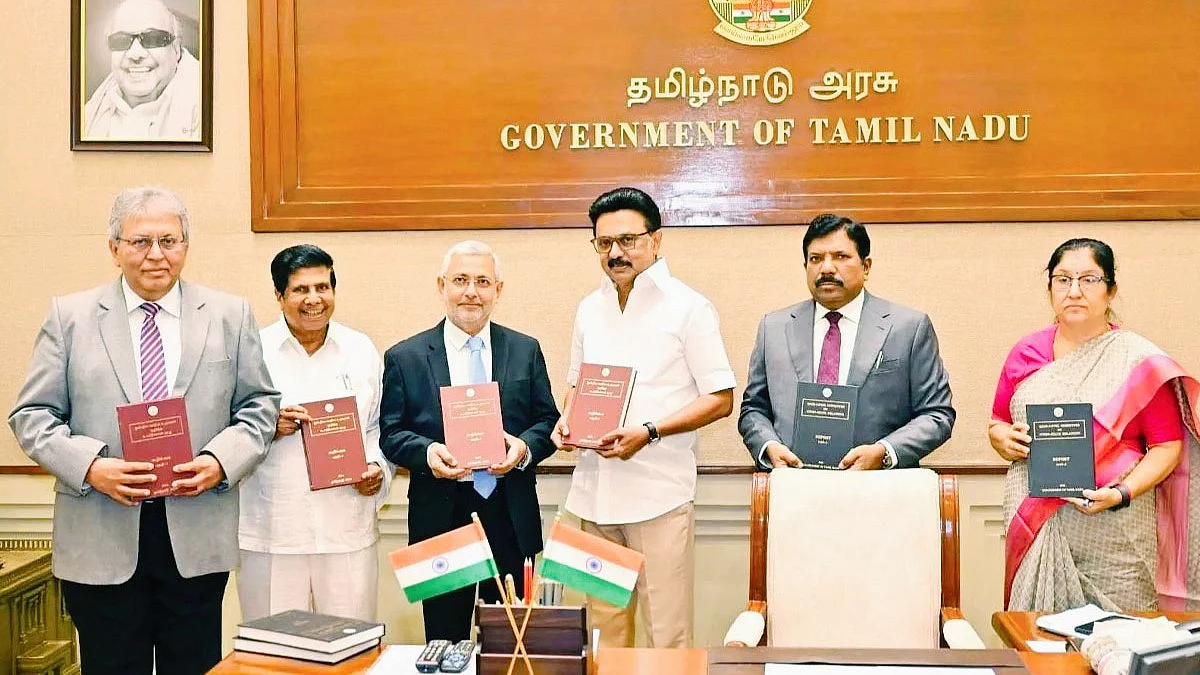
Chaired by a former Supreme Court judge, Part I of the report — in Tamil and English — was tabled on 16 February in the Tamil Nadu Assembly. It covered 10 key subjects, including language policy, the appointment and role of Governors and state responsibilities in framing policies related to education, health, delimitation, elections and GST.
The integration of 552 princely states with British India between 1947 and 1950 shaped the Constitution’s tilt towards a strong Centre. But, argued Tamil Nadu chief minister M.K. Stalin while appointing the committee in April 2025, this model has failed to deliver.
The report notes that despite the Supreme Court’s emphatic ruling in S.R. Bommai v. Union of India (1994) that federalism is part of the ‘basic structure of the Constitution’, the drift towards the Centre continues.
On the move towards ONOE, the committee notes that the draft legislation ‘mandates truncated tenures, unexpired-term elections, and confers unguided discretion on the Election Commission to defer assembly polls… with benefits overstated and harms structural, the proposal violates the Basic Structure and should be withdrawn’.
Empowering the states, the committee argues, ‘is not to weaken the Union, but to right-size it — enabling it to focus on genuinely national responsibilities while restoring to the states the autonomy essential for effective governance… a Union that diffuses its energies across functions better performed by states and local bodies risks distraction from the larger national challenges that only it can address’.
In his letter to chief ministers accompanying the report, Stalin wrote, ‘Large ministries exist in New Delhi that duplicate states’ functions and often attempt to steer the states’ priorities through micromanagement and procedural oversight’.
In one of several interviews last year, Justice Joseph pointed out that while many — including responsible leaders — say ‘nation first,’ it should actually be ‘Constitution first’.
“It is the Constitution that has constituted the nation. Without it, India is not India,” he said, adding
that in changing times, “the relationship of the Centre and the states is something to be examined periodically. The fiscal relationship, the administrative relationship, the legislative relationship, in all these, the need of the hour must be tested.”
****
In 1967, C.N. Annadurai, Tamil Nadu’s first DMK chief minister, had quipped that just as a goat did not require a beard, a state too did not really require a governor.
Present chief minister Stalin — whose running battle with former governor R.N. Ravi was no secret — asserts, “In a democracy, governments are to be run by elected representatives, not by ceremonial appointees.” On 12 March, Ravi replaced Bengal governor C.V. Ananda Bose, following the latter's sudden resignation weeks before Assembly elections in both states. Neither state was consulted.
Also Read: The fantasy of ‘free and fair’ elections
The committee recommends that governors be appointed from a panel of three names approved by the state legislative assembly and given a single, non-renewable five-year term. It suggests that governors be removed before their term only through a resolution of the state assembly and the 13th schedule of the Constitution be redrawn to limit the discretionary powers of the governors.
Here’s a look at some key recommendations.
Article 368: A major structural concern identified by the committee is the flexibility of the constitutional amendment process under Article 368. This, it argues, allows significant alterations to federal balance without robust ratification by states or public consultation.
All constitutional amendments, the committee recommends, should require a two-thirds majority in each House of Parliament and most amendments should require ratification by two-thirds of the states representing two-thirds of India’s population.
Amendments affecting particular states should require ratification by those states alone and mandatory public consultation of three months should precede the introduction of constitutional amendment Bills.
Articles 2 and 3: The committee red flags Parliament’s unilateral power under Article 3 to reorganise state boundaries as inconsistent with the idea of states as secure constitutional units in a federation.
Creation of a new state should require state’s consent or, failing that, a referendum in the affected area. No territorial reorganisation should be undertaken when a state is under President’s Rule. A new Article 3A should prohibit the creation of new Union Territories and mandate periodic referendums for existing ones.
Separate Election Commissions: The Committee recommends limiting the Election Commission of India to conducting elections to the Lok Sabha, the Rajya Sabha and Union territories while entrusting state assembly elections to independent state election commissions. It calls for the withdrawal of the Constitution One Hundred and Twenty-ninth Amendment Bill, 2024, which proposes simultaneous elections, terming it harmful to federal balance and legislative accountability.
Anti-defection law: The committee proposes a six-year ban for defectors from contesting elections, deletion of the merger exception and treating strategic resignations as defections. It also recommends transferring adjudication from the Speaker to high courts with strict time limits, criminalising inducements for defection.
Give education back to states: The committee recommends reversing the 42nd constitutional amendment and moving education, including medical education, back to the State List. It also recommends freeing to universities from central regulatory control and restricting the Union government’s interventions strictly to academic standards.
It recommends disbanding the National Testing Agency, abolishing NEET and NExT by amending the National Medical Commission Act, 2019 and replacing the all-India quota with a voluntary state-determined quota.
GST Council reforms and fiscal autonomy: The committee proposes reducing or eliminating the Union’s veto power, clarifying that GST Council recommendations are advisory in nature and allowing states to vary SGST rates within a limited band. It recommends an independent GST Council Secretariat, a statutory GST Dispute Settlement Authority chaired by a retired Supreme Court judge, instituting an annual GST rate calendar and enforcing a ‘one product one rate’ principle.
****
Other important recommendations include freezing delimitation until 2126, extending the inter-state seat-allocation freeze based on the 1971 Census till 2126, or until total fertility rates converge; declaring English a permanent link language; separate Union and state delimitation commissions and equal representation of states in the Rajya Sabha, with six seats per state and abolition of nominated members to the Rajya Sabha.
Join our official telegram channel (@nationalherald) and stay updated with the latest headlines