


PM Modi’s ‘problematic’ speech leaves states guessing on delimitation
Gaurav Gogoi tells Lok Sabha that J&K delimitation used 2011 Census, while Assam’s was based on 2001 Census by ECI
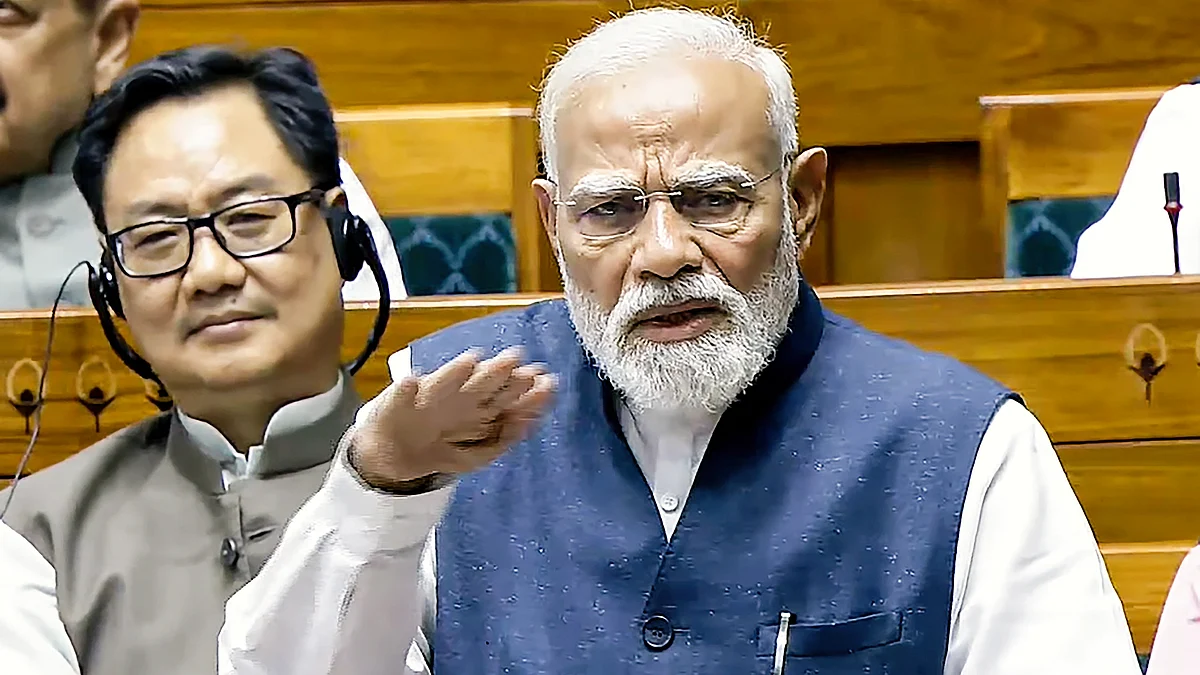


Prime Minister Narendra Modi’s relatively brief speech in the Lok Sabha on Thursday afternoon left several key questions unanswered. Notably, he did not explain why his government did not implement women’s reservation for the 2024 Lok Sabha elections, despite the Women’s Reservation Bill being unanimously passed in 2023. Nor did he clarify why the government now appears keen to implement the measure for the 2029 Lok Sabha polls, after removing conditions it had itself introduced in 2023.
Women’s reservation could, after all, be implemented without expanding the size of the Lok Sabha — an option the Opposition has repeatedly suggested in recent days. Reserving one-third of seats for women would necessarily reduce the number available to men, who remain disproportionately represented in Parliament.
Regional parties such as the Trinamool Congress already have around 40 per cent women MPs, demonstrating that greater representation is achievable within the existing strength of the House. Yet neither the BJP nor the prime minister has explained why such an approach is not being considered.
The prime minister’s speech was marked by expansive rhetoric on the role and contribution of women, but devoted little attention to the central issue at hand — the proposed Delimitation Bill. The rationale for increasing the strength of the Lok Sabha to 850 seats was not explained, nor was it clarified why this specific number was chosen instead of, for instance, 800 or 750.
Equally unclear is why no corresponding expansion has been proposed for state Assemblies. The Bills also leave the strength of the Rajya Sabha unchanged, without offering a justification.
Much of what the prime minister said in the Lok Sabha on Thursday, 16 April, was familiar. In a characteristically rhetorical address, he argued that women’s reservation could no longer be delayed — without acknowledging that the delay since the Bill’s passage in 2023 has occurred under his own government.
In a brief reference to delimitation — which has been linked with women’s reservation for reasons that appear largely political — the prime minister reiterated his assurance that no state would suffer as a result of the redrawing of constituencies and that each state’s proportional representation in the Lok Sabha would be maintained. However, the draft legislation circulated by the government barely a day-and-a-half before being introduced in the House contains no such guarantee.
More significantly, neither the prime minister nor the government has explained why they seek to alter the existing constitutional framework governing delimitation. Under the present scheme, delimitation is required after every census. Article 82 clearly provides that the process shall take place “upon the completion of each census…”.
The proposed 131st Constitutional Amendment, however, breaks this link. Under the new framework, delimitation would become an exercise undertaken only when Parliament chooses to pass a law to that effect. In effect, this would give future governments the discretion to decide when delimitation should occur and which Census data should be used, raising concerns about potential arbitrariness.
Facing criticism from southern states and several smaller states, the government may be compelled to introduce modifications to the Delimitation Bill that was tabled on Thursday. Indications have been given that a supplementary schedule may be added before the Bill is taken up for voting at 4.00 pm on Friday.
However, unless the assurance regarding preservation of the existing balance of representation between states is incorporated into the Constitution itself, such a concession would remain temporary and could be altered through a simple majority in the Lok Sabha at any time before 2029.
There was once a time when the prime minister’s statement on the floor of Parliament was treated as definitive. That is no longer the case. Concerns about the credibility of official assurances have grown in recent years, and the Opposition is seeking not merely verbal commitments but a constitutional guarantee that the principle of proportional representation between states will be preserved in any future delimitation exercise.
Join our official telegram channel (@nationalherald) and stay updated with the latest headlines