


Punjab: Drug menace or political capital?
The issue every party fixates on before an election and struggles to fix afterwards


Let’s rewind to December 2015. Addressing a rally at Talwandi Sabo, near Takht Damdama Sahib, Captain Amarinder Singh declared he would break the backbone of Punjab’s drug menace within four weeks of coming to power. In 2017, he was back as chief minister of a state caught in a spiral of addiction. Today, he can list the steps taken against the cartels. The backbone of the drug menace, however, remained unbroken.
This history matters because, only a few months away from Assembly elections, Punjab is once again being promised a drug-free future.
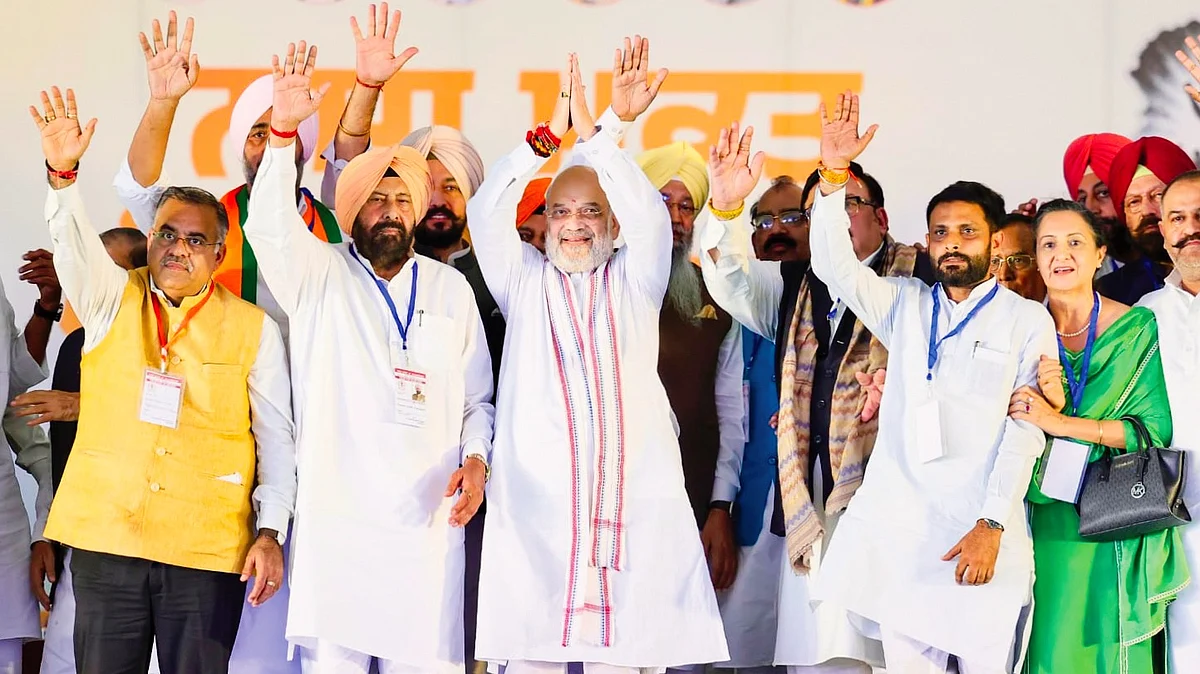
Amarinder Singh is now in the BJP, which has just concluded a 13-day statewide ‘Nasha Mukt Punjab Yatra’. The campaign was meant to cash in on the widespread drug issue for votes in 2027. The party brought in chief ministers of Haryana, Rajasthan and Uttarakhand, along with party president Nitin Nabin and Union home minister Amit Shah. Members of families ravaged by addiction were put on stage to give the campaign an emotional touch.
As the yatra neared its end, Amarinder gave a town-hall-style interview to journalists of The Tribune. One of his remarks was striking: “The BJP does not understand Punjab.”
The drug issue has begun appearing on billboards along the state’s highways, and no party is willing to let the other lay claim to what is becoming an important rallying point.
Chief minister Bhagwant Mann, sensing how the public may react to so sensitive a subject, has accused the Opposition of deliberately painting Punjab as a state plagued by drugs.
DGP Gaurav Yadav has offered numbers in support: 7,582 FIRs registered under the NDPS (Narcotic Drugs and Psychotropic Substances) Act since 1 March 2025, and a conviction rate of 89 per cent. This is being presented as proof that the ‘yudh nasheyan virudh’ (war against drugs) campaign is working.
Critics are unconvinced. The problem, they say, goes beyond statistics. The government’s attitude towards dissenting views on the issue is, they say, intolerant. Anti-drug activist Mohanjit Singh, who waved a black flag at the chief minister, was allegedly tortured by the police. Those who point to the government’s failures tend to find themselves in trouble.
The chorus against drugs has gained fresh momentum since 50-year-old Gulzar Singh killed himself on 7 September. He was allegedly harassed after questioning finance minister Harpal Singh Cheema about drugs being supplied to his area, at a 6 September event. Gulzar was the father of a drug addict. He had no political agenda, only what he had seen in his own home. His suicide has made him a symbol of what many families feel: that their pain is unwelcome when it embarrasses the powerful.
The episode also produced the first show of unity by the Punjab Congress. AICC general secretary in-charge of Punjab, Sachin Pilot, attacked both the AAP government and the BJP-led Centre. He recalled that AAP came to power in 2022 promising to make Punjab drug-free in three months, yet drugs remain easily available.
Shiromani Akali Dal chief Sukhbir Badal joined in, saying that four-and-a-half years on, the government’s own figures exposed the grim ground reality. At the Rakhar Punia gathering at Baba Bakala on 29 August, the Akali Dal (Waris Punjab De) pledged a comprehensive white paper on the drug crisis if voted to power.
With elections only about four months away, every party is attacking the other and promising a drug-free Punjab. Political commentator Prof. Manjit Singh is not impressed. Such assurances, he says, mean nothing.
Addiction, he points out, is not only a complex problem, but also one that touches a large number of people. And that’s exactly — if not only — why all parties raise it. His verdict is scathing: no one is serious. There is no concrete plan, no roadmap and no budget estimate. Above all, Singh says, there is no political will.
The reality behind all the slogans is a deeply entrenched, multi-layered crisis with consequences for public health, the economy and security. It has lasted over three decades and outlived governments of different hues. Successive leaderships have promised change, launched campaigns, set up specialised enforcement units and expanded rehabilitation.
Yet the crisis persists, which raises hard questions about the long-term effectiveness of these efforts.
Surveys, including those cited by parliamentary panels and dependence studies, suggest that millions are affected, with opioid users running into lakhs. Among them is a worrying number of minors and young adults.
The trade is also no longer simply a matter of law and order. Investigations into organised crime, weapon smuggling and attacks on law enforcement often point to a narco-terror nexus funded or coordinated by external handlers.
Punjab does not produce drugs. The crops from which they are made are not grown in this state. But its geography, with a porous international border, has made it a natural transit route and, increasingly, a target. Opium and poppy husk were once dominant. Today it’s heroin and high-potency synthetic drugs and smugglers are using cross-border drones, which complicate border security.
Earlier this century, Indian Punjab and Pakistani Punjab were both part of what was called the Golden Crescent, a major transit corridor for opium and related drugs out of Afghanistan. Within two decades, the transit point has turned into a consumption centre. Punjab is now more market than corridor.
A few months ago, AAP chief Arvind Kejriwal claimed that most drugs once came across the border from Pakistan. Now it’s only about 20 per cent, with 80 per cent arriving through various ports in Gujarat. Though that may well be a political barb aimed at Narendra Modi, it’s not entirely without substance. Large drug consignments have been seized from Mundra and other ports in the not-too-distant past.
It is equally true that a border state like Punjab cannot deal with a problem of this magnitude on its own. It needs the active help of the Union government, in intelligence, border management and control over supply routes.
That is why mutual finger-pointing between the state and the Centre helps no one.
There is also the question of idle hands. Unemployment, rural and urban, is aggravating the situation, and Punjab is among the top five states on this count.
A young person with no work and no future is easy prey for peddlers. Enforcement without employment won’t make the problem go away.
Each of the parties now shouting about drugs has governed Punjab, both singly and in partnership, or ruled at the Centre. Each has had its chance and made its promises. Posters and yatras will not save a generation. What Punjab needs is a funded, time-bound, non-partisan plan that combines tough policing, serious rehabilitation, border control, port security — and jobs.
Until then, the drug menace will remain what it has been for thirty years: the issue every party fixates on during an election and struggles to fix afterwards.
Join our official telegram channel (@nationalherald) and stay updated with the latest headlines