


Punjab: Religious summons and political rehearsals
Three weeks into the new year, one issue has dominated all others: CM Bhagwant Mann’s appearance before the Akal Takht
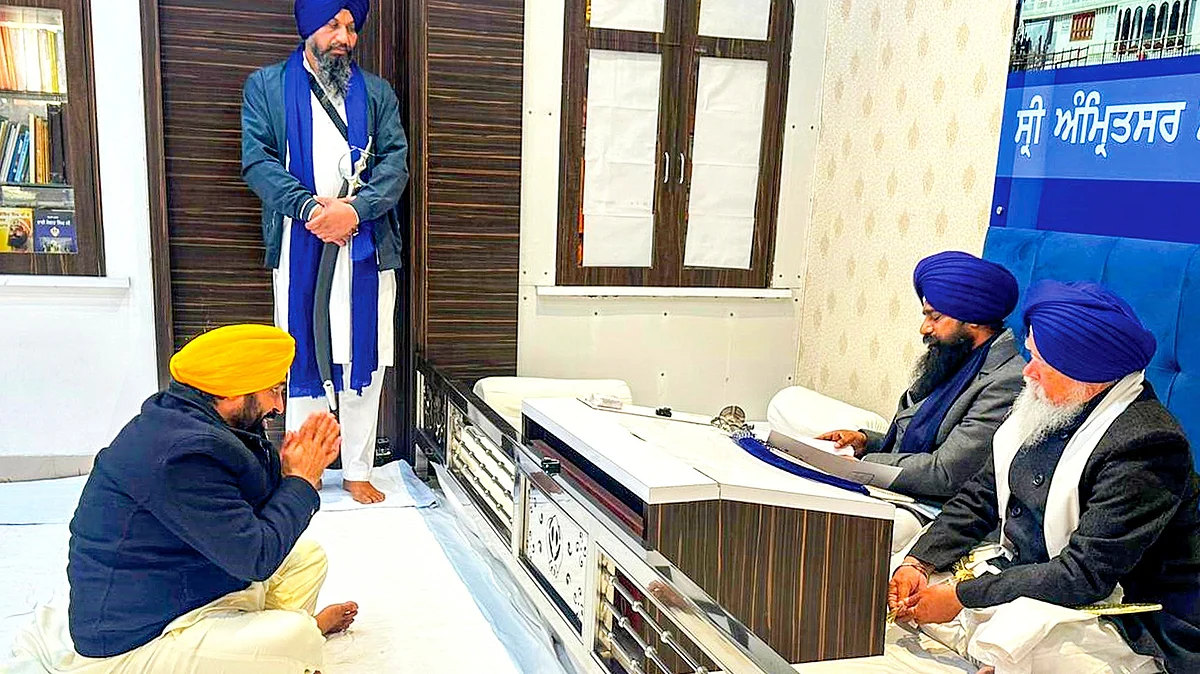


In Punjab’s political theatre, controversies rise and fade with remarkable speed. Yet, three weeks into the new year, one issue has dominated all others: chief minister Bhagwant Mann’s appearance before the Akal Takht.
The summons was the result of a cluster of controversies, largely rooted in Mann’s outspoken remarks, which the Akal Takht felt transgressed the sanctity of Sikh tradition. It also sought an explanation for a video that Mann and his party described as fabricated.
For Mann and the Aam Aadmi Party, this posed an unfamiliar test. Their initial response revealed their uncertainty; a party spokesperson even accused the Shiromani Akali Dal of using the SGPC as a political tool. Mann himself first insisted that he would appear only if the proceedings were broadcast live — a demand the Akal Takht rejected, unwilling to turn a solemn religious forum into a reality show. As the seriousness of the moment sank in, internal dissent faded, and Mann announced he would appear barefoot and submit his explanation.
History offers some perspective here. Four Punjab chief ministers, including Mann — and even late President Giani Zail Singh — have previously been summoned by the Akal Takht. What made this instance different was the venue. Mann was asked to appear before the Akal Takht Secretariat, not its fasil or platform, on the grounds that he is not an Amritdhari Sikh and was therefore termed a ‘pattit’ Sikh. This distinction opened a deeper fault line: can every non-Amritdhari Sikh be labelled thus?
The controversy widened within the SGPC itself. Former president Bibi Jagir Kaur wrote to the current president Harjinder Singh Dhami, and Akal Takht Jathedar Kuldeep Singh Gargaj, arguing that his mere presence violated Sikh sanctity, since only an Amritdhari Sikh can be summoned by the Akal Takht.
When Mann finally arrived on 15 January, he carried two bags, reportedly containing documents to prove his innocence. After the hearing, Jathedar Gargaj told the media that the chief minister had shown humility, accepted fault on several counts and acknowledged that certain statements should not have been made.
With that, the immediate political din subsided. But the matter itself remains unresolved. The full record of Mann’s appearance will now go before the five Singh Sahiban (punj pyaras), whose judgment — punishment or acquittal — will determine how this chapter ultimately ends.
Political circus
This year, the annual Maghi Mela at Muktsar Sahib was less a religious congregation and more a crowded political circus. With the sole exception of the Congress, every major party in Punjab erected its own pavilion and staged large rallies. As a result, news flowing out of an event commemorating the 40 martyrs of the Battle of Muktsar was more political than spiritual.
The largest show was mounted by the Aam Aadmi Party. Its opulent pavilion had already attracted attention, amid allegations that nearly 1,600 buses were arranged to ferry supporters. Alongside the chief minister and his cabinet colleagues, senior leader Manish Sisodia was also present.
Mann’s speech made headlines when he referred to the recovery of 169 out of 328 missing copies of the Guru Granth Sahib from the SGPC, a remark that also appeared to generate sympathy on the eve of his appearance before the Akal Takht.
For the AAP, Muktsar Sahib is familiar political ground. The party had used the 2016 Maghi Mela as a launchpad when it was still new to Punjab. This year’s mobilisation carried echoes of that moment, with an eye firmly on the 2027 Assembly elections.
The Shiromani Akali Dal, led by Sukhbir Badal, was not far behind. Taking the stage, Badal reeled off a series of assurances that effectively resembled a draft manifesto for the next elections.
For the first time, the BJP also set up a separate stage. Previously, it had shared space with the Akali Dal at such events. Union minister Anurag Thakur, Ravneet Singh Bittu, Punjab BJP president Sunil Jakhar and Haryana chief minister Nayab Singh Saini — once again wearing a saffron turban — were present.
In Punjab’s political circles, Saini’s frequent appearances at religious events are seen as part of the BJP’s attempt to carve out space in the state. The stage rang with praise for the ‘double-engine government’, though the crowd was thinner than at other rallies.
Simranjit Singh Mann’s Akali Dal (Amritsar) and Waris Punjab De — the party of MP Amritpal Singh, currently jailed in Dibrugarh under the NSA — also held their own programmes.
The Congress alone stayed away. Citing a 2017 Akal Takht hukumnama (edict) against political events on religious occasions, state party chief Amarinder Singh Raja Warring said the Congress did not believe in mixing religion with politics.
Absence does not mean irrelevance. With elections still a year away, the political churn set in motion at Muktsar will no doubt continue.
Join our official telegram channel (@nationalherald) and stay updated with the latest headlines