


Sudhir Chaudhary’s poll on Yogi’s popularity produces an unexpected result
A poll intended perhaps to gauge support for Yogi Adityanath instead drew an overwhelming response in favour of Akhilesh Yadav
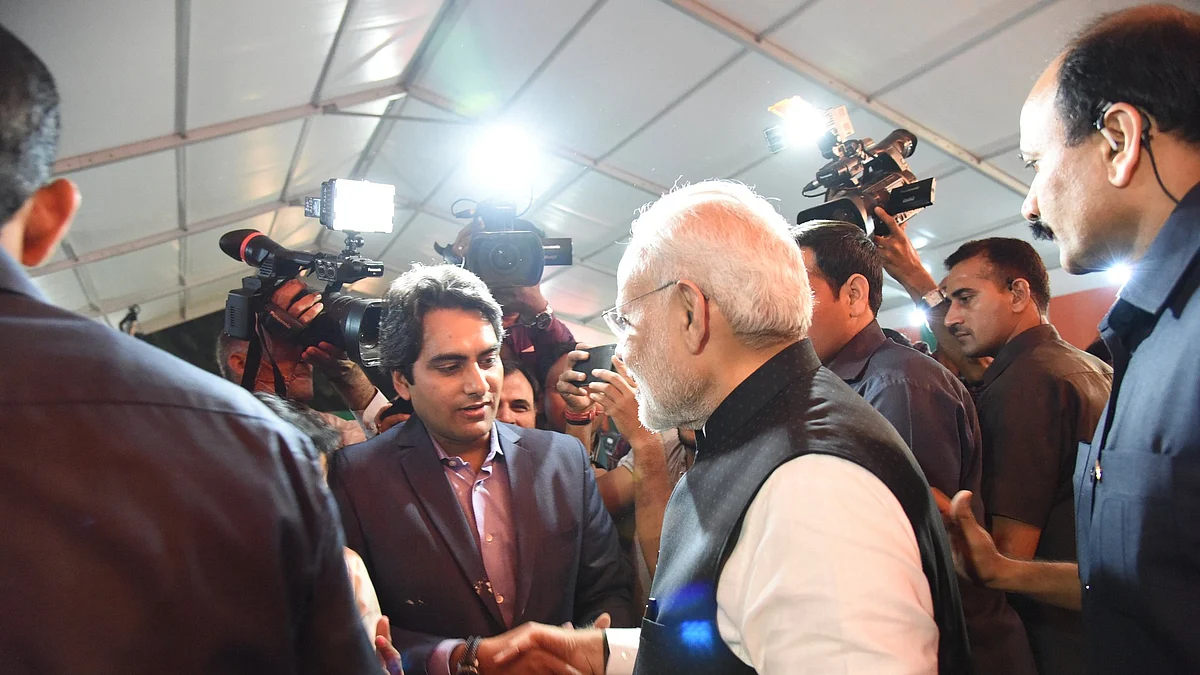


There is an old saying in Uttar Pradesh, particularly in the Purvanchal and Awadh regions: चौबे गए थे छब्बे बनने, दुबे बनकर लौटे [Choubey went out hoping to become Chhabey, but returned as Dubey]. It describes a situation in which an attempt to be clever ends up producing the opposite result. Something similar appears to have happened with Sudhir Chaudhary, who, after working with several pro-establishment television channels, is now working with Doordarshan.
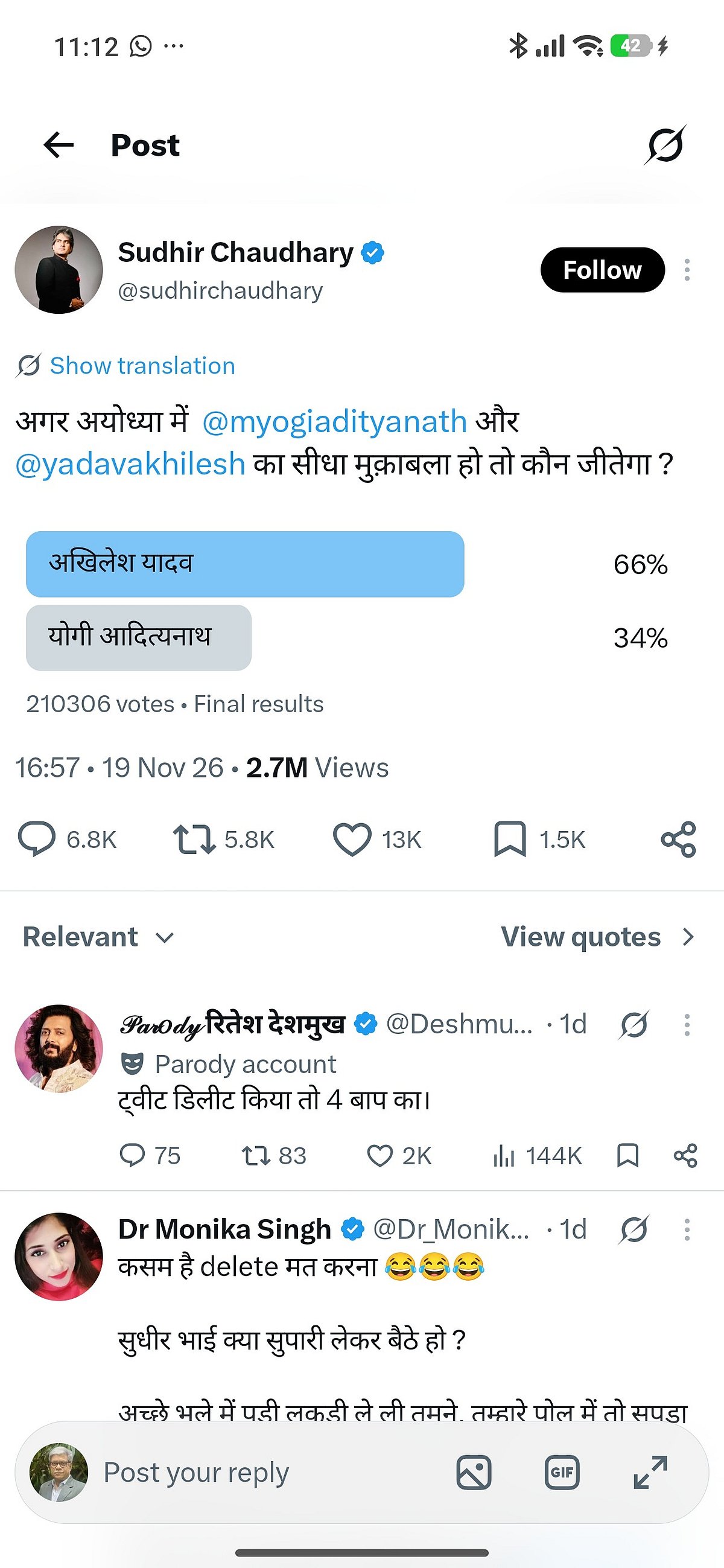
On 19 November 2026, Chaudhary conducted a live poll on social media platform X, the results of which may not have been what he expected. The question was straightforward: ‘If Yogi Adityanath and Akhilesh Yadav were to face each other directly in Ayodhya, who would win?’
Chaudhary may have expected a strong response in favour of Yogi, reinforcing the perception of the chief minister's popularity and the BJP's political standing in Ayodhya. The results, however, went in the opposite direction.
More than 200,000 people voted, with 66 per cent backing Akhilesh Yadav and 34 per cent choosing Yogi. The results soon became a subject of discussion and ridicule on social media. Chaudhary, for his part, acknowledged the outcome, tagging Akhilesh Yadav and congratulating him on “this splendid victory in Ayodhya”.
The episode presents an interesting irony. Journalism often seeks to interpret public sentiment and explain the political mood of the electorate. In this instance, however, a journalist's own poll produced a result that challenged the assumptions behind the question.
There is another aspect to the episode. Reports had earlier suggested that around Rs 15 crore a year was being proposed for Chaudhary's programme on Doordarshan. The amount was not his personal salary, but reportedly the proposed annual contract for the programme produced by a company associated with him. It is worth noting that a prominent face associated with a public broadcaster is now facing questions on social media over the outcome of his own poll.
Chaudhary's name had also figured in a 2012 case involving an alleged attempt to extort money from Naveen Jindal's company through a purported Rs 100-crore advertising deal. He was arrested and spent around 20 days in judicial custody at Tihar Jail. He was subsequently granted bail, and the matter was later settled. It would be inaccurate to describe this as a case in which he served a sentence. Nevertheless, the episode has periodically brought questions about journalistic credibility into public discussion.
Returning to the latest poll, an obvious question arises: why did Chaudhary choose to conduct it? Was it simply an attempt to gauge public opinion on a hypothetical contest between Yogi and Akhilesh in Ayodhya? Or did he expect the exercise to produce another indication of Yogi's popularity?
If the latter was the intention, the outcome offers a lesson about the risks of framing questions around political assumptions. Attempts to create a favourable narrative for those in power can sometimes produce responses that do not fit the expected script. This is worth reflecting on, particularly for journalists who seek to shape rather than merely interpret public opinion.
At the same time, a poll on social media cannot be treated as an election survey. Its results do not represent the views of the entire state, nor can they be taken as a reliable prediction of electoral outcomes. Yet, with more than 200,000 people participating, the response cannot be dismissed as insignificant either. The poll has consequently triggered a wider discussion on social media, with several users commenting on the contrast between the question and the result.
Perhaps the most significant aspect of the episode for Chaudhary is that the response came from the very audience whose opinion he had sought to gauge. In journalism, asking questions is important, but so is being prepared to accept answers that do not match one's expectations. That is particularly true of live formats, where the outcome is beyond the control of the person asking the question.
There is another familiar saying: दूसरों के लिए खोदा गया गड्ढा कभी-कभी अपने लिए भी मुसीबत बन जाता है। [Sometimes, the pit dug for someone else becomes one's own predicament]. Chaudhary's poll has offered a contemporary, digital-age illustration of that possibility.