


The saga of the mystery book that was hushed
No ban yet, but Naravane’s book in limbo for supposed ‘inaccuracies’ that could easily have been spelt out
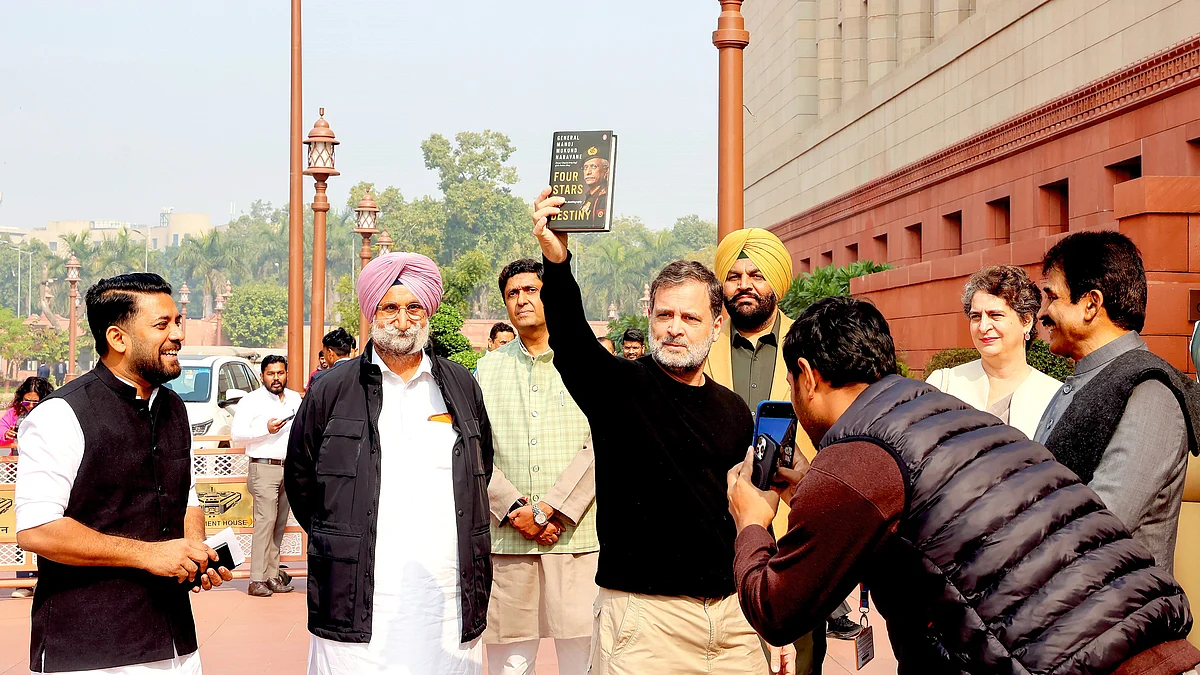


Did defence minister Rajnath Singh score a self-goal when he stopped Rahul Gandhi from reading out ‘five lines’ from former Army chief General M.M. Naravane’s memoirs, citing an essay published in Caravan magazine? If the government wanted to hide the contents of Four Stars of Destiny, it couldn’t have chosen a worse way. Several thousand people have since shared the PDF files of this ‘unpublished’ book.
Exactly a week after the shush-down in Parliament, Penguin Random House India issued a statement on 9 February saying it held the sole publishing rights to the book, and that ‘No copies of the book, either in print or digital form, have been published, distributed, sold, or otherwise made available to the public by Penguin Random House India.’ At around 10.00 pm, General Naravane shared this on X.
On 10 February, Rahul Gandhi arrived in Parliament with a hardbound copy of the book. Around 5.00 pm, General Naravane posted the publisher’s statement again, this time with a cryptic comment: ‘This is the status of the book’. Also on 10 February, the special cell of Delhi Police registered an FIR against the book’s illegal circulation online.
‘Upon verification, it was found that a PDF copy of a typeset book with the same title and apparently prepared by Penguin Random House India Pvt Ltd is available on certain websites and some online marketing platforms have displayed the finished book cover as if it is available for purchase,’ said Delhi Police.
Media reports maintained that the FIR alleged an infringement of the Copyright Act and violation of the IT Act that prohibits online circulation of unauthorised, sensitive or obscene content.
Not only has every other officer of the Indian Army received multiple copies via WhatsApp forwards, by now the PDF would certainly have made its way to readers abroad, making the publishers the aggrieved party. They are entitled to sue those responsible for the circulation and demand compensation. In practice, however, it’s nigh impossible to prosecute an unknown number of ‘culprits’ and recover dues.
Also Read: The mystery of the book that never was
Two earlier posts by Naravane added to the ‘mystery of the unpublished memoir’. In one of them, dating back to December 2023, Naravane had posted the promotional details, the jacket cover and ISBN numbers of the book listed by Amazon, with the caption: ‘The book is now available’. In yet another post, not independently verified by National Herald, he appeared to be responding to a post by the publishers with the words, ‘The response is heartening’. Both posts suggest the book was printed and available for distribution.
In an online report on the controversy, India Today claimed to have verified that physical copies of Four Stars of Destiny had indeed reached distributors and bookstores. The report was taken down within hours. Would the publishers have risked investing in a hardbound book without receiving clearance from the Ministry of Defence (MoD)? In multiple interviews, General Naravane maintained that the publishers had submitted it for clearance.
Significantly, the MoD had not objected to extracts released by news agency PTI in December 2023. Nor had the MoD communicated with author or publishers — at least until 2 February 2026 — that clearance had been denied.
****
The government is yet to ban the book or invoke the Official Secrets Act, a colonial-era law. Neither has the defence minister or the MoD clarified what the ‘factual inaccuracies’ in the book are or why a discussion in Parliament on these alleged inaccuracies is not desirable.
It should have been fairly straightforward to point out those inaccuracies and return the manuscript to the publishers for correction. With the ministry having cleared as many as 34 books written by retired Army officers since 2024 — often after editorial changes in conversation with the authors and publishers — it is not clear why Naravane’s book has been kept hanging since 2023 (when it was first submitted).
Army veterans who have read the book concur that the book actually showers fulsome praise on the current political leadership. Even the Caravan essay (February 2026) notes that General Naravane has been generous in praising prime minister Modi. Why then was clearance denied? Were people other than the PM offended?
Veterans point out a few references that might have been uncomfortable for the political establishment. Naravane writes that in his very first interaction with the media at Manekshaw Centre, after taking over as Army chief, he made it clear that the Indian Army’s allegiance was to the Constitution of India. This to dispel the feeling that the Army was being politicised.
In his book, he also pulls up the local commanders in Ladakh for under-preparedness and poor communication. He points out that Chinese troops had pitched their tents in Indian territory a full month before the skirmish in Galwan on 15-16 June 2020 (in which 20 Indian soldiers were killed). The infringement was not taken seriously by the commanders who felt that as the ice melted the tents would be submerged by rising water levels.
Naravane was also critical of the MEA for not allowing Army commanders negotiating with the Chinese in Ladakh to maintain minutes of the meetings. This led to avoidable misunderstandings with the Chinese often interpreting Indian ‘consent to consider’ proposals as agreement.
Strategic affairs analyst Sushant Singh is scathing in his Caravan essay about the prime minister, the defence minister and the national security advisor passing the buck to the Army chief.
At a tense moment when Chinese tanks were rapidly advancing, General Naravane was told to do whatever he deemed fit (jo uchit samjho, woh karo). Some Army veterans believe the instruction rightly gave the Army chief a free hand. Singh, however, explains that the Cabinet Committee on Security (CCS) had bound the Army chief against opening fire at the LAC without explicit approval from the very top.
In his book, Gen. Naravane writes: ‘Artillery duels were a routine feature on the LOC with Pakistan. On any given day or night, perhaps hundreds of rounds would get fired as per authority delegated to the divisional and corps commanders. If the situation warranted (for instance in case of suspicious movements) or even to counter Pakistani artillery fire, they were free to open up without having to ask anyone higher up in the chain of command.
'But this was a totally different ball game. My position was critical, caught between the Command who wanted to open fire with all possible means and the CCS, which had yet to give me clear-cut executive orders.’
Another passage from the ‘unpublished’ book, quoted by multiple sources, reads: ‘We were ready in all respects, but did I really want to start a war? The country was in bad shape, reeling under the Covid pandemic. The economy was faltering, global supply chains had broken down. Would we be able to ensure a steady supply of spares, etc. under these conditions, in case of a long-drawn-out action? Who were our supporters in the global arena, and what about the collusive threat from China and Pakistan?’
As Singh points out in his essay, starting a war is not a decision that the military takes. It is for the political leadership and the CCS, which in this case, apparently chickened out, handing the army chief a ‘hot potato’.
Is that enough to stall the book, though? Has the government blundered by not allowing the book to be published? And did it perhaps make it worse for itself by stopping the Leader of the Opposition from quoting from the book?
The controversy has achieved exactly what the government wanted to avoid. It has stoked curiosity about the book, led to mass circulation of the PDF and started a raging discussion on India’s alleged timidity in countering the Chinese.
It was on 18 June 2020 that Modi told an all-party meeting, “Na koi ghusa tha, na koi ghusa hai (no one entered [Indian territory])”. This, too, has been questioned in Naravane’s book.
Is that the reason why clearance to publish was denied?
Join our official telegram channel (@nationalherald) and stay updated with the latest headlines