


Uttar Pradesh: Akhilesh has his eye on her vote
With women comprising half the population, Akhilesh Yadav knows just how crucial women’s votes are in the 2027 UP Assembly elections
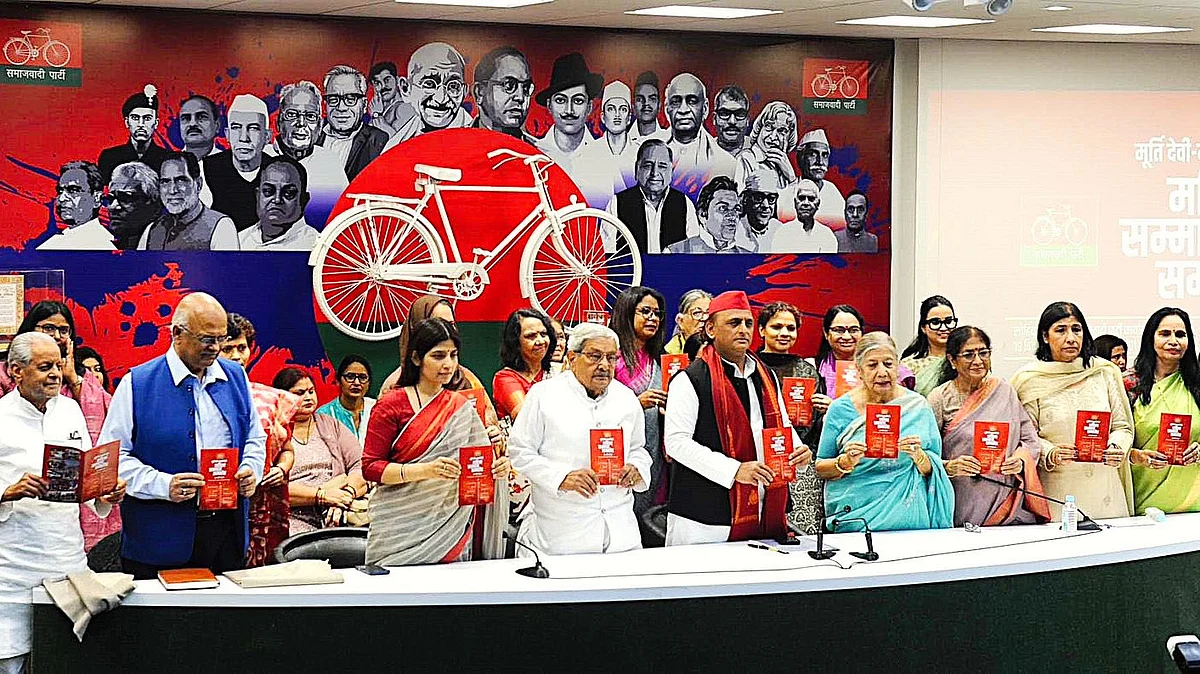


Mamta Gautam makes a living working as domestic help. A Dalit farmer and activist, she also leads a movement to save her land from the clutches of the Adani Group. On 22 March, Mamta was one of 26 women to receive the Murti Devi–Malti Devi Samman at the Samajwadi Party headquarters in Lucknow. Named after Akhilesh Yadav’s mother and grandmother, the honorees were mainly from the backward, Dalit and minority (Pichhda–Dalit–Alpasankhyak or PDA) communities.
Sunaina Devi belongs to the Musahar community. Married off as a child, she could not go to school. Today, thanks to her effort, hundreds of children from the Musahar community have received schooling. Programme coordinator Vandana Mishra said, “Sunaina Devi’s path wasn’t easy. She was beaten and subjected to violence. Yet, she didn’t back down.” Women like Mamta and Sunaina don’t make mainstream headlines.
With women comprising half the population, Akhilesh knows just how crucial women’s votes are in the 403-seat UP Assembly elections of 2027 and has begun establishing women influencers and leaders. Party vice-president of Meerut district Sandeep Yadav says there is a plan to steadily increase the outreach by women leaders among women voters.
Veteran Samajwadi leader Uday Pratap Singh also spoke at the awards ceremony, recalling that early in his political career Mulayam Singh Yadav had gone to jail for the first time fighting for a Dalit woman. He also marked that most of the Murti Devi-Malti Devi awardees were from backward and Dalit communities.
The results of the 2024 Lok Sabha elections seem to have convinced Akhilesh Yadav that his social PDA coalition could turn the political tide in the 2027 UP Assembly elections. The message he wants to convey is this: when it comes to representation, he will go all out to create opportunities for women from backward and Dalit communities.
On 29 March, kicking off the UP election campaign with the Samajwadi Samaanta Bhaichara rally in Dadri, Gautam Buddha Nagar, Akhilesh said, “Pain is the thread that binds the people of the PDA together. On one side are the arrogant people who neglect and oppress, and on the other side are the oppressed and the neglected. There are such unfortunates in every caste and religion. Those who have not suffered the pain of oppression, discrimination and injustice may show sympathy, but they cannot truly feel that pain — the pain we felt when our home was washed with Ganga jal, or when a temple was ‘purified’ after our visit.”
(Following the Samajwadi Party’s defeat in 2017, the chief minister’s residence was reportedly ‘purified’ with water from the Ganga before Yogi Adityanath moved in. Similarly, during the 2024 Lok Sabha elections, after Akhilesh Yadav visited a Shiva temple in Kannauj, BJP workers washed it with ‘holy’ water.)
Akhilesh Yadav appears completely clear and confident about his campaign. Recently, the party appointed Rukmini Nishad, late MP Phoolan Devi’s elder sister, as leader of the UP Samajwadi Mahila Sabha. Earlier, in the 2024 Lok Sabha elections, he built his strategy around the PDA socio-political equation and, in alliance with the Congress, the SP won 43 out of 80 seats in Uttar Pradesh.
Rahul Gandhi’s ‘Save the Constitution’ campaign also played a major role in this victory, but Akhilesh Yadav ensured there was no ambiguity about his intentions — whether in ticket distribution or organisational representation — towards different social groups.
At the Dadri rally, Akhilesh promised that if his party comes to power, it would pay Rs 40,000 annually to poor women under the Stree Samman Samriddhi Yojana and revive the Samajwadi Women’s Pension Scheme. He also spoke of strengthening the 1090 helpline to improve women’s safety.
At the awards ceremony, former chief secretary Alok Ranjan, who has worked with Akhilesh, highlighted initiatives such as the 1090 helpline, Dial 100, the distribution of bicycles, the Asha Jyoti scheme and the Kanya Vidyadhan scheme started during Mulayam Singh’s tenure, emphasising the party’s ongoing commitment to women’s safety and empowerment.
Senior journalist Bhavesh Chandra says that even after nine years in power, chief minister Yogi Adityanath lacks the confidence to seek votes on a positive note. Six or seven minutes into his speeches, he starts talking about law and order under previous governments.
The dominant belief, though, is that women as welfare beneficiaries are increasingly eliding caste and religion to vote for the BJP. According to the Lokniti-CSDS Post Poll Survey 2022, the BJP had a significant 13 per cent lead among women voters compared to the Samaj-wadi alliance.
The largest gender gap in favour of the BJP was observed among the upper castes, where women supported the BJP more than men (90 per cent versus 83 per cent). Among rural women too, the BJP enjoyed a significant lead, with a 16 percentage point gap in the vote share of the two parties.
Senior social activist and professor Rooprekha Verma says women are more intensely aware of their Dalit, backward or caste affiliations. The social status of their husbands imposes a double burden. This is particularly evident among Dalit women. She cites the old practice of dola pratha, where a newly wed Dalit bride was forced to spend her first night with the local landlord.
While Prof. Verma believes that pain can be a unifier, in the case of women, a lot depends on which caste they come from.
Follow us on: Facebook, Twitter, Google News, Instagram, WhatsApp
Join our official telegram channel (@nationalherald) and stay updated with the latest headlines