


Uttar Pradesh Dalits and the social justice conversation
Will Rahul Gandhi’s embrace of Dalit hero Kanshi Ram pay off for the Congress?
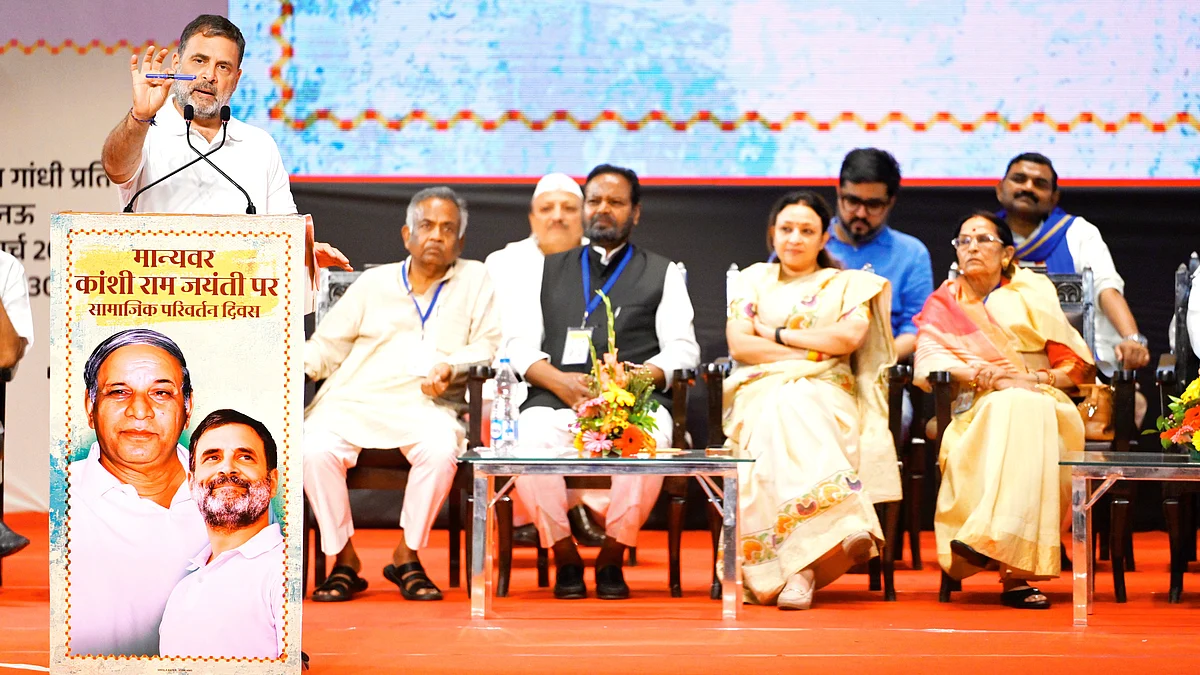


The message conveyed by the Congress party’s Samajik Parivartan Diwas (Social Transformation Day) event at Lucknow to mark the 92nd birth anniversary of Kanshi Ram, founder of the Bahujan Samaj Party, is crystal clear.
The streets of Lucknow as well as the stage of the event were awash with posters of Gandhi, Nehru, Maulana Azad alongside those of Kanshi Ram, Shahuji Maharaj, Jyotiba Phule and Bhimrao Ambedkar. The programme at Jupiter Hall in the Indira Gandhi Pratishthan was scheduled to begin at 2.30 pm, yet by 2.00 pm the hall was packed to capacity.
Seated on the dais were those who had worked closely with Kanshi Ram and held positions within the BSP government including K.K. Gautam, Lalmani Prasad, Anees Ansari, Om Prakash Mahto and B.P. Ashok, among others — all hailing from the Dalit, extremely backward and Pasmanda communities.
When Rahul Gandhi addressed the gathering and said that mere sloganeering would achieve nothing, that he needed a hundred individuals willing to dedicate themselves to grassroots-level change in the politics of Uttar Pradesh — nearly the entire audience rose to their feet, chanting with raised fists: “Me! Me!”
None of this, however, is mere coincidence. The political landscape in Uttar Pradesh has undergone a transformation since campaigning began for the 2024 Lok Sabha election — when riding the momentum generated by the inauguration of the Ram Mandir in Ayodhya, the BJP’s rallying slogan was ‘400 paar’.
Nearly all political analysts, journos and their dogs predicted a sweep for the BJP, but instead, various sections of the electorate in Uttar Pradesh switched allegiance to the Congress and Samajwadi Party, restricting the BJP to 33 seats in the state and its overall tally in the Lok Sabha to 240.
Of the 80 Lok Sabha seats in Uttar Pradesh, the Congress won six — up from one in 2019. The winners, apart from Rahul Gandhi, included Tanuj Punia (SC), Rakesh Rathore (OBC), Imran Masood (Muslim), Ujjwal Rewati Raman Singh (Bhumihar) and K.L. Sharma (Punjabi).
The Samajwadi Party — a Congress ally within the INDIA bloc — secured 37 seats (up from five in 2019) with Dalits, OBCs and Muslims accounting for 86 per cent of its winning candidates.
A post-poll survey conducted by CSDS-Lokniti in 2024 indicated that INDIA bloc candidates garnered votes of 92 per cent Muslims, 82 per cent Yadavs, 56 per cent non-Jatav Dalits and 25 per cent Jatav Dalits.
This is particularly significant because the BJP, which secured 48 per cent of the non-Jatav Dalit vote in 2019, saw the share drop to 29 per cent in 2024. The NDA found some solace in the fact that while it had received only 17 per cent of the Jatav vote in 2019, its vote share among this group rose to 24 per cent in 2024. This of course did not help the NDA’s overall tally with the BJP winning 33 seats (down from 64 in 2019) and its allies bagging three.
This fragmentation of votes resulted in the BSP, led by former chief minister Mayawati, drawing a blank. Senior journalist Kumar Bhavesh Chandra says had the Dalit vote not shifted to the INDIA bloc, the BSP wouldn’t have been wiped out. It is also a fact that there is a sense of indecisiveness among the Dalits which is likely to persist till the run up to the Assembly elections in 2027.
It is no secret that Mayawati has been consistently cosying up to the BJP, led by Narendra Modi, Amit Shah and Yogi Adityanath. Speaker after speaker referred to this at the 13 March rally — without explicitly naming Mayawati — and repeated that leaders representing these communities are “compromised”.
Rahul Gandhi, too, alleged that Prime Minister Modi was “compromised” — a charge he contrasted with the conduct of Ambedkar and Kanshi Ram, neither of whom ever compromised on their principles.
Anil Jaihind, head of the Congress party’s OBC wing, rightly observed that it is not merely leaders of the ruling party who are compromised but many in the Opposition as well. In contrast, Gandhi was openly speaking in favour of social justice, much like Kanshi Ram.
Incidentally, Gandhi subsequently wrote to the prime minister demanding a Bharat Ratna for Kanshi Ram. This evoked a quick response from Mayawati, who posted on X that the Congress was now trying to capitalise on the icons of the BSP.
It is not as if the Congress — or Gandhi — has suddenly begun speaking up for Dalits and their cause of social justice. Congress president Mallikarjun Kharge is a Dalit. The Bihar Assembly elections were fought under Rajesh Ram, also a Dalit.
Throughout the Bharat Jodo Yatra and after, Gandhi has consistently been outspoken on issues related to the Constitution, caste census and reservations. During the Lok Sabha elections, his message — that ‘the Constitution is in danger’ — resonated with people all over the country and specially the disadvantaged classes. This was not merely a slogan.
Rahul Gandhi has successfully conveyed the message that the Constitution, which serves as the only safeguard for the rights of India’s dispossessed — Dalits, OBCs, Adivasis, minorities — from various forms of social exploitation and oppression, is currently under threat. Whenever he holds up a copy of the Constitution — easily identified by its red cover — at public rallies, the audience understands what he is saying: that the only way to protect their rights is to fight for the sanctity of this document.
This line of thought, the same dialogue with the people was reinforced through a series of ‘Samvidhan sammelans’. The cumulative effect of these initiatives is a new public image of Gandhi as a sympathiser and reliable ally of the backward, the deprived, the oppressed.
Khalid Anis Ansari, sociologist and professor at Azim Premji University, views the efforts to reshape and expand the Congress thus: “Compared to Kanshi Ram’s classic definition of social justice (the ‘85 versus 15’ paradigm), Rahul Gandhi’s vision of social justice is more expansive. It encompasses the working class, the labourer and the poor. It is not purely caste-centric; it also incorporates economic dimensions. Until now, Rahul Gandhi was a leader who lacked a distinct constituency (community or vote bank) of his own. Conversely, there are numerous constituencies that lack a leader or political party to represent them.”
Ansari says it is in this context that the party has the option to reach out to those communities that are not typically recognised as the vote banks of any established party — the ati-Dalits (most marginalised Dalits), ati-pichhdas (most backward classes) and the Pasmandas.
“The reality,” he adds, “is that, among those who speak on social justice, Rahul Gandhi stands out as the sole visible figure; for those who do not align with the ideology of the Sangh and the BJP, there appears to be no alternative to Rahul Gandhi.”
Join our official telegram channel (@nationalherald) and stay updated with the latest headlines