


Vote chori: Kapil Sibal, Yogendra Yadav raise more questions on SIR
Online discussion hosted by Sibal finds two former election commissioners joining Yadav in voicing misgivings
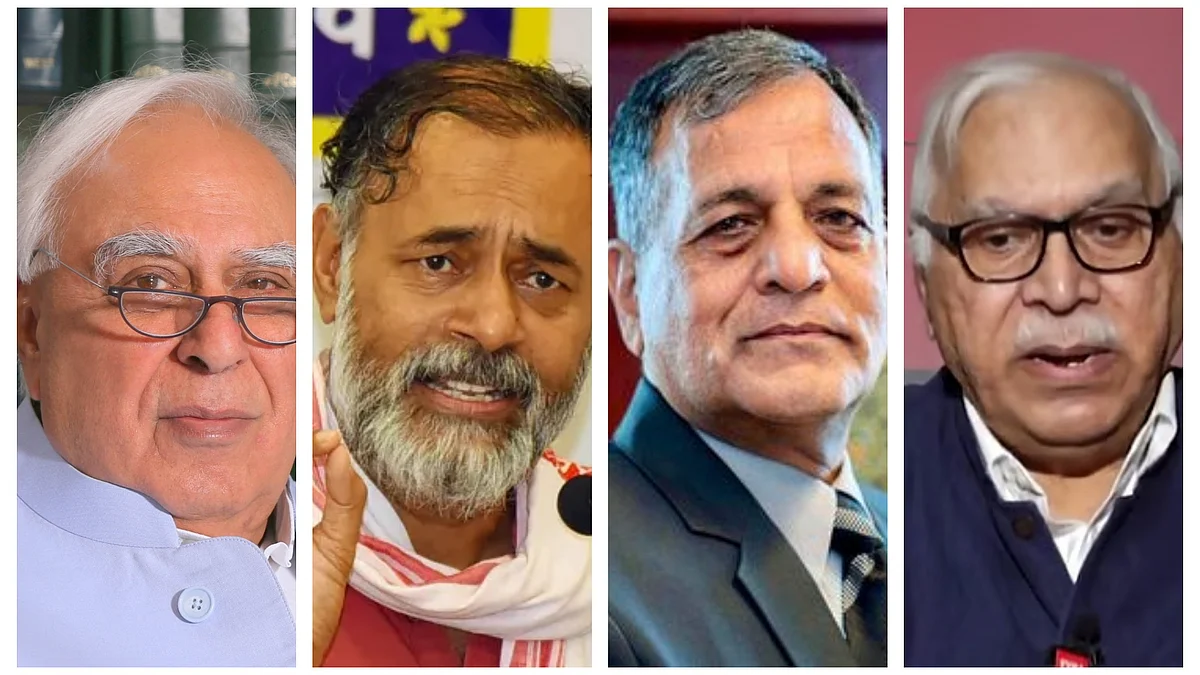


In an unusual recent online discussion, lawyer Kapil Sibal and Yogendra Yadav — one of the petitioners in the ongoing legal challenge to the Special Intensive Revision (SIR) of electoral rolls in Bihar being heard in the Supreme Court since July — seemed to agree that the SIR is a political and not an administrative exercise.
Sibal admitted that normally, he would have avoided discussing a matter which is sub judice. However, he was forced into discussing it publicly because in the course of the hearing, he increasingly felt that the SIR was driven by political motives. Yadav agreed. He, along with others, had challenged the Bihar SIR, but while the election in the state is long over, the hearing is still continuing on the ground that SIR is being conducted in other states as well.
Academic-turned-activist Yadav says he had informed the court about the anomalies. In the final voters’ list after the Bihar SIR released on 30 September, he had referred to 5 lakh duplicate voters in the same constituency and 59 lakh duplicate voters across the state. At least 75,000 entries (in the roll) were actually blank. He had also told the court that in final list contained names written in Tamil and Kannada scripts.
The Election Commission of India (ECI), he pointed out, did not deny his contention. Nor did it make any effort to correct the anomalies even in the revised list of voters released on 17 October. None of the errors — if they were errors — were removed, which supports his submission that the SIR was not meant to correct the electoral roll. The intention was something entirely different.
Also Read: ‘This SIR is error-prone by design’
Former chief election commissioner Ashok Lavasa said during discussion that the ECI should indeed clarify how many ineligible voters it found in Bihar, how many eligible voters it added, and how error-free the electoral roll was after the exercise. There are universally accepted checks, he said, to test the health of an electoral roll and the ECI must have made an analysis. In which case, the analysis needs to be made public to dispel doubts, he felt.
One of the tests, Yadav pointed out, was the elector to population ratio, which indicates if an electoral roll has managed to include all eligible voters. In Bihar, however, the SIR failed the test because while the government estimates the adult population of the state to be 8.22 crore, the ECI could enrol only 7.45 crore, three lakh of them after releasing the final list. This supported his contention that the SIR was an exclusionary exercise, meant to weed out voters not seen as well-disposed to the ruling regime.
Both Lavasa and another former CEC S.Y. Quraishi felt it was up to the ECI to explain why it felt the need to discard a system built up over the last 75 years. The electoral rolls had been digitised by 2003, they pointed out, and thereafter, an annual summary revision was conducted to purify the rolls further. There were rules and processes developed to weed out foreigners and non-eligible Indians. If correction was needed, there were less painful ways of going about it. Why throw the baby out with the bathwater, they wondered.
Also Read: Ask why Assam does not need an SIR
By distributing pre-printed enumeration forms of voters from the 2002-03 electoral rolls, the ECI is actually running the risk of inheriting errors, they felt, and make the electoral rolls even less ‘pure’. What is more, the ECI has not issued new EPICs after the SIR, so the old EPICs continue to be valid.
Yadav alleged that after the jolt suffered in the 2024 Lok Sabha election, when the BJP failed to win a majority, the ruling elite had zeroed in on delimitation of constituencies (which is on the anvil), a One-Nation-One-Election Bill the government is likely to introduce, and the SIR to weed out inconvenient voters. The three measures together, the BJP believes, can guarantee its electoral success in perpetuity.
Another reason why the SIR appears to be driven by politics is the ECI’s decision not to conduct one in Assam. A citizenship test in Assam was conducted under the NRC for six years, and 19 lakh people were found to be ineligible to vote. Inconveniently for the BJP, 12 lakh of them turned out to be Hindus.
Since then, the process of the NRC has dragged on, and now the ECI refuses to ask for documents and valid citizenship from voters in the only state where foreigners and infiltrators have been an issue and where an SIR is not being conducted, Yadav pointed out.
Join our official telegram channel (@nationalherald) and stay updated with the latest headlines