


Bengal polls: Kolkata contrasts Modi spectacle with Mamata connect
Delays and heavy security mark PM’s roadshow, while Banerjee’s localised outreach draws organic crowds
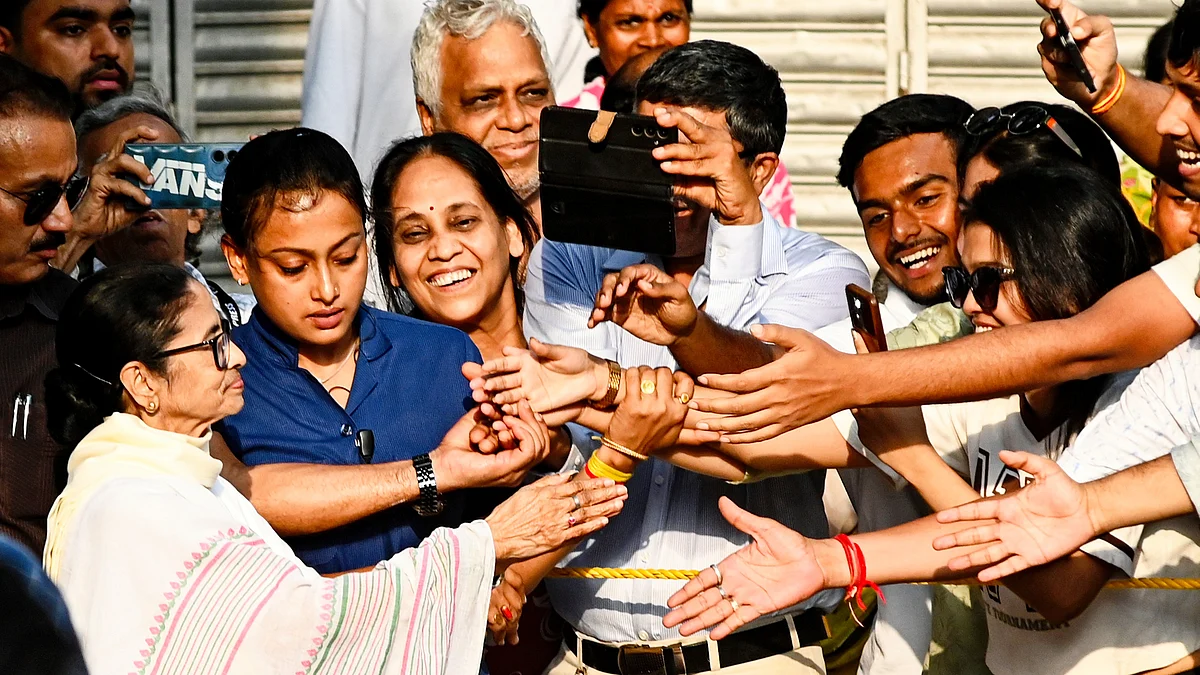


In a revealing contrast of campaign styles, Prime Minister Narendra Modi’s roadshow on Beadon Street and chief minister Mamata Banerjee’s impromptu meeting in Bhabanipur offered sharply different political atmospheres on the same day. With West Bengal heading towards the second and last phase of Assembly elections on 29 April, the back-to-back events in Kolkata highlighted not just organisational differences, but also varying modes of voter engagement.
Modi’s rally, scheduled for 3.00 pm, began at around 6.00 pm, with sections of the crowd waiting in sweltering heat. Attendance was modest, with roughly 2,000 people present along the route. Police had sealed off stretches of the road, and security deployment — including Central forces — was visibly heavy. Supporters lined both sides of the street with flags and cutouts, chanting 'jai Shri Ram' as the prime minister’s convoy passed.
However, the tightly managed nature of the event stood out. Security personnel appeared to position attendees along the narrow stretch to maintain visual density. Among those present was Sudarshan Sinha, who said he had come for a glimpse of the prime minister despite not being a BJP voter. Others expressed political support: Anil Paswan from Entally spoke of backing the BJP for “development”, while Avantika Sharma from north Kolkata said she was open to political change after trying other parties.
There were also murmurs of dissatisfaction within sections of the BJP’s local base. Some supporters from Baranagar complained that long-time party workers such as Jayanta Shaw were not given access to VIP enclosures, while newer entrants appeared to receive preferential placement closer to the convoy.
“I could have watched this on TV,” Shaw remarked. Conversations among attendees also touched on electoral prospects, with some expressing strong views about potential action against Trinamool Congress leaders. Police, when asked about the presence of outsiders, said there was no clear indication, noting that many in the crowd spoke Hindi.
The gathering dispersed quickly after the prime minister’s convoy moved on, with several attendees describing the experience as underwhelming.
A few hours later, in Bhawanipore, the mood was markedly different. Around 7,000 people gathered across narrow lanes in what resembled a neighbourhood event rather than a formal rally. Shops remained open, a green carpet marked the route, and a local band played between brief speeches by Trinamool leaders. Unlike the earlier roadshow, there were no extensive barricades, and movement remained largely unrestricted.
While BJP candidates from central Kolkata constituencies — Manicktala, Chowringhee, Jorasanko, Entally and Kashipur — had campaigned earlier in the day using smaller vehicles, the Bhabanipur gathering in south Kolkata appeared to draw largely local residents. Kolkata Police maintained a visible but low-key presence, with no Central forces deployed.
Among those present was local resident Satish Roy, who said he had come to see “my CM”, adding that he would have attended the prime minister’s event as well had it been held in the area. Banerjee’s interaction with the crowd was informal — at one point, she asked aides to fetch rosogollas from a nearby sweet shop, prompting an immediate response from those gathered.
Her remarks blended local references with political messaging. She spoke about neighbourhood Durga Pujas, long-standing community ties, and religious coexistence. “BJP says I don’t allow Durga Puja, but people come from worldwide now — UNESCO gave it heritage status,” she said, drawing applause.
Banerjee also focused on economic concerns and governance. “Who has the guts to fight Central agencies like me? They’ve hiked taxes so high, people can’t afford clothes or eating out. We haven’t; we give whatever we can with limited resources. We never disrespect the poor,” she said. She alleged that BJP-linked funds were being moved in vehicles from Odisha, telling voters, “Take the money, but don’t vote for them,” and urged vigilance regarding unfamiliar individuals in residential areas.
Referring to administrative changes, she claimed officers had been shifted and warned of possible attempts to move weapons across the Odisha border. “ED works for BJP, but Bengal is with me,” she said. As the gathering grew, she instructed police to ensure that passersby were not obstructed.
Her speech also referenced welfare schemes, future commitments, and opposition to detention camps, while mentioning incidents of distress and promising accountability. “If BJP targets Bengal, Bengal will target BJP,” she said in closing, drawing a strong response from the crowd.
Taken together, the two events underscored contrasting campaign approaches. Modi’s roadshow reflected a highly controlled, security-heavy format with centralised messaging, while Banerjee’s meeting leaned on familiarity, accessibility and local resonance. In a closely watched election, these differences in style — and how they are received — may prove as significant as the messages themselves.
Join our official telegram channel (@nationalherald) and stay updated with the latest headlines