


Bengal SIR: ‘Under adjudication’ until it’s too late?
With 50 lakh voters pending clearance, and more than 90 days needed to complete the process, delays will work in the BJP’s favour
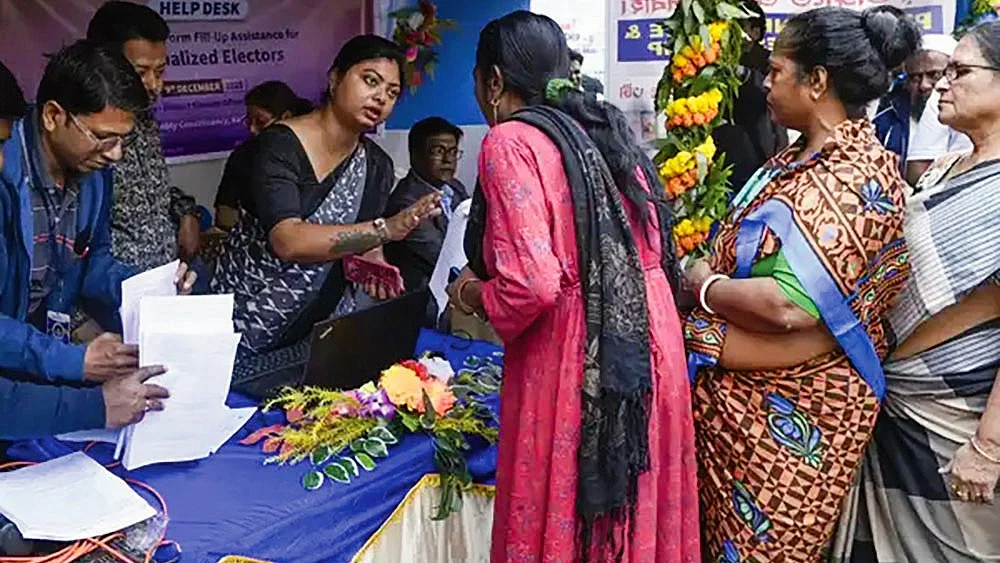


Chief Election Commissioner (CEC) Gyanesh Kumar, on a two-day visit (9-10 March) to Kolkata with two other election commissioners, was welcomed with black flags. Not only at the airport but also on his way to the Westin, a luxury hotel in New Town, Rajarhat. The hotel — owned by a Marwari business family originally from Bihar — enjoys the patronage of Union ministers and visiting BJP leaders and chief ministers.
Given that the city has over 5,000 hotels, was it “just a coincidence that the election commissioners chose to stay in the same hotel?” wondered TMC leader Abhishek Banerjee. Chief minister Mamata Banerjee picked up the gauntlet — attacking the Election Commission of India (ECI) for creating a mess — and sat on dharna.
The war of words took an ugly turn when district magistrates and police superintendents, invited to a meeting with the full bench of the ECI, were summoned to Nabanna, the state secretariat, to brief the political bosses. The CEC took offence and told officials that he would not brook such behaviour. If they didn’t behave, they would pay the price after the election in May. Mamata retorted: would the CEC still be in office after May?
The term of the state Assembly ends on 7 May and elections have to be completed before that. Most political parties including the BJP, the CPI(M) and the Congress have sought that polling — to elect 294 MLAs — be held in one or two phases. Five years ago, the Assembly elections had stretched over eight phases.
The standoff over the special intensive revision (SIR) of electoral rolls, logical discrepancies and micro-observers was temporarily put aside by the Supreme Court’s 10 March directive to set up appellate tribunals to resolve the status of those marked ‘under adjudication’. If their names are struck off the voters’ list, they can approach these tribunals. “The door has opened to some extent,” said Banerjee, as she ended her sit-in demonstration.
However, the fate of the 60 lakh voters ‘under adjudication’ remains uncertain, even as judicial officers from West Bengal, Odisha and Jharkhand are engaged in verifying their claims following an earlier Supreme Court order.
Gyanesh Kumar declared that as of 10 March, 10.6 lakh names from the adjudicated list had been ‘cleared’ by judicial officers, without elaborating if they have been cleared to vote. That leaves 50 lakh more. While these numbers stem from 1.67 crore hearings, including 1.36 crore ‘logical discrepancies’ and 31 lakh voters said to have been left unmapped with the 2002 electoral rolls, there is no clarity on how many of them are now eligible to vote.
The CEC said, “Anyone cleared by the judiciary from Bengal’s adjudicated voter list will make it to the final rolls.” He added that voters still facing issues could enrol their names by submitting Form 6 with proof of Indian citizenship. However, uncertainties persist on how the appellate tribunals are to be set up, the procedures they would follow and whether all appeals can be disposed of before the election.
Two questions, asked repeatedly at the CEC’s media briefing, remained unanswered.
How many Bangladeshis, infiltrators and Rohingyas had been detected in the state during the SIR? Why were voters who had already filled enumeration forms and produced requisite documentation, who had been verified physically, had attended hearings to clear misconceptions and been found to be mapped with the 2002 voters’ list still ‘under adjudication’?
A smile was all they got in response.
****
The Trinamool Congress continues to allege an unholy nexus between the ECI and the BJP. It claims the SIR process is biased and that removal of pro-TMC voters (read Muslims and backward communities) will work in the BJP’s favour.
“The BJP gets pleasure in depriving Bengal and snatching people’s voting rights,” said TMC leader Kunal Ghosh. The CPI(M) is in favour of weeding out bogus voters but opposes the misuse of power. “Our stand is not against the SIR per se but against the misuse of the exercise to delete names of genuine voters from any community,” explained state secretary Mohammad Salim. Congress leader Adhir Ranjan Chowdhury raised the alarm over voter exclusion on account of “minor discrepancies”.
Advocate Anwarul Haque of the Malda district and sessions court confirmed that the district sub-registrar’s office had unilaterally stopped registering properties involving people listed ‘under adjudication’ in the final voters’ list.
While the district magistrate denied the existence of any such instruction, S.K. Asiruddin, a resident of north Sunny Park in Malda town, confirmed that the sale of his plot of land had been stalled because the buyer was found to be ‘under adjudication’.
This incident points to possible complications for the 60 lakh voters listed thus. Rumours circulating in the state suggest that those disenfranchised by the ECI could find their bank accounts frozen, be barred from owning mobile phones, making transactions or registering property. These fears likely explain the number of deaths due to natural causes (like hypertension) and increased cases of depression and suicides reported from different parts of West Bengal.
“I am getting calls from people every day, asking why their names are missing from the final list. Some are crying; some are even ready to pay a price to ensure they get on the first supplementary list,” says Abhijit Bhattacharya, a booth-level officer (BLO) from Kolkata. Bhattacharya pointed out that most of these voters are genuine but have been flagged due to a ‘logical discrepancy’ or ‘wrong mapping’, mostly attributed to mistakes made by the ECI’s own apps, algorithms or personnel.
Basudeb Mondal, another BLO, is optimistic that most of the names pending adjudication will eventually be included in the supplementary lists, as the people are genuine. “Since the officers could not verify all the submitted documents in a very short time, a large number of names are showing up in the adjudication list.”
For the TMC, the race is on to shift as many names as possible from the ‘pending’ to the ‘regular’ list. On the other hand, keeping the pending list long through process delays or by getting embroiled in legal complications works in the BJP’s favour. “They have not filed the proper documents, and hence their names were struck off,” says Biswajit Roy, a BJP leader from Malda district.
According to an ECI source, adjudication papers have been assigned to judicial officers on the basis of demographic distribution of people and number of judges available. “There are some judges who have been allotted 2,000 cases, whereas there are others who have 7,000. They are looking into logical discrepancy and comparing the details in the final list.”
A judicial official involved in the process says that with 600 judges from Bengal and 150 from other states, it will take more than 90 days to complete the process. “There is a high chance that many in the pending list, even if they are genuine voters, may lose their chance to vote.”
The TMC has deployed its vast organisation and hit the ground to carry out its own SIR. Armed with the ‘final’ published list, party workers are visiting all households to physically verify if the residents present tally with those who appear on the list. It is this organisational muscle that will eventually make the difference on polling day.
Join our official telegram channel (@nationalherald) and stay updated with the latest headlines