


Trump declares Venezuela oil ‘blockade’; markets blink, and rally
Crude jumps and global stocks rise as Trump’s latest threat rattles markets but leaves big questions unanswered
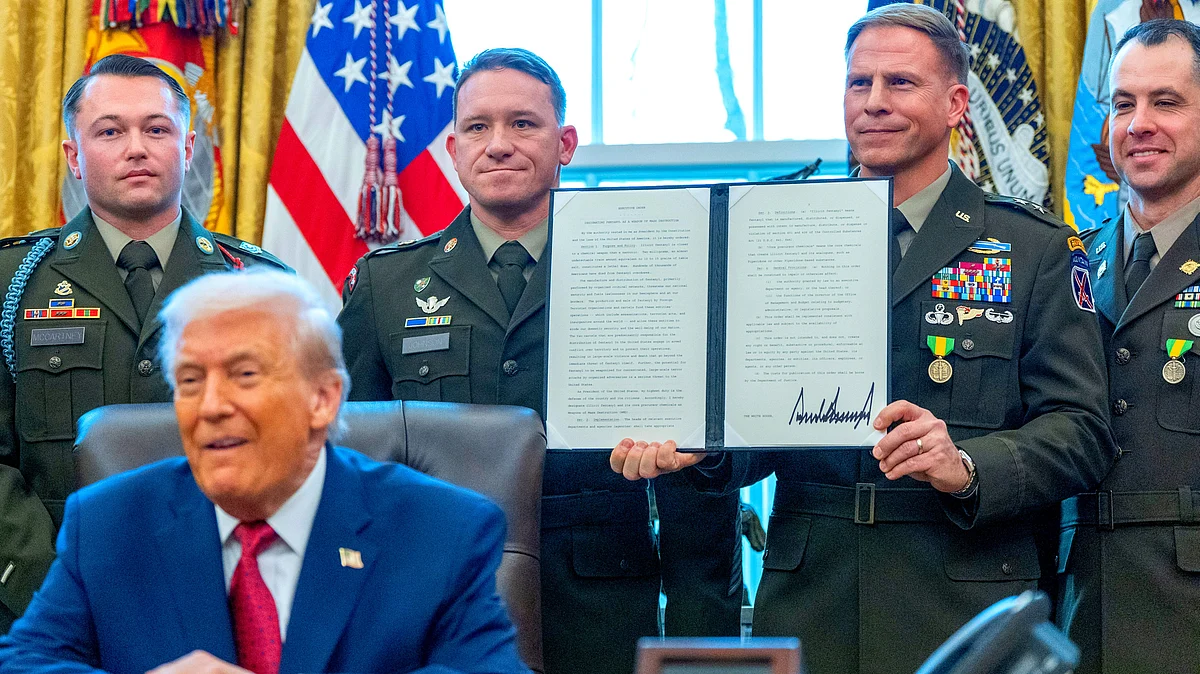


US President Donald Trump on Tuesday ordered what he characteristically billed as a “blockade” of all sanctioned oil tankers entering and leaving Venezuela, a move that immediately rippled through global markets even as questions mounted about how — or whether — it would actually be enforced.
Shares advanced on Wednesday across Europe and Asia, buoyed by strong buying in technology stocks, while US crude prices briefly jumped more than 2 per cent after Trump’s announcement. The market reaction followed last week’s seizure by US forces of an oil tanker off Venezuela’s coast — an unusual escalation that came after a steady build-up of American military assets in the region as the administration intensifies pressure on President Nicolás Maduro.
Quite how Trump intends to implement his self-declared blockade remains unclear, a familiar ambiguity that has come to define much of his foreign policy. It is also uncertain whether he will again lean on the US Coast Guard to interdict vessels, as he did last week. The administration has already moved thousands of troops and nearly a dozen warships, including an aircraft carrier, into nearby waters, lending a certain performative heft to the declaration.
In a typically emphatic post on Truth Social, Trump wrote: “For the theft of our Assets, and many other reasons, including Terrorism, Drug Smuggling, and Human Trafficking, the Venezuelan Regime has been designated a FOREIGN TERRORIST ORGANIZATION. Therefore, today, I am ordering A TOTAL AND COMPLETE BLOCKADE OF ALL SANCTIONED OIL TANKERS going into, and out of, Venezuela.”
Venezuela’s government dismissed the statement as a “grotesque threat”, language that appeared to match both the tone and scale of the announcement.
Markets, meanwhile, took the cue. Futures for the S&P 500 edged 0.1 per cent higher, while those for the Dow Jones Industrial Average were little changed. In Europe, Germany’s DAX added 0.3 per cent to 24,138.73 and France’s CAC 40 rose 0.1 per cent to 8,115.18. Britain’s FTSE 100 surged 1.4 per cent to 9,817.65.
Asian benchmarks were broadly higher. Japan’s Nikkei 225 gained 0.3 per cent to 49,512.28 as traders awaited a Bank of Japan interest rate decision later this week. Expectations of a hike were reinforced by data showing Japan’s exports rose 6 per cent in November from a year earlier, helped by stronger shipments to the US under a trade deal with the Trump administration that set tariffs at a baseline 15 per cent, down from an initially threatened 25 per cent.
Hong Kong’s Hang Seng climbed 0.9 per cent, the Shanghai Composite jumped 1.2 per cent, and South Korea’s Kospi rose 1.4 per cent, lifted by gains in SK Hynix and Samsung Electronics. Australia’s S&P/ASX 200 slipped 0.2 per cent.
Oil prices also firmed. Early on Wednesday, US crude was up 99 cents, or 1.8 per cent, at $56.26 a barrel, while Brent crude gained 96 cents, or 1.6 per cent, to $59.88. The rebound followed a sharp sell-off on Tuesday, when crude prices slid to their lowest levels since 2021 amid expectations that global supply remains more than sufficient.
Oil market participants said the latest uptick reflected anticipation of potential supply disruptions from Venezuela, while reserving judgement on whether Trump’s blockade would translate into concrete action — and whether it might extend beyond already sanctioned vessels.
American presidents enjoy broad discretion to deploy US forces abroad, but Trump’s asserted blockade represents a fresh stress test of presidential authority, said Elena Chachko, an international law scholar at UC Berkeley Law School. Blockades have traditionally been treated as permissible “instruments of war”, but only under strict conditions. “There are serious questions on both the domestic law front and international law front,” she said.
US Representative Joaquin Castro, a Texas Democrat, was blunter, calling the move “unquestionably an act of war”. “A war that the Congress never authorised and the American people do not want,” he wrote on X.
An effective embargo has already been taking shape since the seizure of the tanker last week, with oil-laden vessels lingering in Venezuelan waters rather than risk confiscation. Venezuelan crude exports have fallen sharply since then, a situation compounded by a cyberattack this week that knocked out administrative systems at state-run PDVSA.
China remains the biggest buyer of Venezuelan crude, accounting for about 4 per cent of its imports, with shipments in December averaging more than 600,000 barrels a day, analysts said. For now, the global oil market remains well supplied, with millions of barrels floating off China’s coast. A prolonged disruption, however, could tighten supply and push prices higher.
Two US officials said the policy, if fully implemented, could have a major impact on Maduro. David Goldwyn, a former State Department energy diplomat, said unless lost Venezuelan barrels are offset by additional OPEC spare capacity, oil prices could rise by $5 to $8 a barrel. “I would expect inflation to skyrocket, and massive and immediate migration from Venezuela to neighbouring countries,” he said.
Trump’s pressure campaign has also featured a ramped-up military presence and more than two dozen strikes on vessels in the Pacific and Caribbean near Venezuela, killing at least 90 people. Trump has said US land strikes will soon begin.
Maduro has accused Washington of seeking to overthrow him and seize control of Venezuela’s oil wealth. In interviews with Vanity Fair, Trump’s chief of staff Susie Wiles said Trump “wants to keep on blowing boats up until Maduro cries uncle”, offering an unusually candid window into the administration’s strategic thinking.
Maduro, speaking earlier on Tuesday, said: “Imperialism and the fascist right want to colonise Venezuela to take over its wealth of oil, gas, gold, among other minerals. We have sworn absolutely to defend our homeland and in Venezuela peace will triumph.”
With agency inputs
Join our official telegram channel (@nationalherald) and stay updated with the latest headlines