Art and Culture
Grammys 2026: Music’s biggest night turns into defiant stand against ICE
From Bad Bunny to Billie Eilish, artists use stage to denounce immigration enforcement, affirm migrant dignity
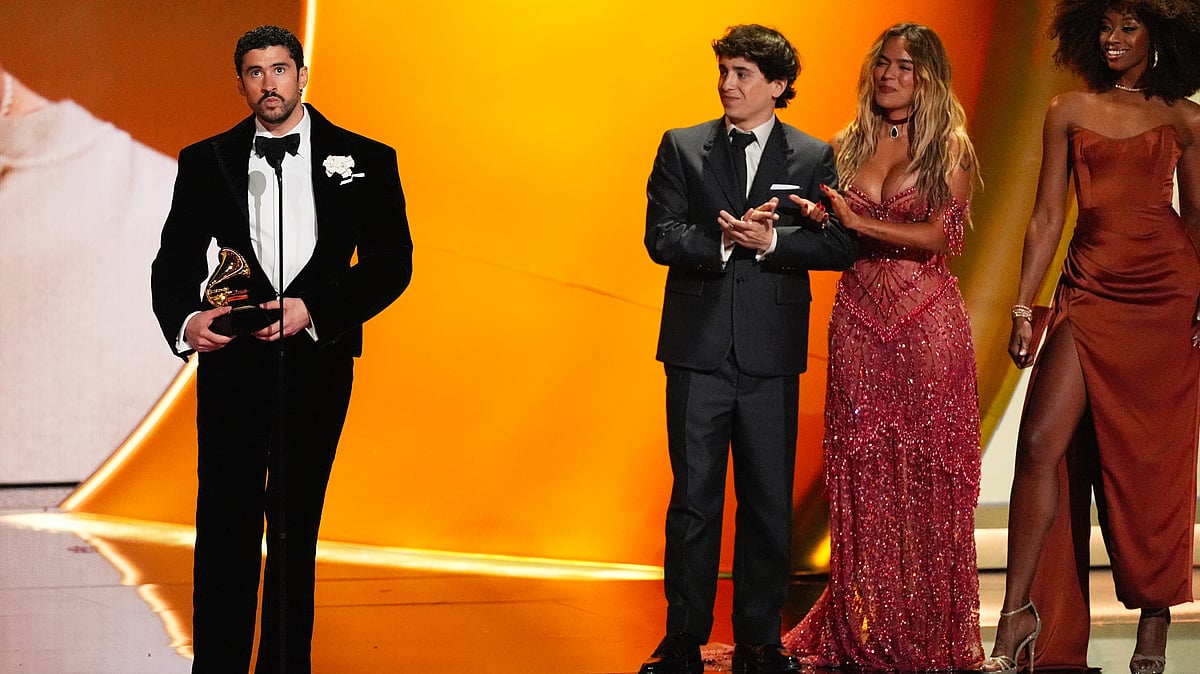
The 2026 Grammy Awards ended with history — and a warning. Bad Bunny closed out the night by winning album of the year for Debí Tirar Más Fotos, becoming the first artist to take the Grammys’ top prize with a Spanish-language album. But long before the final envelope was opened, the ceremony had already taken on a political charge, with repeated, explicit denunciations of ICE (Immigration and Customs Enforcement) and the treatment of immigrants in the United States.
Accepting the night’s highest honour, Bad Bunny spoke first in Spanish, grounding his victory in Puerto Rican pride. “Puerto Rico, believe me when I tell you that we are much bigger than 100 by 35,” he said, invoking a colloquial reference to the island’s small physical size. “There is nothing we can’t achieve.” He thanked the Academy, his collaborators, and his mother “for giving birth to me in Puerto Rico”.
Then he switched to English. “I want to dedicate this award to all the people who had to leave their homeland to follow their dreams.” It was not his first statement of the night — nor his most pointed.
Earlier, Bad Bunny opened his speech not with thanks, but with a declaration. “Before I say thanks to God, I’m going to say ICE out,” he said, drawing thunderous applause. “We’re not savage, we’re not animals, we’re not aliens. We are humans and we are Americans.”
That message reverberated throughout the broadcast. Billie Eilish, accepting song of the year for Wildflower, echoed the sentiment in even starker terms. “No one is illegal on stolen land,” she said. “(Expletive) ICE is all I want to say.” Her remarks, aired live on CBS, left little ambiguity about where she stood.
Over the past decade, ICE has become widely associated not just with immigration enforcement but with practices critics say criminalise people who are simply seeking safety, opportunity or family unity. ICE’s image hardened most sharply after the first Trump administration’s zero tolerance policy, which saw thousands of children separated from their parents at the US–Mexico border and held in detention facilities — scenes that seared themselves into the public consciousness as emblematic of state-sanctioned cruelty.
In the weeks leading up to the Grammys, a surge of federal immigration agents into Minneapolis sparked intense local and national controversy, deepening that resentment. As part of 'Operation Metro Surge', thousands of ICE, Customs and Border Protection and other federal officers were deployed to enforce immigration laws in the Twin Cities — prompting massive protests, lawsuits from state officials and a general strike by unions and community groups.
Outrage grew after several high-profile incidents during the operation, including the fatal shooting of ICU nurse Alex Pretti by federal agents, which drew a civil-rights investigation, and the earlier killing of Renée Good during a separate encounter.
In one of the most widely circulated episodes, five-year-old Liam Conejo Ramos was taken into ICE custody with his father despite their pending asylum claim; a federal judge later ordered their release and sharply criticised the detention as unconstitutional. In another example, ICE agents attempted to enter the Ecuadorian consulate in Minneapolis — a move condemned as a violation of diplomatic norms.
These confrontations have made ICE less an abstract enforcement arm and more a symbol of what many view as aggressive, militarised immigration policy — one that even affected US citizens and young children in ways that alarmed local residents and lawmakers alike.
Immigration — and the violence of its enforcement — therefore became a central theme of the night, not an aside. Artist after artist used their moments to foreground migrant humanity, often tying their own family histories to the present political climate.
Before that, Olivia Dean was named best new artist. Fighting back tears, she told the audience: “I’m up here as a granddaughter of an immigrant. I wouldn’t be here… I am a product of bravery. Those people deserve to be celebrated.”
At the earlier Premiere Ceremony, where most Grammys are handed out, the tone was no less direct. Shaboozey, accepting country duo/group performance, dedicated his award to his mother, an immigrant who had just retired after 30 years as a psychiatric nurse. “Immigrants built this country — literally,” he said. “This is for them.”
Kehlani, after winning her first Grammy, ended her speech bluntly: “Imma leave this and say, (expletive) ICE.”
Backstage, Gloria Estefan gave voice to the fear underpinning the evening’s defiance. “There are hundreds of children in detention centers,” she said. “I don’t recognize my country in this moment.”
Bad Bunny’s album of the year win was presented by Harry Styles, who himself won the category in 2023, beating Bad Bunny’s Un Verano Sin Ti — then the first Spanish-language album ever nominated. This time, history tilted the other way.
The broader ceremony was packed with major wins. Kendrick Lamar and SZA took record of the year for Luther, with Lamar also winning rap album for GNX, breaking Jay-Z’s record to become the most-decorated rapper in Grammy history. Lady Gaga won pop vocal album for Mayhem, while Jelly Roll claimed the newly renamed contemporary country album award.
Yet even these victories unfolded against the backdrop of protest. Music and politics were not running on parallel tracks; they were colliding in real time.
The ceremony’s in memoriam segment honoured D’Angelo and Roberta Flack, with Ms. Lauryn Hill returning to the Grammy stage for the first time since her own album of the year win in 1999. Elsewhere, performances by Tyler, the Creator, Sabrina Carpenter, Justin Bieber, Rosé and Bruno Mars delivered spectacle and virtuosity.
But what defined the night was not just performance — it was insistence. At a moment when immigration enforcement has become harsher and more visible, the Grammys became an unlikely but unmistakable site of resistance. Again and again, artists refused neutrality. They named ICE. They rejected dehumanisation. And they used the biggest platform in American music to say, clearly, who belongs.
With agency inputs
Join our official telegram channel (@nationalherald) and stay updated with the latest headlines