Environment
Bend rules, grab land, evict residents
That seems to be the order of play in BJP-ruled states. Odisha’s bauxite-rich hills are just the latest on the hitlist, writes Rashme Sehgal
Bending rules to acquire land is no longer an exception — it’s the default setting across BJP-ruled states. And those facing the brunt of this brutal takeover are the Adivasi communities, ancestral inhabitants of forests rich in bauxite, iron ore and coal.
The latest flashpoint is in Odisha’s Sijimali, located between Kalahandi and Rayagada districts. On 7 April, tribal villagers resisting Vedanta Ltd’s proposed bauxite mining in these biodiverse hills were injured in police action. On 25 March, activist leaders Lingaraj Azad and Suresh Sangram — long-time defenders of Adivasi rights over their jal, jangal, jameen — were arrested and booked under the draconian UAPA, alongside charges of conspiracy and sedition under the BNS.
Instead of trying to have a dialogue with his people, Odisha’s first tribal chief minister Mohan Charan Manjhi is following a script that has by now been enacted in several BJP-ruled states: arrest the leaders and target the dissenting villagers.
Activist Saranaya Nayak, from the Asia Pacific Forum on Women’s Law and Development, has been working in this region for several years. “Five villages are getting the worst of it, being the centre of dissent,” Nayak says.
“The situation is so bad in Sajabari and Kantamal that women are not allowed to step out, not even to collect drinking water or buy provisions. The police have been using terror tactics across this entire mining belt. Several RTIs show that gram panchayat signatures of consent were forged. The local administration is behaving like the minions of the East India Company.”
****
Varanasi, the prime minister’s Lok Sabha constituency in Uttar Pradesh, saw a similar crackdown in August 2023, when a large police contingent, backed by the Rapid Action Force, stormed the premises of the Sarva Seva Sangh at Rajghat, a 12.5-acre historic property on the banks of the Ganga.
The land had been transferred in 1960 under then railway minister Lal Bahadur Shastri, with the original sale deed preserved onsite. For decades, the complex functioned as the nerve centre of Seva Sangh’s publication wing, spreading Gandhian thought. All of that was gone in a single demolition drive and its residents summarily evicted.
For the past two years, farmers have been on the warpath in 11 villages across Varanasi district, resisting the forcible acquisition of 800 acres of prime agricultural land under the Krishi Dwar Yojana scheme. Their land — part of a farmers’ co-operative established in 1952 by then MLA from Varanasi Raj Narain — is being handed over to private builders. Their leaders have been arrested, but the farmers are defiant: “We will give up our lives, but not our land.”
In nearby Ayodhya, reports indicate that over 4,000 houses and shops were demolished to facilitate the Ram temple complex, displacing over 50,000 people. Many of these long-term residents and traders have received little or no compensation.
Residents of areas like Barhata Manjha accuse the administration of seizing their land with token payouts. Nandlal Gupta, president of a local traders’ body, says, “It’s shocking: many shopkeepers are now working as labourers or autorickshaw drivers to make ends meet.”
Meanwhile, the BJP-backed Time City Multi State Cooperative Housing Society has bought land around the Saryu river and sold it at three to five times the price to the Adani and Lodha groups. Farmers here say they were arm-twisted into selling their land.
When the issue of forcible acquisition was raised, the Time City group claimed these people were ‘illegal occupiers’. Opposition leaders have alleged that a plot bought for Rs 2 crore was resold to the Shri Ram Janmabhoomi Teerth Kshetra Trust for Rs 18.5 crore within ten minutes. Socialist activist Aflatoon of the Samajwadi Jan Parishad points out, “New zamindars led by Adani, Ambani and Patanjali have replaced the zamindars of yore.”
In neighbouring Madhya Pradesh, while the BJP makes a big production of the Janjati Gaurav Diwas (Tribal Pride Day), former Congress MLA Bala Bachchan says, “They are busy grabbing tribal lands. That’s the BJP’s real face.”
Bachchan was speaking on behalf of Gond tribal Mahkam Singh who, along with his brother, filed a case in a sub-divisional magistrate court in 2021. He accused four-time BJP MLA Kedarnath Shukla and his brother Markande Shukla of forging documents to snatch a 17 acre plot in Harbaro village of Sidhi district.
Reports from 2025 indicate that BJP leaders encroached upon nearly 15,000 acres of government land in Chhatarpur and Vidisha — land that had earlier been cleared under an anti-mafia drive. The area is now reportedly being diverted for private plantations and sold to developers for residential colonies.
Assam is even worse. After systematically shutting down nearly two dozen public sector industries, the Himanta Biswa Sarma government is openly partnering with a few favoured corporate houses at the expense of tribal communities.
Political patronage was on full display when the Ambani group was allocated a 1,000 MW solar power project requiring 6,000 acres in Karbi Anglong, to be funded by the Asian Development Bank. Faced with stiff opposition, the ADB ultimately withdrew its $434.25 million loan. The project is now on hold.
Equally controversial was the allotment of 1,134 acres in the Parbatjhora sub-division of Kokrajhar district to the Adani Group for a 3,200 MW thermal power plant. This too has been met with resistance from tribal groups.
Undeterred, the Sarma government has allocated 3,000 bighas in the North Cachar Hills Autonomous Council (Dima Hasao district) to Kolkata-based Mahabal Cement. The extraordinary scale of the allotment prompted a Gauhati High Court judge to ask if handing over an entire district to a private firm was “some kind of joke”.
All three allotments violate the Sixth Schedule, which mandates prior consultation with tribal communities.
In Rajasthan, deputy chief minister Diya Kumari stands accused of occupying government land in Jaipur, including historical bungalows and properties in the Jalebi Chowk area.
A petition filed in the Rajasthan high court accuses Union minister Gajendra Singh Shekhawat of forging land records to usurp public land worth Rs 50 crore in Jodhpur. Records show that Lok Sabha Speaker Om Birla and his family bought land in the Suthala sanctuary area in violation of the Wildlife Protection Act.
Gujarat has its own share of fraudulent acquisitions. A particularly shocking case involves former BJP MLA Rajendrasinh Chavda, who nabbed an entire government-owned wasteland hill in Himmatnagar, Sabarkantha and got it registered in the names of five people, including his daughter Payal and sister-in-law Dikshitaben.
In neighbouring Maharashtra, the Mahayuti alliance of the BJP, Shiv Sena (Shinde) and NCP (Ajit Pawar) has gained notoriety for a series of high-profile land grabs.
The most prominent case involves Parth Pawar, son of the late deputy chief minister Ajit Pawar, who allegedly tried to grab 40 acres of prime government land reserved for the Mahar community in Pune. The land he was eyeing had a market value of Rs 1,800 crore. Pawar formed a company that registered the land transaction for Rs 300 crore. The stamp duty was Rs 21 crore but he deposited only Rs 500. The shady deal was later cancelled.
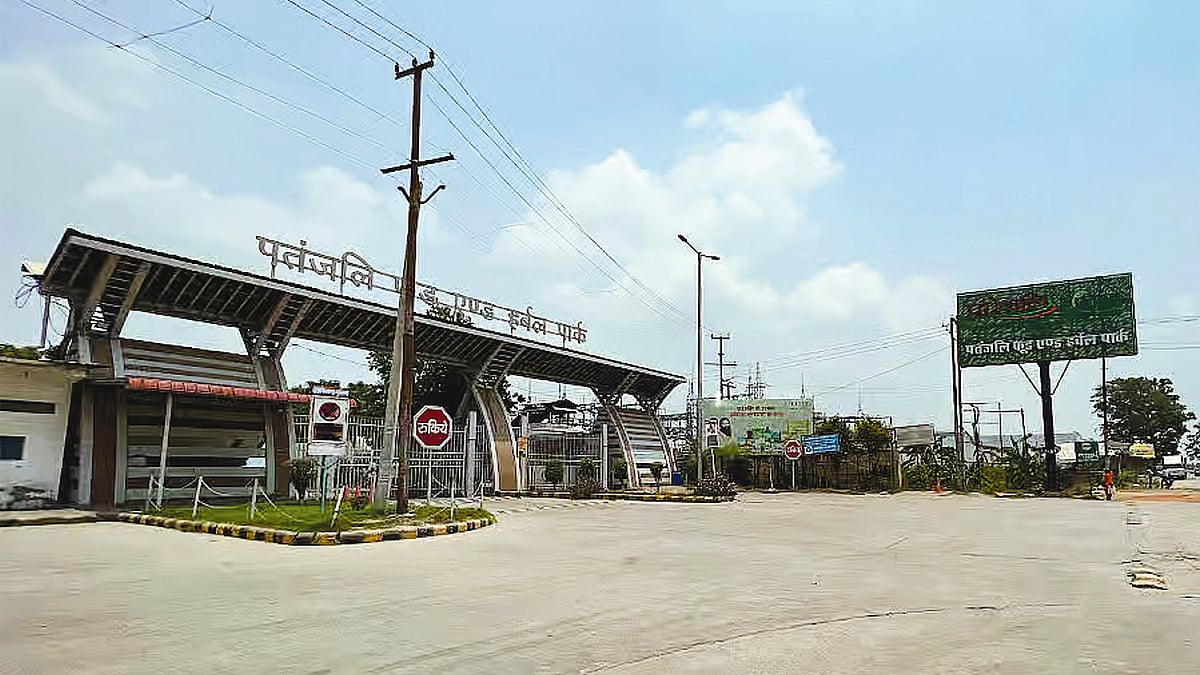
The small hill state of Uttarakhand has all sorts of land-grab scandals, but leading the pack is Baba Ramdev’s Patanjali group, which has not only been given land at throwaway rates in Uttarakhand but also 1,200 acres in Assam — free of cost.
In Himachal Pradesh, the earlier BJP state government granted Patanjali a 30-acre plot in Solan district for a token payment of one rupee; the Madhya Pradesh government gifted the group a 40-acre plot at an 88 per cent discount and Maharashtra gave away 600 acres in Nagpur at a discount of 75 per cent.
Join our official telegram channel (@nationalherald) and stay updated with the latest headlines