Environment
An idea delinked from commonsense
Excerpts from a conversation with Himanshu Thakkar on India’s ill-conceived river-linking projects
An engineer from IIT-Bombay, Himanshu Thakkar is currently the coordinator of South Asia Network on Dams, Rivers & People (SANDRP) and the editor of Dams, Rivers & People. He has been associated with the water and environment sector for more than 25 years and has worked closely with the World Commission on Dams, the Narmada Bachao Andolan and the Centre for Science and Environment. Rashme Sehgal draws him out on India’s ill-conceived river-linking projects:
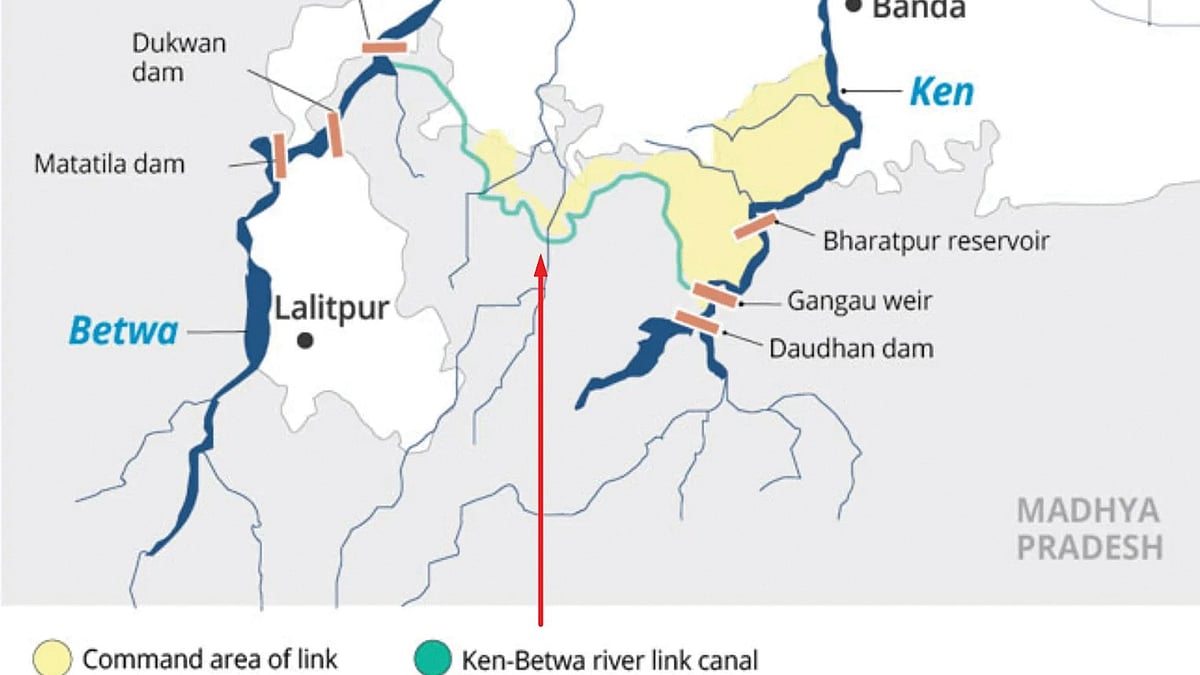
Prime Minister Modi says interlinking the Ken river (in Madhya Pradesh) to the Betwa (in neighbouring Uttar Pradesh) will help irrigate 1.06 million hectares, provide drinking water to 6.2 million people and generate 130 MW of hydropower and solar energy. Are these valid claims?
The Ken-Betwa Link Project (KBLP) that PM Modi laid the foundation for in December 2024 does not have (valid) forest or wildlife clearances. Let me clarify. Both clearances were on the condition that the hydropower component would be taken out of the protected area. But it hasn’t been done.
The hydrological figures remain a state secret and have not been peer reviewed or put out in the public domain. There is absolutely no basis to conclude that Ken has surplus water and Betwa is water-deficient. Worse, the project documents do not even look at far cheaper, quicker, less destructive alternatives. To paraphrase what PM Modi said in the context of the Polavaram dam, politicians think of dams as ATMs.
The environmental impact assessment of the project is so shoddy it hasn’t even properly studied the impact on the Panna Tiger Reserve (PTR). When the MoEF (ministry of environment and forests) expert appraisal committee (EAC) on river valley projects refused to clear the project after four meetings, Uma Bharati (then Union water resources minister) threatened a dharna.
The ministry then reconstituted the EAC, with S.K. Jain as chairman, and cleared the Ken-Betwa project in its very first meeting in December 2016, overruling the reasons for refusal. The same S.K. Jain went on to become director-general of the project.
The forest advisory committee (FAC) and the Supreme Court-appointed central empowered committee (CEC) argued forcefully against the project, but the CEC report was not even considered by the apex court!
Senior foresters had warned against building a dam on the Ken and a connecting canal between the two rivers. The Betwa already has seven dams on it and none provide the amount of irrigation water being claimed by the irrigation department.
The official minutes of the FAC meeting note that the project will involve felling 46 lakh trees (each of a girth greater than 20 cm) from the forest area alone. This will have a huge hydrological impact, besides adversely impacting the environment, biodiversity and climate of this entire region. But none of these impacts have been properly assessed.
The FAC and the National Board for Wildlife (NBWL) had recommended the height of the dam be reduced, and all inflows into the dam be released as environment flows in non-monsoon months. It wanted an independent assessment of the claim that there is no alternative for Bundelkhand. The CEC report had conclusively proved that this claim was false.
The project was sold with one USP: that it would solve Bundelkhand’s water problem. But from the very beginning, the detailed project report (DPR) showed that the key objective of the project was to facilitate water transport to the upper Betwa basin areas like Raisen and Vidisha. So, the Ken-Betwa project will in fact facilitate export of water out of drought-prone Bundelkhand!
The project lays down a plan to irrigate 6.35 lakh hectares of farmland in six districts (three each in MP and UP) at a cost of Rs 45,000 crore, besides providing jobs in construction and tourism.
There is no hydrological justification for spending Rs 45,000 crore. The ground reality is that this interlinking is not about helping the tribal people of this region or even those living in the downstream areas of UP’s Banda district. Most of Bundelkhand has an average annual rainfall of over 900 mm, which if harvested can solve Bundelkhand’s water problems.
Far better alternatives exist. Four decades ago, Bundelkhand was not known for water stress. It was a region of dense forests and good local water systems. Continuous neglect has led to the present situation and the project will end up destroying the hydrological backbone of the Ken.
Recent studies show that the gap between the so-called surplus and deficit basins has narrowed, which further negates the justification for ILR (inter-linking of rivers).
Studies have also shown that ILR projects can adversely impact the thermal and temperature gradient in the Bay of Bengal and Indian Ocean, thereby impacting our monsoons, but the government has chosen to ignore all this data.
But the government is planning river-linking at scale — in Punjab, Kerala, Telangana... Is it even feasible?
The ILR concept is flawed. The suggestion that floods indicate water surplus and drought means water deficit is flawed. By that logic, parts of Rajasthan are water surplus these days, as they have excess rainfall, and parts of Meghalaya, the home of rain-clouds, are water-deficit.
Water-intensive crops like sugarcane and paddy can turn any area drought-prone. So, the [ILR] concept itself is flawed. As [flawed as] the notion that water flowing into the sea is a waste. Rivers are supposed to flow to the sea, and estuaries, where the river meets the sea, are the most fertile and biodiverse areas.
All states are ready to accept water from another state, but no state wants to give water to another state — the party in power would consider it suicidal.
The Ken-Betwa project will submerge 6,017 ha. of forest land in the heart of the Panna Tiger Reserve (PTR). The Ken Gharial Sanctuary is also endangered.
The adverse impact of the project on the PTR is well documented even in the official CEC report. PTR is home to tigers, leopards, sloth bears, chinkara, chausinga, wolves, the mugger crocodile, the long-snouted gharial, mahseer fish and several species of raptors. Striped hyenas, civet cats, jackals, foxes, nilgai, chital, sambar, wild pigs, langurs and rhesus monkeys are also found in the area.
The massive dam is bound to isolate the upstream aquatic fauna, directly impacting the breeding habits of the aquatic life forms both upstream and downstream of the dam.
What is not so well known is that the project will also destroy some of the geological wonders of India. Raneh Falls, just downstream from the proposed dam site is described as India’s mini Grand Canyon and mini-Niagara. This wonderful geological site is likely to be permanently destroyed.
You’ve been vocal on the urgent need for an overhaul of the institu-tional architecture of our water sector, on disbanding the Central Water Commission.
The CWC has a large number of conflicting functions and responsibilities and its record is very poor — in areas like hydrology, geomorphology, rivers, dam safety and design, flood forecasting, flood management and early warning systems, which are supposed to be its core competency areas. The CWC functions more like a lobby for large dams with practically no accountability.
The state of our water resources is worrisome. We have meandered along using groundwater as our back-up. Groundwater is our water lifeline.
Ninety per cent of the additional water India has used in the past 50 years was groundwater — where the CWC has no role. In the shadow of the CWC’s dam advocacy, our local water systems, rivers, wetlands have been completely neglected and destroyed. This has had a hugely adverse impact on groundwater recharge, which is fast approaching an ICU-like situation.
What kind of local water management solutions should we go for?
Local, participatory management has to be the backbone of water governance. It must extend to all aspects of monitoring, managing, developing water resources, including groundwater, rivers, local water systems as also rainfall monitoring and sand mining. Rainwater harvesting, groundwater recharge, water budgeting and selection of appropriate crops are all best left to local communities.
Join our official telegram channel (@nationalherald) and stay updated with the latest headlines